
“Biosafety Levels 1-4: Complete Guide for Students & Lab Professionals”
Introduction:
Biosafety is one of the most important pillars of modern laboratory practice. Every laboratory, whether it performs basic teaching experiments or advanced research on highly infectious pathogens, carries a responsibility to protect laboratory personnel, patients, the environment, and the surrounding community. Accidental exposure, laboratory-acquired infections, or unintended release of biological agents can have serious public health consequences.
To reduce these risks, internationally recognized organizations such as the Centers for Disease Control and Prevention (CDC), the World Health Organization (WHO), and professional bodies like the American Society for Microbiology (ASM) have established clear biosafety principles. One of the most widely used systems is the classification of laboratories into Biosafety Levels (BSL-1 to BSL-4).
Understanding Biosafety Levels
Biosafety Levels (BSLs) are standardized containment categories used to define the safety requirements for laboratories handling biological agents. Each level is based on a combination of:
1. The risk posed by the microorganism.
2. The type of laboratory work performed.
3. The routes of possible exposure.
4. The availability of treatment or preventive measures.
Biosafety levels do not describe how dangerous an organism is by itself. Instead, they describe how laboratories must control the risk associated with working with that organism. As the biosafety level increases, the containment measures, facility design, and operational controls become more stringent.
Biosafety levels range from BSL-1 (lowest risk) to BSL-4 (highest risk). Most clinical diagnostic laboratories operate at BSL-2, while specialized research facilities may operate at BSL-3 or BSL-4.
How Biosafety Levels Are Assigned ?
The assignment of a biosafety level is based on a biological risk assessment, as recommended by CDC and WHO guidelines. This assessment evaluates both the biological agent and the laboratory procedures.
Key factors considered include:
The severity of disease caused by the organism
How the organism is transmitted (inhalation, ingestion, skin contact, needle-stick injury)
The infectious dose required to cause illness
The stability of the organism in the environment
The availability of effective treatment, vaccines, or post-exposure prophylaxis
The type of laboratory procedures performed, especially those that generate aerosols
This risk-based approach ensures that laboratories apply appropriate and proportional safety controls, rather than unnecessary or inadequate measures.

Biosafety Level 1 (BSL-1)
Biosafety Level 1 (BSL-1) is the lowest level of biological containment. It applies to laboratories that work with well-characterized microorganisms that are not known to cause disease in healthy adults. These organisms pose minimal potential hazard to laboratory workers and the environment.
BSL-1 laboratories are commonly found in educational institutions, basic research laboratories, and training facilities. They do not require special containment equipment or isolation from other areas of the building.
Examples of Agents
Typical BSL-1 organisms include:
Non-pathogenic strains of Escherichia coli
Bacillus subtilis
Lactobacillus species
Yeasts used in teaching laboratories
These organisms are widely used for instructional purposes because they are considered safe when handled properly.
Laboratory Practices and Safety Measures
BSL-1 laboratories follow standard microbiological practices, including:
Conducting work on open laboratory benches
Prohibiting mouth pipetting
Washing hands after handling biological materials and before leaving the lab
Proper handling and disposal of sharps
Routine cleaning and disinfection of work surfaces
Basic personal protective equipment (PPE) such as laboratory coats, gloves, and eye protection is used based on risk assessment
Biosafety Level 2 (BSL-2)
Biosafety Level 2 (BSL-2) applies to laboratories that handle moderate-risk biological agents associated with human disease. These agents can cause infection, but the diseases are usually treatable or preventable.
BSL-2 is the most common biosafety level in clinical diagnostic laboratories, including microbiology, serology, hematology, and molecular diagnostic laboratories.
Examples of Agents
Common BSL-2 organisms include:
Salmonella species
Shigella species
Staphylococcus aureus
Hepatitis B and C viruses
Human immunodeficiency virus (HIV)
Dengue virus
These agents require additional safety precautions due to their ability to cause disease through accidental exposure.
Laboratory Practices and Safety Measures
In addition to BSL-1 practices, BSL-2 laboratories require:
Restricted access during laboratory work
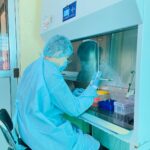
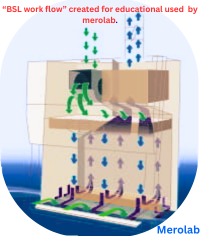
Use of Class II Biological Safety Cabinets (BSCs) for aerosol-generating procedures
Availability of autoclaves or approved decontamination methods
Clearly visible biohazard signage
Immediate decontamination of spills and contaminated waste
Personnel must receive formal biosafety training and demonstrate competency before working independently.
Biosafety Level 3 (BSL-3)
Bio–safety Level 3 (BSL-3) laboratories handle serious or potentially lethal biological agents, especially those transmitted through aerosols. Infections caused by these organisms may be severe and can spread through inhalation.
BSL-3 laboratories are commonly used for tuberculosis diagnostics and research on emerging or re-emerging infectious diseases.
Examples of Agents
Examples of BSL-3 pathogens include:
Mycobacterium tuberculosis
SARS-CoV-2 (COVID-19 virus)
Bacillus anthracis (Anthrax)
West Nile virus
Yellow fever virus
Laboratory Design and Safety Measures
BSL-3 laboratories require specialized engineering controls, including:
Controlled access and secure entry systems
Directional airflow that moves air from clean areas to contaminated areas
HEPA-filtered exhaust air
All work performed within certified biological safety cabinets
Sealed floors, walls, and ceilings for easy decontamination
Laboratory staff may be required to use respiratory protection, and medical surveillance programs are strongly recommended.
Biosafety Level 4 (BSL-4)
A Biosafety Level 4 (BSL-4) laboratory is designed with the highest containment standards to safely manage the world’s most dangerous infectious agents.t. These laboratories work with highly dangerous and exotic pathogens that cause severe or fatal disease and for which no effective treatment or vaccine is available.
BSL-4 laboratories are extremely rare and operate under the most stringent safety and security conditions.
Examples of Agents
BSL-4 agents include:
Ebola virus
Marburg virus
Lassa fever virus
Other viral hemorrhagic fever viruses
Laboratory Design and Safety Measures
BSL-4 laboratories require:
Complete physical separation from other laboratory areas
Class III biosafety cabinets or full-body, positive-pressure suits
For maximum biosafety, BSL-4 laboratories operate dedicated ventilation systems that use HEPA filtration to safely remove airborne pathogens.
Mandatory shower-out procedures and clothing changes
Total decontamination of all waste and materials before exit
Only highly trained and authorized personnel are allowed to work in BSL-4 facilities.
Specialized Biosafety Classifications
Animal Biosafety Levels (ABSL)
Animal Biosafety Levels (ABSL-1 to ABSL-4) apply to laboratories working with animals infected with biological agents. These facilities require additional controls related to animal housing, handling, and waste management.
Agricultural Biosafety Levels (BSL-Ag)
BSL-Ag laboratories are designed to protect agriculture and ecosystems from highly contagious animal or plant pathogens. The focus is on preventing environmental spread rather than human infection alone.
Importance of Biosafety in ISO-Certified Laboratories.
For laboratories seeking ISO 15189 or ISO 17025 accreditation, biosafety is a critical requirement. Auditors assess:
Risk assessments and biosafety policies.
Staff training and competency records.
Facility design and engineering controls.
Waste management and emergency preparedness.
Strong biosafety practices demonstrate professionalism, regulatory compliance, and commitment to public health.
Conclusion:
Biosafety levels provide a structured and practical framework for managing biological risks in laboratories. By following CDC, WHO, and ASM guidelines, laboratories can safely conduct their work while protecting staff, patients, and the community.
Understanding the differences between BSL-1, BSL-2, BSL-3, and BSL-4 allows laboratory professionals to design appropriate facilities, apply effective safety measures, and maintain high standards of biosafety and biosecurity.
A well-implemented biosafety program is not only a regulatory requirement, but also an ethical responsibility and a foundation of laboratory excellence.