Introduction
Blood clotting is a life-saving process that prevents excessive blood loss after injury. One of the most important initiators of this process is Tissue Factor 3, also known as Factor III or Thromboplastin. Unlike many other clotting factors that circulate in the blood, Tissue Factor is normally hidden within body tissues and becomes active only when blood vessels are damaged.
In hematology, Tissue Factor is recognized as the key trigger of the extrinsic coagulation pathway. It plays a central role not only in normal hemostasis but also in many clinical conditions such as thrombosis, sepsis, cancer, and disseminated intravascular coagulation (DIC).
What Is Tissue Factor 3 (Factor III)?
Tissue Factor is a membrane-bound glycoprotein composed of approximately 263 amino acids. It is encoded by the F3 gene and is primarily expressed on cells outside the bloodstream.
Location in the Body
Tissue Factor is found in:
- Subendothelial connective tissue
- Fibroblasts
- Smooth muscle cells
- Pericytes
- Activated monocytes and macrophages
- Placental tissue
Under normal conditions, Tissue Factor is not in contact with circulating blood, which helps prevent unnecessary clot formation.
Tissue Factor in Hematology
From a hematological perspective, Tissue Factor is unique because:
- It does not circulate freely in plasma
- It becomes active only after vascular injury
- It initiates the fastest clotting pathway
Because of these features, Tissue Factor 3 is often called the “physiological trigger of coagulation.”
Role of Tissue Factor in Blood Coagulation
Tissue Factor plays a central role in hemostasis, the process that stops bleeding. When a blood vessel is damaged:
- The endothelial barrier is disrupted
- Tissue Factor is exposed to blood
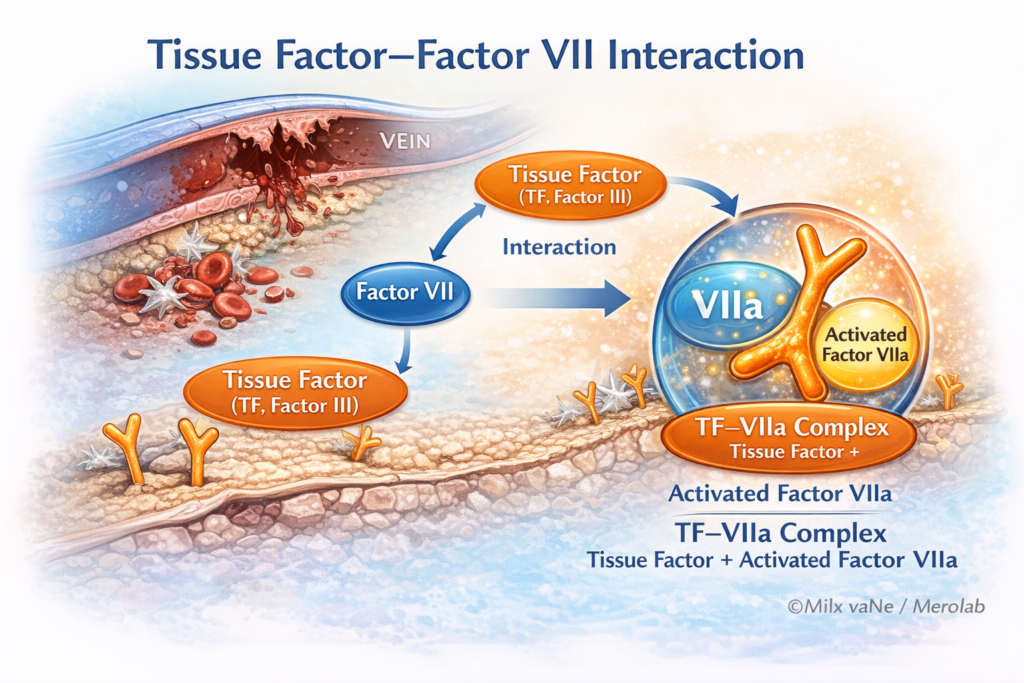
- It binds with Factor VII, a plasma clotting factor
This interaction rapidly activates the extrinsic pathway, leading to clot formation within seconds.
Mechanism of Tissue Factor in the Coagulation Cascade
The coagulation mechanism involving Tissue Factor occurs in a structured and efficient manner.
Step-by-Step Mechanism
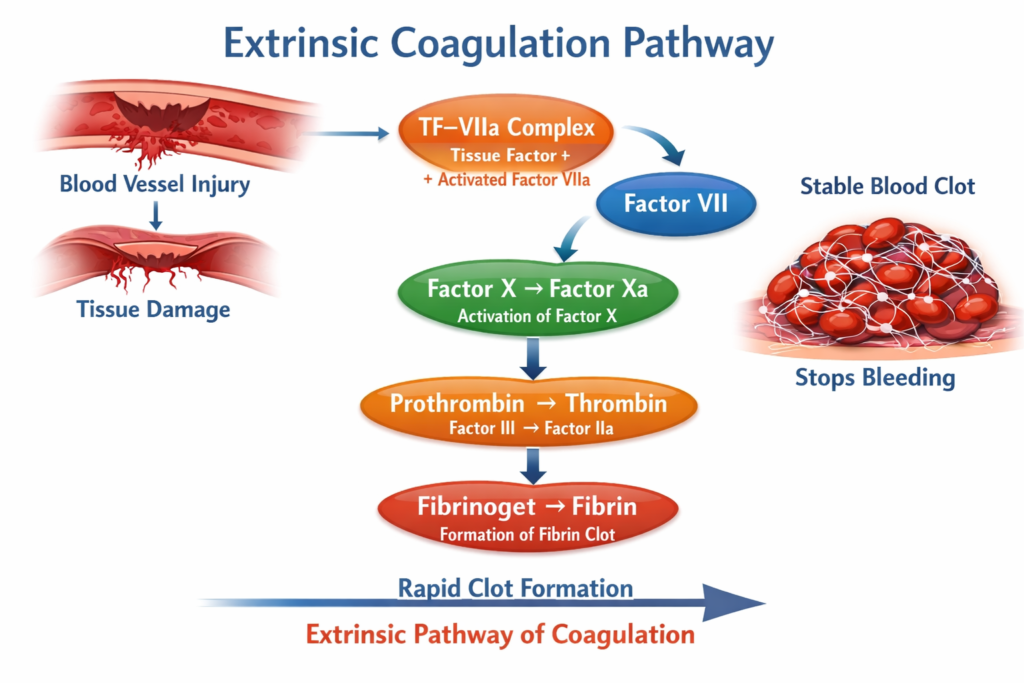
- Vascular Injury
Damage to the blood vessel exposes Tissue Factor to circulating blood. - Binding With Factor VII
Tissue Factor binds to Factor VII, forming the TF–VII complex. - Activation to TF–VIIa
Factor VII is converted into its active form, Factor VIIa. - Activation of Factor X and Factor IX
The TF–VIIa complex activates:- Factor X → Factor Xa
- Factor IX → Factor IXa
- Formation of Thrombin
Factor Xa converts Prothrombin (Factor II) into Thrombin (Factor IIa). - Fibrin Formation
Thrombin converts Fibrinogen (Factor I) into Fibrin, forming a clot mesh. - Stable Clot Formation
Fibrin strands stabilize the platelet plug, stopping bleeding.
This mechanism explains why the extrinsic pathway is fast and efficient, especially in acute injury.
Regulation of Tissue Factor Activity
The body carefully regulates Tissue Factor to prevent excessive clotting.
Tissue Factor Pathway Inhibitor (TFPI)
- TFPI is a natural anticoagulant
- It inhibits the TF–VIIa complex
- It prevents uncontrolled clot formation
A balance between Tissue Factor and TFPI is essential for normal hemostasis.
Physiological Functions of Tissue Factor
Beyond coagulation, Tissue Factor has several important physiological roles:
- Initiation of blood clotting after injury
- Maintenance of vascular integrity
- Participation in inflammatory responses
- Contribution to immune defense
- Support of wound healing and tissue repair
- Role in embryonic development and placental function
Tissue Factor and Inflammation
Tissue Factor acts as a link between coagulation and inflammation. During infection or tissue injury:
- Inflammatory cytokines increase Tissue Factor expression
- Monocytes express more Tissue Factor
- This may protect against bleeding but also increases clot risk
This interaction explains why clotting disorders are common in severe infections.
Clinical Significance of Tissue Factor
Tissue Factor is clinically important because abnormal expression can lead to serious bleeding or thrombotic disorders.
Conditions Associated With Increased Tissue Factor
- Sepsis
- Cancer-associated thrombosis
- Atherosclerosis
- Acute coronary syndrome
- Stroke
- Disseminated intravascular coagulation (DIC)
- Pregnancy-related complications
In these conditions, excessive Tissue Factor can cause pathological clot formation.
Tissue Factor in Cancer
Cancer cells often express high levels of Tissue Factor 3, which:
- Promotes tumor growth
- Enhances angiogenesis
- Increases risk of venous thromboembolism
This explains why cancer patients have a higher risk of blood clots.
Tissue Factor in Sepsis and DIC
In sepsis:
- Inflammatory mediators increase Tissue Factor 3 expression
- Widespread clotting occurs in small vessels
- This may progress to DIC
DIC is a life-threatening condition characterized by:
- Microvascular thrombosis
- Consumption of clotting factors
- Severe bleeding
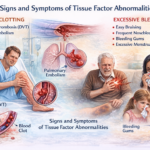
Signs and Symptoms of Tissue Factor-Related Disorders
Symptoms of Excessive Tissue Factor Activity
- Deep vein thrombosis (DVT)
- Pulmonary embolism
- Stroke-like symptoms
- Chest pain
- Shortness of breath
- Limb swelling and pain
Symptoms of Reduced Tissue Factor Activity
- Prolonged bleeding
- Easy bruising
- Frequent nosebleeds
- Heavy menstrual bleeding
- Excessive surgical bleeding
Laboratory Evaluation of Tissue Factor Function
There is no direct routine test to measure Tissue Factor 3 levels
Indirect Tests Include:
- Prothrombin Time (PT)
- International Normalized Ratio (INR)
These tests assess the extrinsic and common pathways of coagulation.
Normal Ranges (Indirect Assessment)
Test | Normal Range |
Prothrombin Time (PT) | 11–14 seconds |
INR | 0.8–1.2 |
These values may vary slightly by laboratory.
Critical Values and Clinical Alert Levels
- PT > 20 seconds → High bleeding risk
- INR > 4.0 → Risk of spontaneous bleeding
- Very short PT → Possible hypercoagulable state
Such values require immediate medical attention.
Tissue Factor in Anticoagulant Therapy Monitoring
Tissue Factor is essential in:
- PT/INR testing for warfarin therapy
- Evaluation of liver disease
- Assessment of vitamin K deficiency
Laboratory thromboplastin reagents contain Tissue Factor-like substances.
Disorders Related to Tissue Factor Pathway
- Congenital Factor VII deficiency
- Acquired coagulation disorders
- Liver disease
- Vitamin K deficiency
- Autoimmune clotting disorders
Importance in Research and Modern Medicine
Tissue Factor 3 is an active area of research due to its role in:
- Cancer biology
- Cardiovascular disease
- Sepsis management
- Development of targeted anticoagulants
Blocking Tissue Factor activity is being explored as a therapeutic strategy.
Summary
Tissue Factor 3 (Factor III) is the primary initiator of blood coagulation through the extrinsic pathway. It ensures rapid clot formation after vascular injury and plays additional roles in inflammation, immunity, and tissue repair. However, abnormal Tissue Factor activity can lead to severe bleeding or life-threatening thrombosis.
Understanding Tissue Factor is essential for students, laboratory professionals, clinicians, and researchers working in hematology and related fields.
FREQUENTLY ASKED QUESTIONS
What is Tissue Factor (Factor III)?
Tissue Factor, also called Factor III or thromboplastin, is a protein found in body tissues that starts the blood clotting process when a blood vessel is injured.
What role does Tissue Factor play in coagulation?
Tissue Factor activates the extrinsic pathway of coagulation by binding with Factor VII, leading to rapid clot formation to stop bleeding.
Where is Tissue Factor found in the body?
It is mainly found in subendothelial tissue, smooth muscle cells, fibroblasts, and activated immune cells, but not normally in circulating blood.
Why is Tissue Factor important in hematology?
Tissue Factor is important because it is the primary trigger of coagulation and is widely used in laboratory testing such as Prothrombin Time (PT).
What happens if Tissue Factor activity is increased?
Increased Tissue Factor activity may cause abnormal clot formation, leading to conditions like deep vein thrombosis, stroke, or disseminated intravascular coagulation (DIC).
What are the signs of low Tissue Factor activity?
Low activity may cause prolonged bleeding, easy bruising, frequent nosebleeds, and excessive bleeding after surgery.
How is Tissue Factor related to cancer?
Many cancer cells express high levels of Tissue Factor, which increases the risk of blood clots and tumor progression.
What is the role of Tissue Factor in sepsis?
In sepsis, Tissue Factor expression increases due to inflammation, which may lead to widespread clotting and DIC, a life-threatening condition.
Is Tissue Factor used in laboratory testing?
Yes. Tissue Factor is a key component of thromboplastin reagents used in Prothrombin Time testing.