
Introduction
Autoclave tape plays a small but essential role in every laboratory, hospital, and clinical setting where sterilization takes place. Despite its simple appearance, this thin strip of tape helps confirm that instruments and materials have been exposed to a sterilization process. For students, laboratory technicians, and healthcare workers, understanding how autoclave tape works — and just as importantly, what it cannot tell you — is a fundamental part of infection control and quality assurance.
What Is Autoclave Tape?
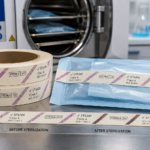
Autoclave tape is a type of adhesive tape coated with a heat-sensitive chemical indicator that changes color when exposed to the high temperatures reached during autoclaving, a process that uses pressurized steam to sterilize equipment and materials. The tape is typically applied to packages, pouches, or wrapped instruments before they are placed inside an autoclave (a sterilization device that uses steam under pressure to kill microorganisms).
Once the sterilization cycle finishes, the tape’s stripes usually change from a light color, such as white or cream, to a dark color, often black or brown. This visible change provides a quick, simple way to confirm that an item has been processed through an autoclave cycle.
It’s important to understand from the start that autoclave tape confirms exposure to heat, not necessarily complete sterilization. We will explain this key distinction in more detail later in this article.
Definition
Autoclave tape belongs to a category of sterilization monitoring tools known as chemical indicators. According to widely used sterilization classification systems, chemical indicators are grouped into different classes based on how many sterilization parameters they actually verify.
Autoclave tape is generally classified as a Class 1 chemical indicator, also called a “process indicator.” This means it only confirms that an item has been exposed to the sterilization process — it does not confirm that the necessary time, temperature, and steam saturation needed for actual microbial destruction were fully achieved.
History of Autoclave Tape and Sterilization Indicators
Sterilization science has evolved significantly since steam sterilization was first introduced, and indicator technology has advanced alongside it.
- Late 1800s: Charles Chamberland developed the first practical steam sterilizer (autoclave), building on earlier work related to Louis Pasteur’s research on microorganisms.
- Early-to-mid 1900s: As autoclaves became standard equipment in hospitals and laboratories, the need arose for simple visual confirmation that items had actually been placed inside a functioning sterilizer.
- Mid-1900s: Early heat-sensitive indicator tapes and inks were developed, offering a basic, low-cost way to distinguish processed from unprocessed items.
- Later 1900s–present: More advanced chemical indicators (Class 2 through Class 6) were developed, offering increasingly specific confirmation of sterilization parameters, while basic autoclave tape remained useful as a first-line, low-cost process indicator.
Today, autoclave tape continues to serve as a widely used, simple tool, typically used alongside more advanced indicators rather than as a sole method of confirming sterility.
Classification of Sterilization Indicators
To understand where autoclave tape fits, it helps to see the broader classification of chemical indicators, often based on guidelines from international standards organizations:
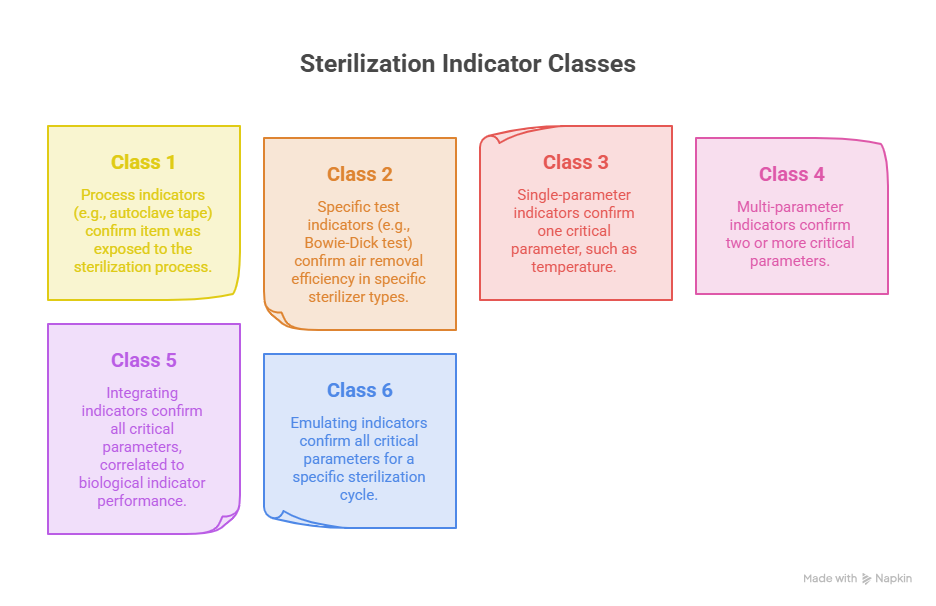
Autoclave tape sits at the most basic level (Class 1), which explains why it should never be used as the only method of confirming sterility for critical medical instruments.
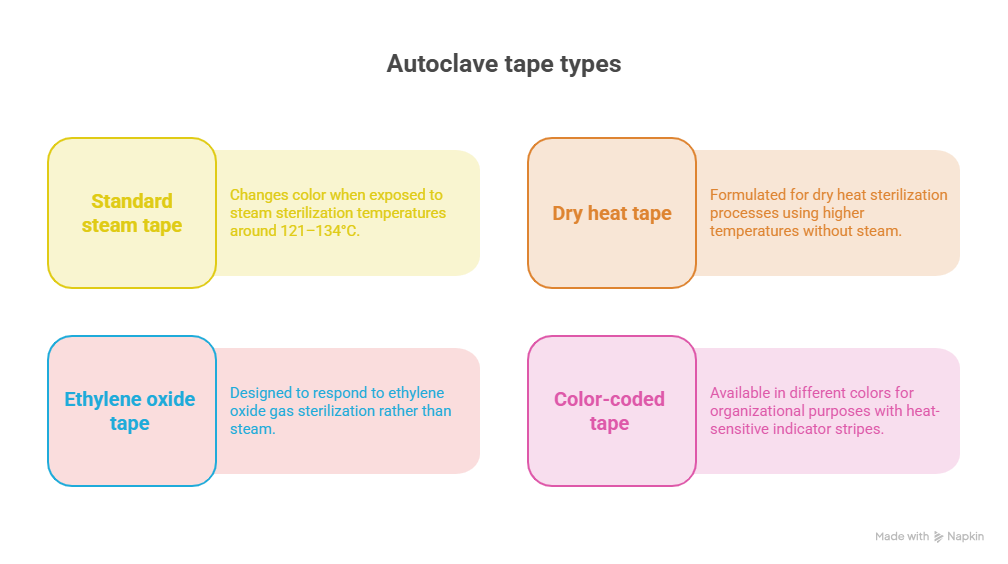
Types of Autoclave Tape
Components and Materials
A typical roll of autoclave tape includes:
- Adhesive backing – allows the tape to stick securely to paper, fabric, or plastic sterilization pouches.
- Base tape material – often made of paper or a paper-plastic blend that can withstand sterilization conditions.
- Heat-sensitive chemical indicator ink – printed in diagonal stripes, which changes color upon exposure to the required temperature.
- Printed markings (optional) – some tapes include space for writing the sterilization date, batch number, or operator initials.
Principle Behind Autoclave Tape
The working principle behind autoclave tape is based on a simple chemical reaction. The indicator ink contains heat-sensitive compounds that undergo a visible color change once they reach a specific temperature threshold, generally aligned with typical steam sterilization temperatures.
This principle allows for quick visual confirmation, but it’s important to remember that the color change principle is based on temperature exposure alone — it does not measure exposure time or steam penetration, both of which are equally critical for achieving true sterilization.
Working Principle and Mechanism
Here’s how the mechanism works, step by step:
- Autoclave tape is applied to the outside of a wrapped instrument pack, pouch, or sterilization container before processing.
- The package is placed inside the autoclave chamber along with other items to be sterilized.
- During the sterilization process, pressurized steam increases the chamber temperature to the required level, typically between 121°C and 134°C, depending on the selected sterilization protocol.
- Once the tape’s indicator ink reaches its designated temperature threshold, a chemical reaction occurs, causing the stripes to change color, typically from white to black or dark brown.
- After the cycle ends and the load cools, staff visually inspect the tape. A clear color change suggests the item was exposed to adequate heat during the cycle.
Procedure: How to Use Autoclave Tape Correctly
- Select the appropriate tape based on the sterilization method being used (steam, dry heat, or ethylene oxide).
- Apply the tape securely across the seam or opening of the wrapped item or pouch before placing it in the autoclave.
- If sufficient space is available, label the sterilization tape with essential details, such as the sterilization date or the corresponding batch number.
- Load the autoclave following standard loading guidelines to allow proper steam circulation around all items.
- Run the sterilization cycle according to the validated time, temperature, and pressure settings for the specific load type.
- Inspect the tape after the cycle completes and the load has cooled, confirming that the color change has occurred as expected.
- Document the result, especially in regulated laboratory or healthcare settings, alongside other quality control checks.
Applications of Autoclave Tape
- Sealing sterilization pouches and wraps to keep them closed during processing.
- Providing a quick visual indicator that a package has passed through a sterilization cycle.
- Supporting basic quality assurance documentation, especially when combined with written logs and higher-level indicators.
Advantages
- Simple, inexpensive, and easy to use.
- Provides a fast visual cue distinguishing processed from unprocessed items.
- Useful for organizing workflow in busy laboratory or clinical settings.
- Widely available and compatible with most standard autoclave and sterilization equipment.
Disadvantages and Limitations
This is one of the most important sections to understand clearly, since misunderstanding these limitations can affect patient and laboratory safety.
- Does not confirm true sterility. A color change only shows that a certain temperature was reached — it does not confirm that the correct exposure time or steam penetration occurred.
- Cannot detect steam quality issues, such as trapped air pockets, which can prevent proper sterilization even if temperature appears adequate.
- Should never be used alone to verify that critical or semi-critical medical instruments are truly sterile.
- Color changes can sometimes be misleading if the tape is old, improperly stored, or exposed to heat outside the sterilization cycle.
Does not verify microbial kill, unlike biological indicators, which use actual bacterial spores to confirm sterilization effectiveness.
Clinical Significance
Autoclave tape plays an important supporting role in infection control, but its clinical significance must be understood in context.
- It provides an initial, quick check that an item was placed inside a functioning sterilization cycle.
- It helps prevent the accidental use of unprocessed instruments by clearly marking treated versus untreated items.
- However, for critical instruments used in surgery or invasive procedures, healthcare facilities rely on more advanced indicators — such as Class 5 or Class 6 chemical indicators, and biological indicators using bacterial spores — to confirm true sterilization efficacy.
Relying solely on autoclave tape for critical sterilization decisions could create a false sense of security, which is why proper sterilization monitoring programs combine multiple indicator types.
Interpretation of Results
Observation | Interpretation | Recommended Action |
Tape stripes fully changed to dark color | Item was exposed to expected sterilization temperature | Proceed according to standard protocol, alongside other QC checks |
Partial or uneven color change | Possible incomplete heat exposure or poor steam penetration | Investigate load packing, steam supply, and cycle parameters |
No color change at all | Item likely did not reach sterilization temperature | Do not use item; reprocess and investigate the sterilizer |
Color already changed before cycle begins | Possible improper storage or tape exposed to heat prematurely | Discard and replace with new tape; review storage conditions |
Frequently Observed Errors
- Assuming a color change alone confirms complete sterility.
- Using expired or improperly stored autoclave tape.
- Overloading the autoclave chamber, preventing proper steam circulation and even heat exposure.
- Failing to combine autoclave tape with biological indicators for critical instrument sterilization.
- Not documenting sterilization results consistently for quality assurance purposes.
Troubleshooting Common Issues
Problem | Possible Cause | Solution |
No color change after a cycle | Sterilizer malfunction, incorrect cycle settings, tape placed outside effective area | Check sterilizer function and cycle parameters; reposition tape correctly next time |
Inconsistent color change across a load | Overloading, poor steam circulation | Reduce load size; follow manufacturer loading guidelines |
Tape falls off during cycle | Poor adhesive quality, incorrect application, excessive moisture | Use compatible tape correctly; ensure surfaces are dry before applying tape |
Color change occurs but items later shown to be non-sterile | Autoclave tape limitation (Class 1 indicator only) | Introduce biological indicators and higher-class chemical indicators for critical items |
Care and Maintenance
- Store autoclave tape rolls in a cool, dry location away from direct heat or sunlight.
- Check expiration dates, since indicator chemicals can degrade over time.
- Avoid storing tape near heat sources, ovens, or other equipment that could cause premature color change.
- Replace tape rolls that show signs of damage, discoloration, or reduced adhesive quality.
Quality Assurance: IQC and EQA in Sterilization Monitoring
Since autoclave tape is only a basic process indicator, proper quality assurance requires additional layers of verification.
Internal Quality Control (IQC) in sterilization monitoring typically includes:
- Using autoclave tape as a first-level visual check for every load.
- Running higher-class chemical indicators within each load to verify specific sterilization parameters.
- Performing regular biological indicator testing, using bacterial spore samples that confirm actual microbial destruction, following facility protocols (often weekly or per load, depending on regulations).
- Maintaining sterilization cycle logs, including time, temperature, and pressure readings for every run.
External Quality Assessment (EQA) may involve:
- Participating in external proficiency testing programs related to sterilization monitoring.
- Periodic equipment validation and calibration checks performed by qualified technicians.
- Facility audits, often guided by standards from organizations such as CLSI or relevant national regulatory bodies, to confirm that sterilization monitoring practices remain consistent and effective.
Combining autoclave tape with these additional quality assurance layers ensures a much more reliable overall sterilization monitoring system.
Safety Precautions
- Always allow sterilized items and packaging to cool before handling, since autoclaved materials can retain significant heat.
- Wear appropriate personal protective equipment when loading or unloading autoclaves.
- Avoid direct skin contact with freshly processed tape or packaging immediately after a cycle.
- Follow facility protocols for handling any items that fail sterilization indicator checks, ensuring they are not mistakenly used.
Key Takeaways
- Autoclave tape is a Class 1 chemical indicator that confirms exposure to a sterilization process, not complete sterility.
- The tape changes color when exposed to specific sterilization temperatures, typically shifting from white to black or dark brown.
- It should always be used alongside higher-class chemical indicators and biological indicators for critical or semi-critical medical instruments.
- Proper storage, correct application, and regular monitoring are essential for reliable results.
- A full quality assurance program, including IQC and EQA practices, ensures sterilization monitoring remains accurate and trustworthy over time.
Conclusion
Autoclave tape remains a simple, inexpensive, and widely used tool for basic sterilization monitoring in laboratories, hospitals, and clinics. While it offers a fast and convenient way to visually confirm that an item passed through a sterilization cycle, it’s essential to understand its limitations. Autoclave tape confirms exposure to heat — not complete sterility.
For truly reliable infection control, autoclave tape should always be used as part of a broader quality assurance system, combined with higher-class chemical indicators and regular biological indicator testing. By understanding both the strengths and limitations of autoclave tape, laboratory professionals and healthcare workers can help ensure that sterilization practices remain safe, effective, and trustworthy for patients and staff alike.
Add Your Heading Text Here
Does autoclave tape confirm that items are completely sterile?
No. Autoclave tape only confirms that an item was exposed to a certain sterilization temperature. It does not confirm exposure time, steam penetration, or actual microbial destruction, so it should not be used as the sole method of verifying sterility.
What color change should I expect from autoclave tape?
Most standard steam autoclave tapes change from white or cream-colored diagonal stripes to black or dark brown once exposed to the required sterilization temperature.
Can autoclave tape be used for dry heat or gas sterilization?
Standard steam autoclave tape is designed for steam sterilization. Different indicator tapes are formulated specifically for dry heat or ethylene oxide gas sterilization processes.
Why shouldn't autoclave tape be the only sterility indicator used?
Because it is a Class 1 process indicator, it cannot confirm all the critical parameters needed for true sterilization. Higher-class chemical indicators and biological indicators provide more reliable confirmation, especially for critical medical instruments.
What does it mean if the autoclave tape shows no color change?
This suggests the item likely did not reach the expected sterilization temperature. The item should not be used, and the sterilizer or cycle parameters should be investigated.
How should autoclave tape be stored?
It should be stored in a cool, dry area away from direct heat or sunlight, and expiration dates should be checked regularly to ensure the indicator chemicals remain effective.
What is the difference between autoclave tape and a biological indicator?
Autoclave tape only shows temperature exposure through a color change, while a biological indicator contains actual bacterial spores that confirm whether the sterilization process was strong enough to kill highly resistant microorganisms.
Disclaimer
The information and materials provided on MeroLab are intended solely for educational, informational, professional learning, and public health awareness purposes. The website may contain content related to medical laboratory science, laboratory techniques, diagnostic tests, medical devices and instruments, reagents, diseases and health conditions, laboratory procedures, quality management, research, exam preparation, MCQs, and other healthcare-related topics.