

A multichannel pipette is a laboratory tool that lets scientists measure and transfer liquid into several wells or tubes at the same time instead of doing it one by one. If you have ever seen a technician quickly filling all the rows of a microplate with reagent, they were most likely using a multichannel pipette. This device has become essential in modern laboratories because it saves time, reduces hand fatigue, and improves consistency when many samples need the same volume of liquid.
What Is a Multichannel Pipette? (Definition)
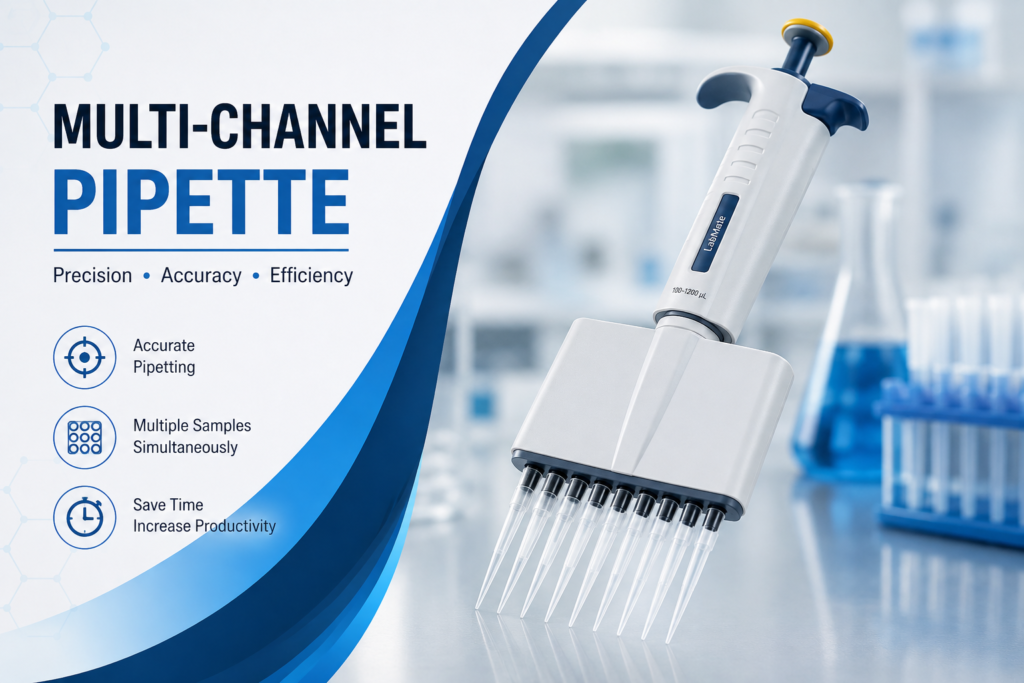
A multichannel pipette is a liquid-handling instrument with several pipetting channels (usually 8 or 12) built into a single device, allowing the user to aspirate (draw up) and dispense the same volume of liquid into multiple wells or tubes simultaneously. Each channel works independently for aspiration and dispensing but is controlled by one shared plunger mechanism, so all channels move together in a single motion.
The word “multichannel” simply means “having many channels,” referring to the multiple pipetting tips that operate together. This is different from a single-channel pipette, which has only one tip and is used to transfer liquid to one location at a time. Multichannel pipettes are most commonly designed to match the spacing of a 96-well microplate, a flat plastic plate with 96 small wells arranged in 8 rows and 12 columns, widely used in laboratory testing.
A Brief History of the Multichannel Pipette
The single-channel micropipette was invented in the 1950s and 1960s, transforming laboratory liquid handling by replacing glass pipettes with adjustable, precise instruments. As laboratory testing expanded in the 1970s and 1980s, particularly with the rise of techniques like the enzyme-linked immunosorbent assay (ELISA), which uses 96-well microplates to test many samples at once, the need for faster, multi-sample pipetting became clear.
Manufacturers responded by designing pipettes with multiple tips spaced to match microplate wells, allowing technicians to fill an entire row or column in one motion instead of eight or twelve separate actions. This innovation was a major step forward for laboratories handling large sample volumes, such as diagnostic testing centers, vaccine research facilities, and pharmaceutical companies.
In more recent years, electronic multichannel pipettes have become widely available. These battery-powered devices use a motor to aspirate and dispense liquid, offering programmable volumes, repeat dispensing modes, and reduced hand strain compared to traditional manual pipettes.
Classification and Types of Multichannel Pipettes
Multichannel pipettes can be grouped in several ways, including by the number of channels, by operating mechanism, and by volume range.
- Classification by Number of Channels
Type | Number of Channels | Common Use |
8-channel pipette | 8 | Filling one column of a 96-well plate |
12-channel pipette | 12 | Filling one row of a 96-well plate |
16-channel pipette | 16 | Working with 384-well plates (two rows at a time) |
24-channel pipette | 24 | High-throughput 384-well plate work |
- Classification by Operating Mechanism
- Manual (mechanical) multichannel pipettes: Operated by hand using a spring-loaded plunger; volume is set manually using a dial or digital display.
- Electronic multichannel pipettes: Battery-operated devices with a motorized piston; volume and speed are set digitally, and many models offer programmable repeat dispensing.
- Classification by Volume Range
- Low-volume multichannel pipettes: Typically 0.5–10 microliters (a microliter, written as µL, is one-millionth of a liter), used for very small sample volumes.
- Medium-volume multichannel pipettes: Typically 5–50 µL or 20–200 µL, the most common range used in routine assays.
- High-volume multichannel pipettes: Typically 30–300 µL or higher, used when larger volumes of reagent or media are needed per well.
Multichannel Pipette vs Single-Channel Pipette
Feature | Multichannel Pipette | Single-Channel Pipette |
Number of tips | 8, 12, 16, or 24 | 1 |
Speed for plate work | Very fast | Slower, one well at a time |
Best use case | Microplate-based assays (ELISA, PCR setup) | General single-sample transfers |
Cost | Generally higher | Generally lower |
Learning curve | Slightly steeper | Easier for beginners |
Components and Parts of a Multichannel Pipette
Understanding the parts of a multichannel pipette helps users operate and maintain it correctly:
- Plunger button: The top button pressed to aspirate and dispense liquid; in electronic models, this may be replaced by control buttons.
- Volume adjustment dial or digital display: Used to set the desired volume for each channel.
- Tip ejector button: Releases used tips without the need to touch them, reducing contamination risk.
- Shaft and tip cones: The row of narrow cones at the bottom, spaced evenly to match a 96-well or 384-well plate, onto which disposable tips are attached.
- Body (handle): The main housing that the user grips; designed to be ergonomic to reduce hand strain during repeated use.
- Battery and digital control panel (electronic pipettes only): Powers the motor and allows programming of volume, aspiration speed, and dispensing mode.
Tip spacing adjuster (in some advanced models): Allows the distance between tips to be changed to match different plate formats, such as switching between 96-well and 384-well spacing.
Principle and Working Principle of the Multichannel Pipette
The working principle of a multichannel pipette is based on air displacement, the same basic concept used in single-channel micropipettes, but applied across several channels simultaneously.
Here is how it works step by step:
- The user sets the desired volume using the dial or digital display.
- Disposable tips are attached to each of the tip cones.
- Pressing the plunger button (or activating the motor in electronic models) moves a piston upward in each channel, creating a small vacuum.
- This vacuum draws liquid up into all tips at the same time when they are dipped into the source liquid.
- When the plunger is pressed again (or the dispense function is activated), the piston pushes air back down, forcing the liquid out of all tips simultaneously into the target wells.
Because all channels share one mechanical or motorized system, this design ensures that each channel draws and releases nearly the same volume, improving consistency across multiple samples.
Step-by-Step Procedure for Using a Multichannel Pipette
Follow these steps to use a multichannel pipette correctly and accurately:
- Select the correct pipette based on the volume range and number of channels needed for your plate format.
- Set the desired volume using the adjustment dial or digital control panel.
- Attach fresh, sterile tips to all channels, pressing down firmly and evenly so each tip is securely seated.
- Check that all tips are attached properly by visually inspecting them for a snug, even fit.
- Position the pipette above the source liquid, such as a reagent reservoir or the first row of a microplate.
- Press the plunger to the first stop and dip the tips into the liquid at a consistent, shallow depth.
- Release the plunger slowly to aspirate liquid evenly into all channels.
- Move the pipette to the target wells, aligning each tip carefully over its intended well.
- Dispense the liquid by pressing the plunger smoothly to the first and then second stop (blow-out), ensuring complete and even delivery.
Eject the used tips into a waste container using the tip ejector button, avoiding manual contact with contaminated tips.
Applications of Multichannel Pipettes
Multichannel pipettes are widely used across many areas of science, medicine, and industry, including:
- ELISA testing: Rapidly adding samples, reagents, and wash buffers across 96-well plates for diagnostic and research assays.
- PCR (polymerase chain reaction) setup: Distributing master mix or samples into multiple reaction wells at once.
- Cell culture: Seeding cells evenly into multiple wells of culture plates.
- Drug discovery and pharmaceutical research: High-throughput screening of compounds across large numbers of wells.
- Vaccine and clinical research: Processing large batches of patient samples efficiently and consistently.
Academic and teaching laboratories: Training students in efficient, plate-based liquid handling techniques.
Advantages of Multichannel Pipettes
- Time-saving: Dispenses liquid into multiple wells simultaneously instead of one at a time.
- Improved consistency: Reduces variation between samples processed in the same batch.
- Reduced repetitive strain: Fewer total pipetting motions are needed compared to using a single-channel pipette repeatedly.
- Ideal for high-throughput work: Well suited for laboratories processing large numbers of samples daily.
- Programmable features (electronic models): Allow repeat dispensing, multi-dispensing, and volume memory for complex protocols.
Disadvantages of Multichannel Pipettes
- Higher cost compared to single-channel pipettes, especially electronic models.
- Less flexibility for single, individual sample transfers outside of plate formats.
- Tip attachment challenges: Uneven tip seating can cause inconsistent volumes across channels.
- Maintenance complexity: More components mean more potential points of mechanical failure.
- Training requirement: Proper technique across multiple channels requires more practice than single-channel pipetting.
Clinical Significance of the Multichannel Pipette
In clinical and diagnostic laboratories, the multichannel pipette plays an important role in tests that rely on microplate formats, such as ELISA-based tests for infectious diseases, hormone levels, and autoimmune markers. Because these tests often process many patient samples in a single run, consistent and accurate pipetting across all wells is critical.
If one channel delivers a slightly different volume than the others, it can lead to inter-well variability, which may cause inaccurate optical density readings and, ultimately, incorrect test interpretations. This is why proper technique and regular calibration of multichannel pipettes are considered essential parts of laboratory quality management, particularly in settings such as blood banks, public health laboratories, and pharmaceutical quality control departments.
Interpretation of Results Related to Pipetting Accuracy
While the multichannel pipette itself does not produce a “result” in the way a diagnostic test does, its accuracy directly affects the interpretation of assay results. For example:
- In an ELISA test, uneven pipetting across wells can cause false variation in optical density readings, which may be misread as a true biological difference between samples.
- In serial dilution assays performed across a plate, inconsistent multichannel pipetting can distort the expected dilution pattern, affecting calculations such as antibody titers or drug concentrations.
- Laboratories often include control wells in each plate specifically to detect pipetting-related inconsistencies before trusting the final results.
Frequently Observed Errors When Using Multichannel Pipettes
- Uneven tip seating, where one or more tips are not fully attached, causing inconsistent volumes.
- Air bubbles from aspirating too quickly, distorting the true volume in one or more channels.
- Inconsistent immersion depth, dipping tips at different depths into the source liquid across channels.
- Cross-contamination, caused by touching tips against well walls or reusing tips between different samples.
- Incorrect volume setting, especially when switching between protocols requiring different volumes.
- Skipping the blow-out step, leaving residual liquid in some tips and not others.
- Misalignment with plate wells, causing liquid to be dispensed into the wrong wells or onto the plate surface.
Troubleshooting Common Problems
Problem | Possible Cause | Solution |
One channel dispenses less liquid than others | Tip not fully seated or worn seal | Reattach tip firmly; inspect and replace worn seals |
Liquid drips from tips after dispensing | Damaged tip or O-ring | Replace tips; check pipette for internal wear |
Inconsistent volumes across wells | Uneven aspiration speed or depth | Standardize dipping depth and aspiration speed |
Electronic pipette not responding | Low battery or software glitch | Recharge or replace battery; restart device |
Tips fall off during use | Incorrect tip brand or worn tip cones | Use manufacturer-recommended tips; service pipette |
Care and Maintenance of Multichannel Pipettes
Proper maintenance ensures long-term accuracy and reliability:
- Clean the exterior regularly with a lint-free cloth and mild disinfectant, avoiding harsh solvents that can damage plastic components.
- Store pipettes vertically on a pipette stand when not in use, to prevent liquid from entering the internal mechanism.
- Avoid dropping the pipette, as internal misalignment can affect all channels at once.
- Schedule regular preventive maintenance with a qualified service technician, including internal cleaning and seal replacement.
- Charge electronic pipettes fully before extended use and follow the manufacturer’s battery care guidelines.
Replace worn O-rings, seals, and pistons as recommended by the manufacturer to maintain consistent performance across all channels.
Quality Assurance: IQC and EQA for Multichannel Pipettes
Because multichannel pipettes affect many samples at once, quality assurance is especially important.
Internal Quality Control (IQC) practices include:
- Routine gravimetric calibration checks, where each channel is tested individually by weighing dispensed water on a calibrated analytical balance.
- Documented calibration schedules, typically every three to twelve months, depending on laboratory policy and usage frequency.
- Channel-to-channel verification, comparing the volume delivered by each individual channel to detect any channel performing outside acceptable limits.
- Staff competency assessments to confirm consistent, correct pipetting technique among all users.
External Quality Assessment (EQA) practices include:
- Sending pipettes for third-party calibration certification according to recognized standards such as ISO 8655, which specifically covers piston-operated volumetric instruments like pipettes.
- Participating in inter-laboratory proficiency testing programs, where results from plate-based assays are compared across multiple laboratories to confirm consistency.
Laboratories accredited under quality systems such as those referenced by CLSI (Clinical and Laboratory Standards Institute) often include multichannel pipette calibration as part of routine equipment quality assurance documentation.
Safety Precautions When Using Multichannel Pipettes
- Always use appropriate personal protective equipment (PPE), including gloves and eye protection, when handling biological or chemical samples.
- Never force tips onto the pipette if they do not fit correctly, as this can damage the tip cones.
- Handle electronic pipettes carefully around liquids, since internal electronic components can be damaged by spills.
- Dispose of used tips that contacted biological material in a designated biohazard sharps or waste container.
- Avoid overreaching or awkward wrist positions during extended pipetting sessions to reduce the risk of repetitive strain injury.
- Follow your laboratory’s standard operating procedures (SOPs) for handling infectious or hazardous samples, including work within a biosafety cabinet when required.
Key Points
- A multichannel pipette allows simultaneous liquid transfer into multiple wells or tubes, most commonly matching 96-well microplate spacing.
- Common types include 8-channel and 12-channel pipettes, available in manual and electronic versions.
- The device works on the principle of air displacement, using a shared mechanism to move multiple pistons together.
- Multichannel pipettes are essential for high-throughput work such as ELISA testing, PCR setup, and cell culture.
- Regular calibration, proper technique, and quality assurance are critical to prevent inter-well variability that could affect test interpretation.
- Safety practices, including proper PPE use and correct tip disposal, protect both the user and sample integrity.
Conclusion
The multichannel pipette has transformed the way laboratories handle liquid across multiple samples, making high-throughput testing faster, more consistent, and more efficient. From diagnostic ELISA testing to cell culture and pharmaceutical research, this instrument plays a quiet but powerful role in modern scientific work. Understanding its types, correct technique, common errors, and maintenance needs helps students, laboratory professionals, and researchers achieve accurate, reliable results every time they reach for one.
As laboratories continue to adopt automation and electronic liquid-handling systems, the multichannel pipette remains a core skill worth mastering. Learning to use it correctly is not just about speed—it is about protecting the accuracy and integrity of every result that depends on it.
Frequently Asked Questions (FAQs)
What is a multichannel pipette used for?
A multichannel pipette is used to measure and transfer liquid into multiple wells or tubes at the same time, commonly for microplate-based tests like ELISA and PCR setup.
What is the difference between an 8-channel and a 12-channel pipette?
An 8-channel pipette matches the 8 rows of a standard 96-well plate, filling one column at a time, while a 12-channel pipette matches the 12 columns, filling one row at a time.
Are electronic multichannel pipettes better than manual ones?
Electronic multichannel pipettes offer programmable features and reduced hand strain, making them useful for repetitive, high-volume tasks, though manual pipettes remain reliable and cost-effective for many routine applications.
How often should a multichannel pipette be calibrated?
Most laboratories calibrate multichannel pipettes every three to twelve months, depending on usage frequency and internal quality control policies.
Can a multichannel pipette be used for single samples?
While technically possible using one channel, multichannel pipettes are designed for multi-well work; a single-channel pipette is more practical and precise for individual sample transfers.
Why do some channels in a multichannel pipette deliver different volumes?
This is usually caused by worn seals, damaged pistons, uneven tip seating, or inconsistent user technique, all of which can be identified through routine calibration checks.
What plate formats work with multichannel pipettes?
Multichannel pipettes are most commonly designed for 96-well plates, though some models, such as 16-channel or 24-channel pipettes, are designed for 384-well plates.
What is the working principle of a multichannel pipette?
It works through air displacement, where a piston movement in each channel creates a vacuum that draws liquid in, and a reverse movement pushes the liquid back out.
Why is multichannel pipette accuracy important in clinical testing?
Because many diagnostic tests process multiple patient samples on a single plate, inconsistent pipetting can distort results across wells, potentially affecting diagnostic interpretation.