

Introduction
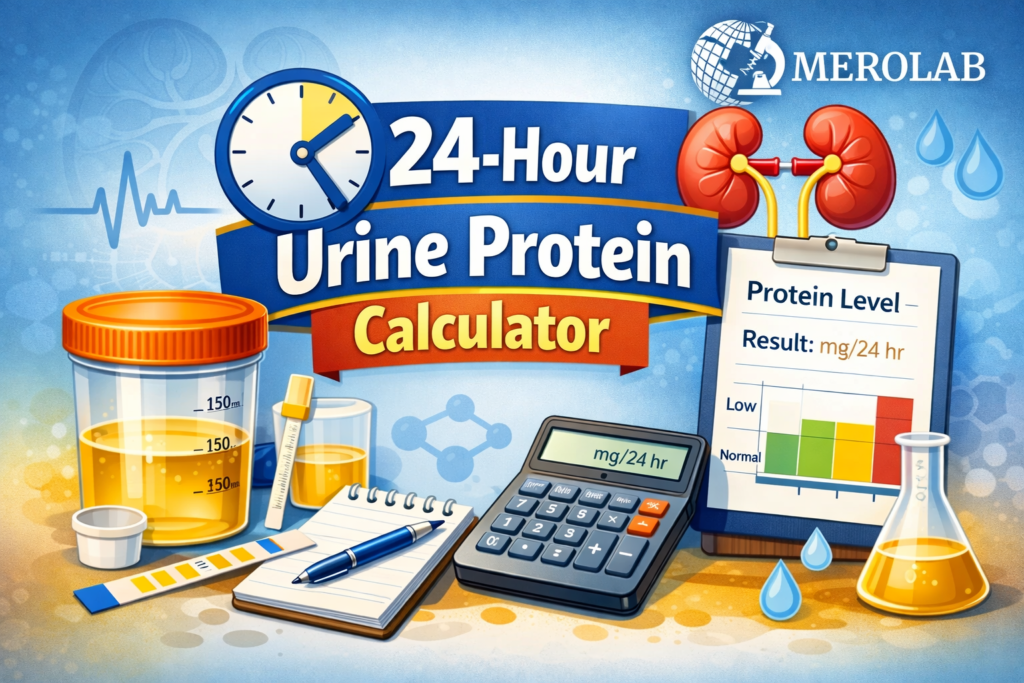
24 hours urine protein calculator accurately measures total daily urine protein, making it essential for detecting and monitoring kidney disease. It helps identify proteinuria early, supports diagnosis in diabetes, hypertension, and pregnancy-related conditions, and reduces calculation errors for faster, reliable clinical decisions.
🧪 24‑Hour Urine Protein
| Age group | Gender | Weight (kg) | Normal (mg/24h) |
|---|---|---|---|
| Adults (≥18y) | All | Any | < 150 |
| Children (2–17y) | All | < 30 | < 100 |
| Children (2–17y) | All | ≥30 | < 150 |
| Infants (<2y) | All | Any | < 80 |
| Pregnancy | Female | — | < 300 |
Why is a 24-Hour Urine Protein Calculator Used?
A 24 hours urine protein calculator is used to estimate the total amount of protein excreted in urine over a full day. Protein is normally present in urine only in very small amounts. When the kidneys are damaged or not functioning properly, larger quantities of protein can leak into the urine. The calculator helps healthcare professionals quickly determine the total protein loss based on laboratory results and urine volume measurements. This information supports the diagnosis, monitoring, and management of various kidney-related conditions.
Importance of a 24-Hour Urine Protein Calculator
The 24 hours urine protein calculator plays an important role in evaluating kidney health. It provides a convenient and accurate way to calculate daily protein excretion without performing complex manual calculations. This tool helps doctors assess the severity of kidney disease, monitor disease progression, and evaluate the effectiveness of treatment. It is especially valuable for patients with chronic kidney disease, nephrotic syndrome, diabetes-related kidney damage, hypertension, and pregnancy-associated conditions such as preeclampsia. By offering a standardized calculation, the tool improves efficiency, reduces calculation errors, and supports better clinical decision-making.
Clinical Significance of 24-Hour Urine Protein
- The 24 hours urine protein test is considered the most accurate method for measuring daily protein loss through the kidneys
- Unlike random urine samples, it reflects protein excretion over an entire day, giving a true picture of kidney function
- It helps assess the integrity of the glomerular filtration system and overall renal health
Proteinuria as an Early Indicator of Kidney Disease
- Healthy kidneys prevent significant protein loss by filtering blood efficiently and reabsorbing proteins in the tubules
- Only very small proteins normally appear in urine and are mostly reabsorbed
Damage to the filtration or reabsorption system allows protein to leak into urine, signaling early kidney injury
Normal and Abnormal Protein Levels
- Normal range: 30–150 mg per 24 hours
- Abnormal (pathological): 150–2999 mg per 24 hours
- Nephrotic-range proteinuria: ≥3000 mg per 24 hours, associated with severe kidney disease and increased cardiovascular risk
Types of Proteinuria and Their Causes
• Glomerular proteinuria
-
- Mainly albumin loss
- Indicates damage to the glomerular membrane
- Seen in diabetes, lupus nephritis, and membranous nephropathy
Tubular proteinuria
- Loss of low-molecular-weight proteins
- Caused by impaired tubular reabsorption
- Associated with interstitial nephritis, toxin exposure, and Fanconi syndrome
Overflow proteinuria
- Occurs when excessive small proteins in blood overwhelm normal kidneys
- Common in multiple myeloma due to light-chain overproduction
- Reflects systemic disease rather than primary kidney damage
Orthostatic Proteinuria
- Seen mainly in adolescents and young adults
- Protein appears only during daytime activity and disappears at night
- Total protein loss is usually below 1000 mg/day
- Benign condition with an excellent long-term prognosis
- Correct identification avoids unnecessary investigations
Signs and Symptoms of Proteinuria
Early Asymptomatic Stage
- Early proteinuria causes no noticeable symptoms
- Often detected incidentally during routine tests, pregnancy screening, or health checkups
- Kidney damage may progress silently for long period
Changes in Urine
- Persistent foamy or frothy urine due to high protein content
- Foam is dense and long-lasting, unlike normal urine bubbles
- Patients often notice this only when specifically asked
Edema and Fluid Retention
- Loss of protein lowers blood albumin levels
- Reduced oncotic pressure leads to fluid leakage into tissues
Common early signs include:
- Morning eyelid swelling
- Swelling of feet, ankles, and hands
Severe cases may cause:
- Generalized body swelling (anasarca)
- Ascites and pleural effusions
Ascites and pleural effusions General and Associated Symptoms
- Fatigue, weakness, and reduced stamina
- Symptoms related to underlying disease may appear, such as:
- High blood pressure-related headaches
- Diabetic complications
- Lupus-related rashes and joint pain
Special Conditions
- In plasma cell disorders, proteinuria may occur with:
- Bone pain
- Recurrent infections
- Pathological fractures
- During pregnancy:
- Proteinuria with hypertension after 20 weeks suggests preeclampsia
- Warning signs include severe headache, visual changes, and upper abdominal pain
Requires urgent medical monitoring
Diagnostic and Prognostic Importance
Accuracy and Reliability
- The 24 hours urine protein test provides precise quantitative results
- It avoids errors caused by hydration status, muscle mass, or time of sampling
- Especially important when protein levels are very high
Disease Monitoring
- Useful for tracking disease progression and response to treatment
- Rising protein levels may signal relapse before kidney function worsens
- Falling levels indicate effective therapy
Prognostic Value
- Higher protein excretion predicts faster kidney function decline
- Reduction in proteinuria improves long-term renal outcomes
- Prognosis improves regardless of initial protein levels if proteinuria decreases
Role in Further Evaluation
- Abnormal results guide next diagnostic steps, including:
- Urine protein electrophoresis
- Imaging studies
- Autoimmune and systemic disease testing
- Severity determines urgency of nephrology referral
Public Health Importance
- Chronic kidney disease affects a large global population
- Early detection through urine protein testing can slow disease progression
Converts silent kidney damage into actionable clinical data
Limitations of a 24 Hours Urine Protein Calculator
Although a 24 hours urine protein calculator is a useful tool, it has several limitations. The accuracy of the calculation depends entirely on the accuracy of the urine collection process. If a patient misses some urine samples or collects urine incorrectly during the 24 – hours period, the calculated result may not reflect the true amount of protein excreted. The calculator also cannot identify the underlying cause of proteinuria and should not be used as a substitute for a complete clinical evaluation. In addition, laboratory measurement errors, incomplete patient information, and variations in daily protein excretion can affect the final result. Therefore, calculator results should always be interpreted together with clinical findings and other laboratory tests.
Conclusion
A 24 hours urine protein calculator is a practical tool that helps estimate daily urinary protein loss and supports the assessment of kidney function. It improves calculation accuracy, saves time, and assists healthcare providers in patient management. However, its reliability depends on proper urine collection and accurate laboratory data. For this reason, calculator results should always be considered as part of a broader clinical assessment rather than as a standalone diagnostic tool.
What is a 24-hour urine protein test?
It is a laboratory test that measures the total amount of protein excreted in urine over 24 hours. It helps assess kidney function.
How should I collect the 24-hour urine sample?
-
Discard the first morning urine
-
Collect all urine for the next 24 hours
-
Store the container in a cool place or refrigerator
-
Add the final urine sample at the same time the next day
What is the difference between dipstick protein and 24-hour urine protein?
-
Dipstick test gives a quick estimate
-
24-hour urine protein test gives an accurate total amount