
Introduction
Few instruments have shaped modern laboratory science as quietly and profoundly as the centrifuge. Tucked into the corner of nearly every hospital lab, blood bank, research facility, and pharmaceutical plant, this spinning machine performs a task that would otherwise take hours or days through gravity alone: separating mixtures into their component parts based on density.
For students entering laboratory sciences, medical technology, or biotechnology, the centrifuge is often one of the first instruments they learn to operate — and one of the most important to understand deeply. This guide walks through where the centrifuge came from, how it actually works at a physical level, how centrifuges are classified and categorized, the major types in use today, and why this single invention has had such an outsized impact on healthcare and research.
A Brief History of the Centrifuge
Origins in Physics
The scientific groundwork for the centrifuge was laid long before any machine existed. In the mid-1600s, Dutch scientist Christiaan Huygens — also known for discovering Saturn’s moon Titan — coined the term “centrifugal force” while studying rotational motion. His work, along with later contributions from Isaac Newton and other classical physicists, established the theoretical basis for understanding how spinning objects experience an outward-pushing force. For roughly two centuries, this remained largely a topic of theoretical mechanics rather than a practical tool.
From the Dairy Industry to the Laboratory
The leap from theory to working machine came from an unlikely source: the dairy industry. In the 1860s, a German engineer named Antonin Prandtl designed a hand-cranked device intended to speed up the separation of cream from milk, a process that traditionally relied on gravity and could take a full day. By spinning milk rapidly, the denser skim milk moved outward while the lighter cream concentrated near the center — dramatically shortening a task that used to require patience into one that took minutes.
Only a few years later, Swiss physician and biologist Friedrich Miescher adapted this spinning principle for use inside a laboratory. Using a rudimentary centrifugal setup, Miescher isolated a substance from white blood cells that he called “nuclein.” That substance is now recognized as nucleic acid — the material we today call DNA. This makes the early centrifuge not just a dairy tool, but a direct enabler of one of biology’s most consequential discoveries.
Shortly afterward, Swedish engineer Gustaf de Laval improved on Prandtl’s design by adding a turbine mechanism, producing the first continuous-flow centrifugal separator. This innovation made industrial-scale centrifugation commercially viable and set the pattern that continuous-flow industrial centrifuges still follow today.
Electrification and the Rise of the Ultracentrifuge
Early centrifuges were powered entirely by hand, which limited both the speeds they could reach and how widely they could be adopted. That changed in the early twentieth century with the introduction of electrically powered centrifuges, which allowed for far greater consistency and much higher rotational speeds.
The next major leap came in the 1920s, when Swedish chemist Theodor Svedberg developed the ultracentrifuge — a machine capable of spinning at speeds high enough to separate particles as small as proteins and viruses. Svedberg’s work on sedimentation and particle behavior under extreme centrifugal force eventually earned him a Nobel Prize, and the unit used to describe sedimentation rates, the “Svedberg unit,” is named in his honor.
The Modern Era
Through the twentieth century, centrifuge technology diversified rapidly. Manufacturers introduced refrigerated centrifuges to protect heat-sensitive biological samples, microprocessor-controlled models for precision timing and speed regulation, and compact benchtop units suited to smaller clinical labs. What began as a simple hand-cranked cream separator has, over roughly 160 years, evolved into a family of highly specialized instruments used across medicine, biotechnology, forensics, and industry.
The Physical Principle Behind Centrifugation
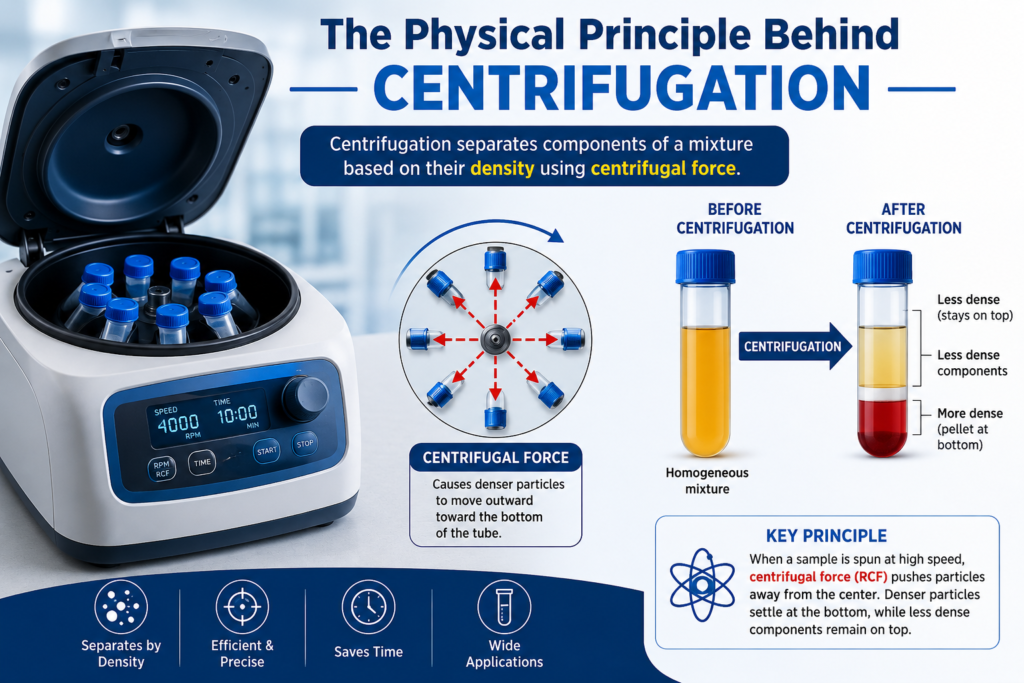
At its core, centrifugation is an engineered acceleration of a process that would otherwise happen naturally, but very slowly: sedimentation under gravity.
Why Particles Settle
Any mixture of particles suspended in a liquid — blood cells in plasma, for instance — will eventually separate on its own if left undisturbed. Denser particles are pulled downward by gravity faster than lighter ones, which is why, given enough time, red blood cells will settle to the bottom of a test tube while plasma remains on top. The problem is that gravity is a comparatively weak force, so this natural separation can take many hours or even days, and fine particles like proteins may never separate meaningfully under gravity alone.
Introducing Centrifugal Force
A centrifuge solves this by spinning the sample rapidly around a fixed central axis. As the rotor accelerates, every particle inside the sample tube experiences an outward force proportional to its mass, the rotor’s speed, and its distance from the axis of rotation. This force can be many thousands of times stronger than gravity — which is why centrifugal effects are usually expressed not in RPM alone, but in “relative centrifugal force” (RCF), measured in multiples of gravitational force (× g).
Under this amplified force, denser particles migrate outward — toward the bottom of the tube in a fixed-angle or swinging-bucket setup — much faster than they would under gravity alone, while lighter components remain nearer the center of rotation. The mixture separates into distinguishable layers within minutes rather than hours.
The Sequence of Events Inside a Spin
- Loading – Sample tubes are placed into the rotor, and technicians must ensure the load is balanced; an uneven load causes dangerous vibration at high speed.
- Acceleration – The rotor increases speed until it reaches the programmed RPM or RCF.
- Force application – Sustained rotation applies continuous outward force to every particle in the sample.
- Differential sedimentation – Because denser particles respond more strongly to this force, they move outward faster than lighter ones, creating layers.
- Deceleration and recovery – “The rotor comes to a full stop before the lid can be opened, helping keep the separated layers intact and undisturbed during sample collection.”Variables That Determine Separation Quality
Variable | Effect on the Separation Process |
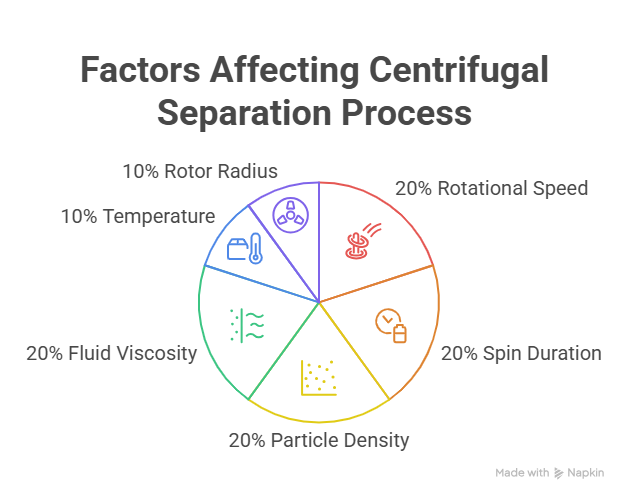
Rotational speed (RPM/RCF) | Greater speed produces stronger outward force and faster separation |
Spin duration | Longer runs allow more complete sedimentation, especially for fine particles |
Particle density | Denser components migrate outward more quickly than lighter ones |
Fluid viscosity | Thicker fluids resist particle movement, slowing the entire process |
Temperature | Can affect both the physical stability of the sample and its separation behavior |
Rotor radius | A larger radius increases the effective centrifugal force at a given RPM |
Choosing the right combination of these variables is a skill in itself — running a sample too fast or too long can damage fragile cells, while too gentle a spin may fail to separate the components at all.
Classifying Centrifuges
Centrifuges are grouped in several overlapping ways depending on what aspect of the machine is being considered.
By Rotational Speed
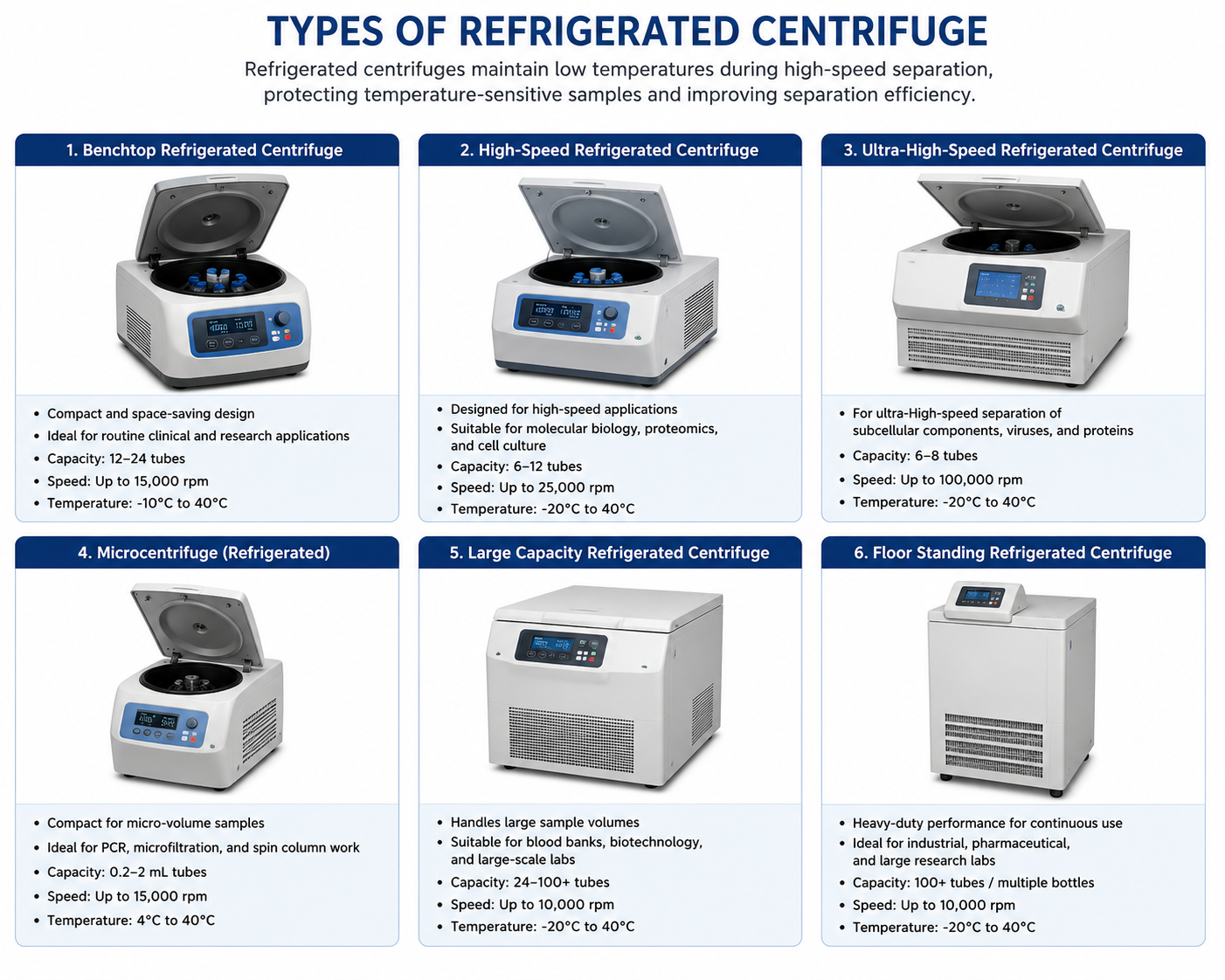
- Low-speed centrifuges typically operate up to around 4,000–6,000 RPM and are used for general tasks such as separating blood cells or urine sediment.
- High-speed centrifuges run in the range of roughly 15,000–20,000 RPM and are suited to isolating finer particles such as proteins.
- Ultracentrifuges exceed 20,000 RPM, in some cases running past 100,000 RPM, and are needed to separate extremely small structures such as viruses, ribosomes, and other macromolecules.
By Physical Size
- Micro centrifuges are compact benchtop units built for very small sample volumes, common in molecular biology work.
- Benchtop centrifuges are mid-sized machines suited to everyday clinical laboratory use.
- Floor-standing centrifuges are large-capacity units built for industrial or high-throughput laboratory environments.
By Temperature Control
- Refrigerated centrifuges maintain a controlled low temperature throughout the run, protecting samples such as enzymes or hormones that degrade at room temperature.
- Non-refrigerated centrifuges run at ambient temperature and are adequate for routine, non-sensitive samples.



Major Types of Centrifuges and Their Uses
Microcentrifuge — Built for volumes typically under 2 mL, these are a staple of molecular biology labs, used for spinning down DNA, RNA, and protein preparations.
Clinical centrifuge — The workhorse of hospital and diagnostic labs, used for everyday tasks including serum and plasma separation, urinalysis, and hematocrit testing.
Refrigerated centrifuge — Reserved for temperature-sensitive biological materials that would otherwise degrade during processing.
Ultracentrifuge — Designed for advanced research applications, this centrifuge separates extremely small particles—such as viruses, cellular organelles, and large biomolecules—by operating at exceptionally high rotational speeds.
Continuous flow centrifuge — Designed to process large, uninterrupted volumes of liquid, commonly found in industrial and pharmaceutical manufacturing.
Hematocrit centrifuge — Used specifically to measure packed cell volume (PCV) in blood, an important diagnostic value for conditions like anemia.
Blood bank centrifuge — A specialized machine used to separate whole donated blood into its usable components: red blood cells, plasma, and platelets.
Rotor Designs
The rotor holds and spins the sample tubes, and its geometry affects both separation quality and speed:
- Fixed-angle rotors hold tubes at a constant angle, producing fast sedimentation with a shorter particle travel path.
- Swinging-bucket rotors allow tubes to pivot outward during rotation, which tends to produce better-resolved, more distinct layers.
Continuous tubular rotors are built for ongoing processing of large sample volumes rather than discrete batches.
Why Centrifuges Matter
The centrifuge’s importance extends well beyond convenience:
- Diagnostic accuracy — Proper separation of blood into its components underlies reliable testing for anemia, infections, and metabolic conditions.
- Blood banking — Centrifugation makes it possible to separate donated whole blood into red cells, plasma, and platelets for targeted transfusion use.
- Scientific research — Ultracentrifuges remain essential tools in virology, genetics, and cell biology, tracing back to the same principle Miescher used to discover DNA over 150 years ago.
- Pharmaceutical development — Drug formulation and quality control processes rely heavily on centrifugal separation.
Efficiency — Automated, programmable centrifuges have cut sample processing time dramatically compared to both manual methods and the earliest hand-cranked machines.
Applications Across Industries
Centrifuges are now embedded in a wide range of fields, including:
- Clinical pathology and diagnostic testing
- Blood banks and transfusion medicine
- Pharmaceutical manufacturing
- Biotechnology and genetic research
- Forensic laboratories
- Food and beverage processing
- Environmental testing
Where Centrifuge Technology Is Headed
Modern development continues along several tracks:
- Automation and programmability, reducing manual error in routine runs
- Portability, enabling point-of-care testing outside traditional lab settings
- Digital monitoring, giving real-time visibility into speed, temperature, and run time
- Energy efficiency, aligning with broader sustainability goals in laboratory design
Safety Considerations
Because centrifuges spin at high speed, proper handling matters as much as understanding the science behind them:
- Always balance opposing sample tubes before starting a run.
- Never open the lid until the rotor has come to a complete stop.
- Inspect rotors and tubes regularly for cracks or wear.
- Follow manufacturer-specified speed and time settings rather than improvising.
- Wear appropriate personal protective equipment when handling biological samples.
Conclusion
What started in the 1860s as a hand-cranked machine for separating cream from milk has, over more than a century and a half, become one of the most indispensable instruments in medicine and science. Along the way, the same physical principle that sped up dairy processing also enabled the discovery of DNA and the development of the ultracentrifuge — a chain of innovation that connects a Bavarian dairy station to modern genomics labs. Understanding both the history and the underlying physics of centrifugation gives laboratory professionals and students a fuller appreciation of a tool they may otherwise take for granted.
Frequently Asked Questions
Q1: What is the main function of a centrifuge?
It separates the components of a liquid mixture based on differences in density, using centrifugal force generated by rapid spinning.
Q2: Who invented the centrifuge?
The first practical centrifuge is credited to German engineer Antonin Prandtl in the 1860s, originally built to separate cream from milk. It was later adapted for laboratory use by Friedrich Miescher.
Q3: What are the main types of centrifuges used in laboratories?
Common types include microcentrifuges, clinical centrifuges, refrigerated centrifuges, ultracentrifuges, and blood bank centrifuges.
Q4: How is a centrifuge classified?
Centrifuges are typically classified by speed (low-speed, high-speed, ultracentrifuge), size (micro, benchtop, floor-standing), and temperature control (refrigerated or non-refrigerated).
Q5: What is the difference between a centrifuge and an ultracentrifuge?
A standard centrifuge separates components at relatively moderate speeds, while an ultracentrifuge reaches far higher rotational speeds, allowing it to isolate very small particles such as viruses and macromolecules.
Q6: What safety measures should be followed while using a centrifuge?
Balance all sample tubes before starting, wait for the rotor to stop completely before opening the lid, inspect equipment regularly, and wear appropriate protective equipment.