
Introduction:
A Coulter counter is one of the most groundbreaking inventions in the history of laboratory science. Before its discovery, counting blood cells was a slow, manual, and often inaccurate process. Today, this remarkable instrument allows laboratories to count and size millions of particles within seconds, transforming the speed and accuracy of medical diagnostics.
From hospitals to research institutions, the Coulter counter has become a trusted name in automated cell counting technology. In this article, we will explore the Coulter counter in complete detail — covering its history, classification, types, parts, working principle, uses, importance, and proper care and maintenance.
By the end of this guide, you will clearly understand why the Coulter counter remains one of the most valuable instruments in modern laboratory medicine.
What Is a Coulter Counter?
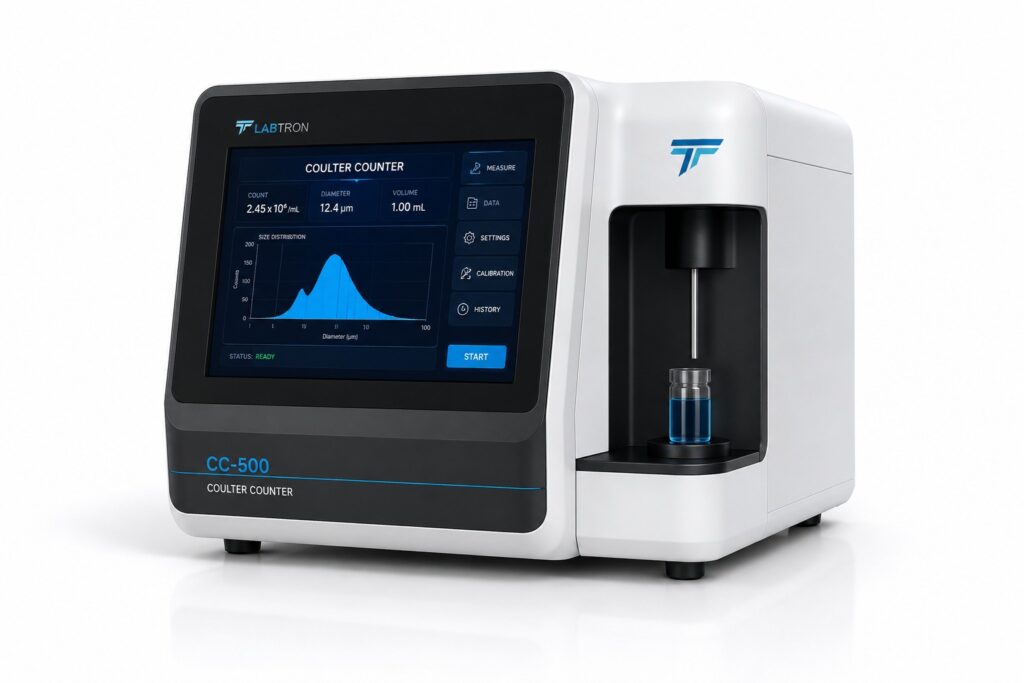
A Coulter counter is an electronic instrument used to count and measure the size of microscopic particles, such as blood cells, suspended in an electrically conductive fluid. It works by detecting changes in electrical resistance as particles pass through a tiny aperture.
This instrument is widely used in hematology laboratories for performing complete blood counts (CBC), making it an essential tool in diagnosing anemia, infections, and various blood disorders. Its speed, accuracy, and reliability have made it a gold standard in automated particle counting.
History and Background of Coulter Counter
The story of the Coulter counter begins in the early 1950s with an American inventor named Wallace H. Coulter. He developed a revolutionary method, later known as the Coulter Principle, to count and size particles electronically rather than manually under a microscope.
Before this invention, laboratory technicians had to count blood cells by hand using a microscope and a counting chamber, a process that was time-consuming and prone to human error. Wallace Coulter’s innovation changed this forever by introducing an automated, electrical method for accurate cell counting.
In 1953, Coulter patented his invention, and by the late 1950s, Coulter counters were being adopted in hospitals and laboratories across the world. Over the decades, the technology has continued to evolve, becoming faster, more precise, and more compact, while still relying on the same fundamental principle discovered by its inventor.
Today, the Coulter counter remains a foundational technology behind modern automated hematology analyzers used in laboratories worldwide.
Classification of Coulter Counter
The Coulter counter can be classified based on its design, level of automation, and application.
- Based on Automation Level
- Manual Coulter Counter – Requires the operator to load samples and initiate counting manually.
- Semi-Automated Coulter Counter – Combines manual sample loading with automated counting and calculation.
- Fully Automated Coulter Counter – Performs sample loading, counting, and data analysis with minimal human intervention, commonly used in high-volume laboratories.
- Based on Application
- Hematology Coulter Counter – Specifically designed for counting blood cells such as red blood cells, white blood cells, and platelets.
- Industrial Particle Counter – Used to measure particle size distribution in industries such as pharmaceuticals, cosmetics, and food production.
- Based on Aperture Design
- Single Aperture Counter – Uses one aperture for counting particles, suitable for basic applications.
- Multi-Aperture Counter – Uses multiple apertures simultaneously to improve accuracy and speed, especially in advanced laboratory models.
Types of Coulter Counter
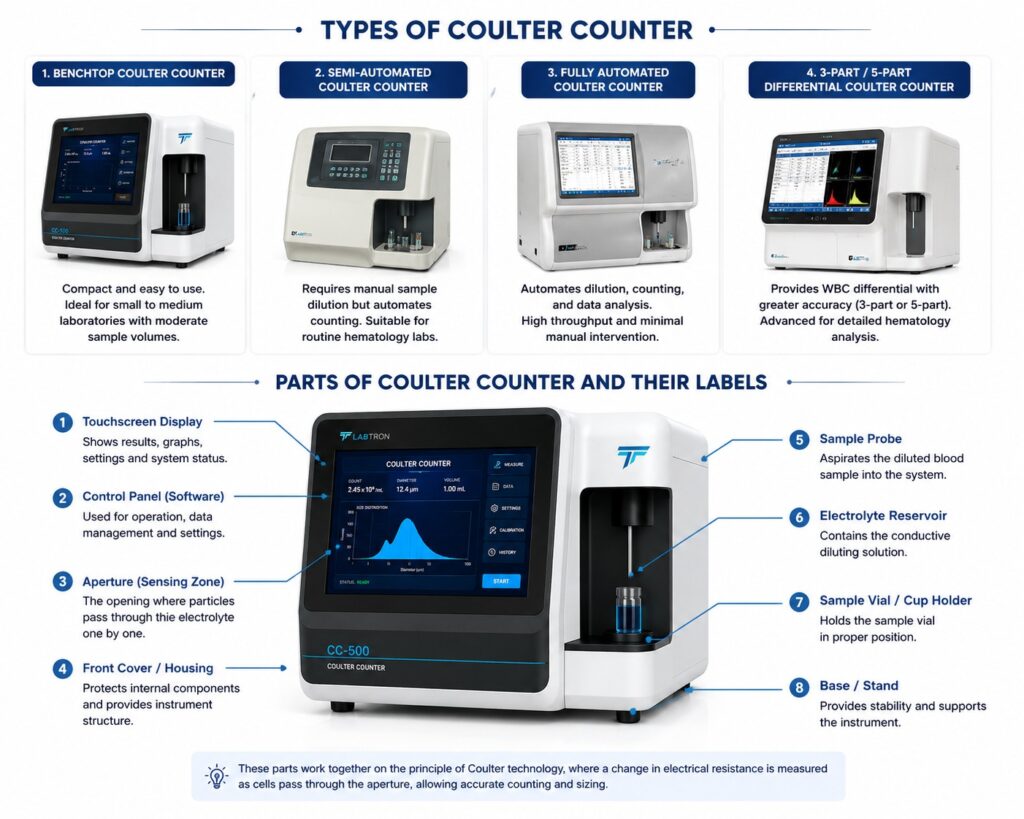
There are several types of Coulter counter designed for different laboratory and industrial needs.
Type Common Use
Benchtop Hematology Analyzer | Routine blood cell counting in hospitals |
Research-Grade Coulter Counter | Detailed particle size analysis in laboratories |
Industrial Particle Counter | Quality control in manufacturing industries |
Portable Coulter Counter | Point-of-care testing in smaller clinics |
Each type of Coulter counter has been engineered to balance speed, accuracy, and convenience, depending on the scale and purpose of the laboratory or facility.
Parts of a Coulter Counter
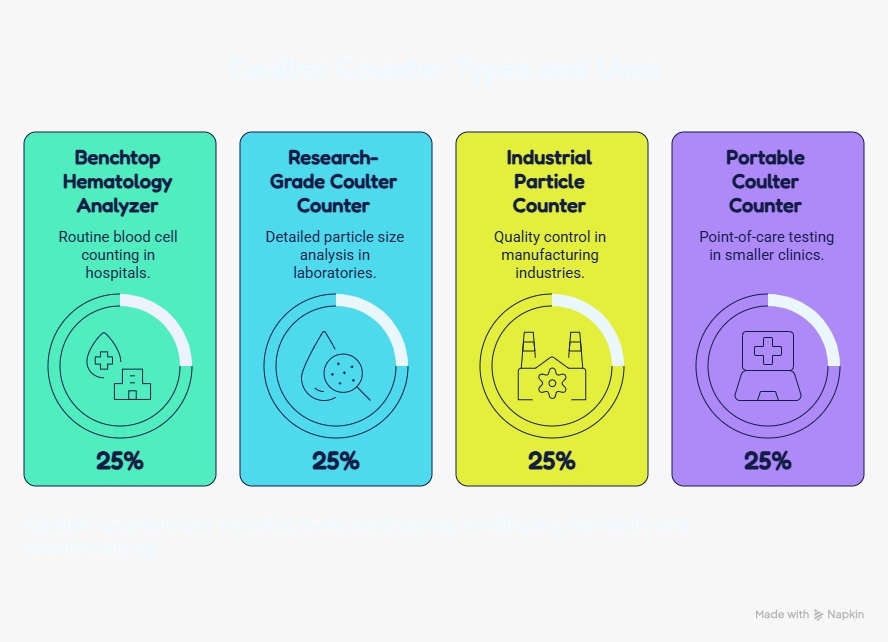
Understanding the parts of a Coulter counter is important for accurate operation and result interpretation.
Core Components
- Aperture Tube – Contains a tiny aperture through which particles pass one at a time.
- Electrodes – Positioned on either side of the aperture to measure changes in electrical resistance.
- Electrolyte Solution – A conductive fluid in which the sample is suspended, allowing electrical current to flow.
- Vacuum System – Draws the sample fluid through the aperture in a controlled and steady manner.
Electronic and Display Components
- Signal Amplifier – Strengthens the electrical pulses generated as particles pass through the aperture.
- Pulse Height Analyzer – Measures the size of each pulse, which corresponds to the size of the particle.
- Digital Display Panel – Shows particle count, size distribution, and other calculated results.
- Data Processing Unit – Converts raw electrical signals into meaningful diagnostic data, such as red and white blood cell counts.
Sample Handling Components
- Sample Cup – Holds the diluted blood or particle sample before analysis.
- Sample Probe – Draws a precise volume of sample into the system for testing.
Working Principle of Coulter Counter
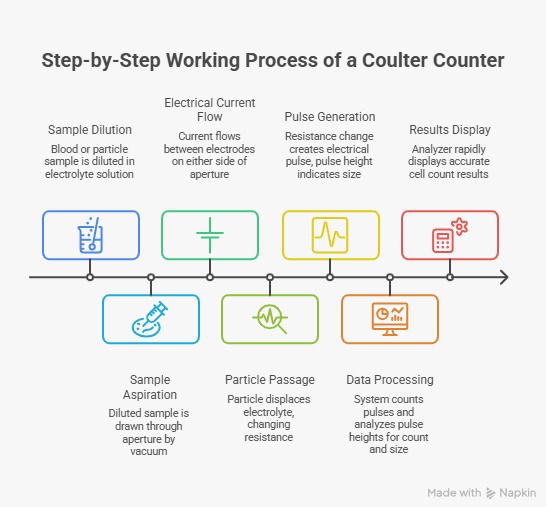
The working principle of a Coulter counter is based on a concept known as the Coulter Principle, which measures changes in electrical resistance to count and size particles.
Step-by-Step Working Process
- The blood or particle sample is diluted in an electrolyte solution to ensure individual particles remain separated.
- The diluted sample is drawn through a small aperture using a controlled vacuum system.
- An electrical current flows continuously between two electrodes placed on either side of the aperture.
- As each particle passes through the aperture, it temporarily displaces the electrolyte, causing a brief change in electrical resistance.
- This change generates an electrical pulse, where the height of the pulse corresponds directly to the size of the particle.
- The system counts the total number of pulses to determine particle count, while pulse height data provides information on particle size distribution.
- The analyzer processes the sample rapidly and displays accurate cell count results on the digital screen within a few seconds.
Despite its simple working principle, the Coulter counter delivers fast, accurate, and reproducible cell counts with minimal human error, making it a more reliable and efficient alternative to traditional manual counting methods.
Uses of Coulter Counter
The Coulter counter is used extensively in healthcare, research, and industrial settings due to its speed and precision.
In Hematology and Diagnostics
- Performing complete blood counts (CBC)
- Counting red blood cells/ Erythrocytes (RBC), white blood cells/ Leukocytes (WBC), and platelets/Thrombocytes
- Diagnosing conditions such as anemia, leukemia, and infections
In Research
- Studying cell size distribution in biological samples
- Supporting stem cell and cancer research
- Analyzing particle behavior in experimental studies
In Industrial Applications
- Measuring particle size in pharmaceutical formulations
- Quality control testing in cosmetic and food industries
- Analyzing particle distribution in environmental samples
In Veterinary Medicine
- Conducting blood cell counts for animal health diagnostics
Importance of Coulter Counter in Modern Laboratories
The Coulter counter has fundamentally transformed the field of laboratory diagnostics. Before its invention, manual cell counting was not only slow but also highly susceptible to human error, which could compromise patient diagnosis.
By automating the counting process, the Coulter counter significantly improved both the speed and accuracy of blood cell analysis. Today, it forms the technological foundation of nearly all modern automated hematology analyzers used in hospitals and diagnostic centers worldwide.
Its impact extends beyond healthcare, playing a crucial role in industries where precise particle measurement is essential for quality control and research accuracy.
Advantages of Coulter Counter
- Provides fast and highly accurate particle counting
- Reduces human error compared to manual counting methods
- Capable of analyzing thousands of particles within seconds
- Offers detailed particle size distribution data
- Widely applicable across healthcare, research, and industrial fields
Limitations of Coulter Counter
- Requires regular calibration to maintain accuracy
- Aperture blockage can occur with larger or clumped particles
- Initial equipment cost can be high for smaller laboratories
- Requires proper technical training for optimal use
Care and Maintenance of Coulter Counter
Proper care and maintenance of a Coulter counter is essential to ensure consistent accuracy and long-term reliability.
Daily Care Tips
- Clean the aperture tube regularly to prevent blockages from debris or clumped particles.
- Use only recommended electrolyte solutions to avoid contamination.
- Wipe down sample probes and cups after each use.
- Check for air bubbles in the system, as they can affect accuracy.
Maintenance Best Practices
- Perform regular calibration using standardized control samples.
- Replace worn or damaged aperture tubes promptly.
- Schedule periodic professional servicing to check electronic components.
- Store electrolyte solutions in a clean, contamination-free environment.
- Train laboratory staff thoroughly on proper sample handling and instrument operation.
- Following these maintenance steps helps preserve measurement accuracy and significantly extends the operational lifespan of the Coulter counter.
Difference Between Coulter Counter and Manual Cell Counting
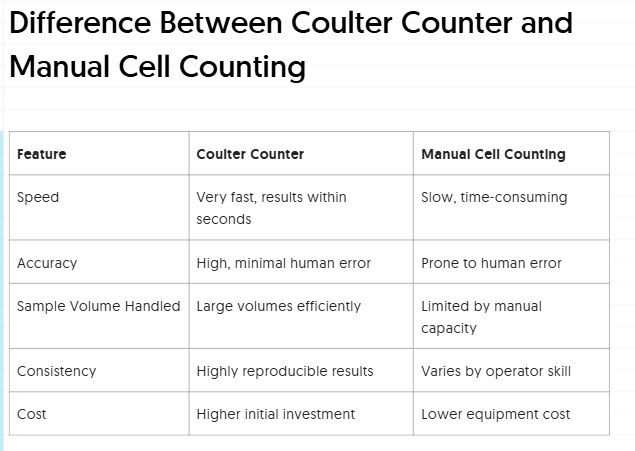
This comparison clearly shows why the Coulter counter has become the preferred choice in modern laboratories, despite the higher upfront investment required.
Why Coulter Counter Remains a Trusted Technology Today
Even decades after its invention, the Coulter counter continues to be a trusted and essential technology in laboratory medicine. Its ability to deliver fast, accurate, and reproducible results has made it indispensable in hospitals, research institutions, and industries around the world.
As automated diagnostic technology continues to advance, the core principle behind the Coulter counter remains unchanged, standing as a testament to Wallace Coulter’s brilliant and lasting scientific contribution.
For further reading on hematology analyzers and particle counting technologies, professionals can explore trusted academic resources such as PubMed and PMC, which offer peer-reviewed research on automated cell counting and laboratory diagnostics.
Conclusion
The Coulter counter stands as one of the most powerful and transformative inventions in laboratory science. From its remarkable history to its elegant working principle, this instrument has reshaped how blood cells and microscopic particles are counted and analyzed across the globe.
Understanding its classification, types, parts, uses, and proper care ensures that laboratory professionals, students, and researchers can make the most of this invaluable technology while maintaining accuracy and equipment longevity.
Want to explore more about essential laboratory instruments and diagnostic technologies? Continue reading our expert guides to strengthen your knowledge of modern laboratory science and equipment.
Frequently Asked Questions (FAQs)
What is a Coulter counter used for?
A Coulter counter is used to count and measure the size of microscopic particles, such as blood cells, for diagnostic and research purposes.
What is the main working principle of a Coulter counter?
It works by measuring changes in electrical resistance as particles pass through a small aperture, generating electrical pulses that correspond to particle count and size.
Who invented the Coulter counter?
The Coulter counter was invented by Wallace H. Coulter in the early 1950s, based on a concept known as the Coulter Principle.
What are the main parts of a Coulter counter?
Key parts include the aperture tube, electrodes, electrolyte solution, vacuum system, and pulse height analyzer.
How can I maintain a Coulter counter properly?
Regularly clean the aperture tube, use recommended electrolyte solutions, perform routine calibration, and schedule periodic professional servicing.