
Introduction
Automated PCR has transformed the way laboratories detect infections, genetic conditions, and other diseases at the molecular level. PCR, short for polymerase chain reaction, is a laboratory technique that copies, or amplifies, tiny amounts of genetic material (DNA or RNA) millions of times, making it easy to detect even a very small amount of a virus, bacterium, or genetic mutation in a sample.
Traditionally, PCR testing required multiple manual steps, including nucleic acid extraction, reagent preparation, and careful pipetting, all performed by highly trained laboratory scientists. Automated PCR systems have changed this by combining these steps into a single, streamlined process, often called “sample-to-result” testing, reducing hands-on time and minimizing human error.
Definition of Automated PCR
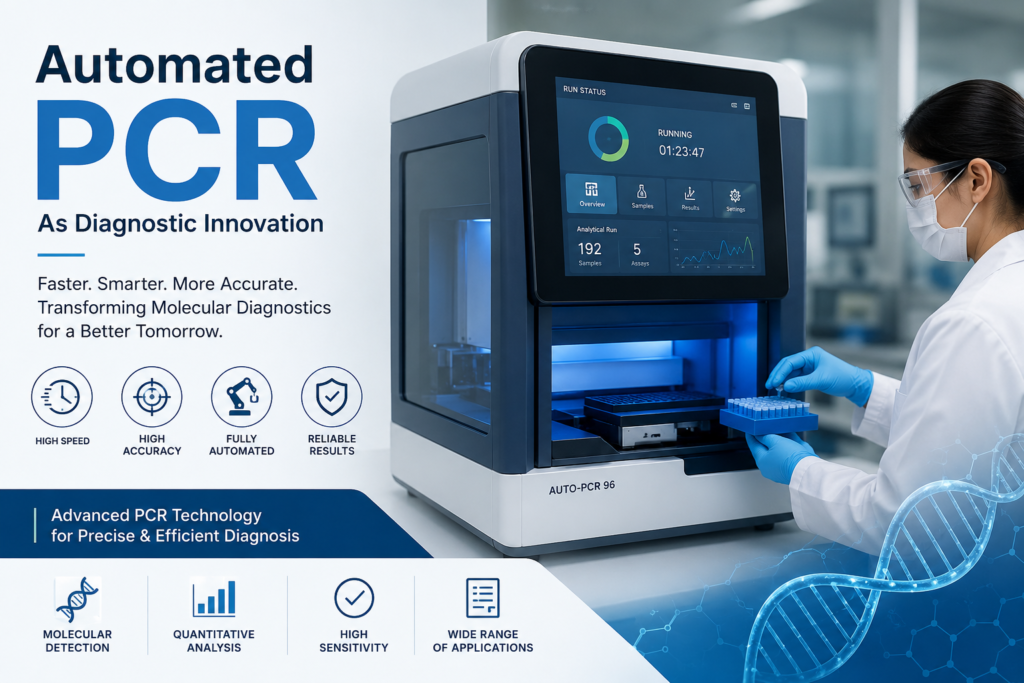
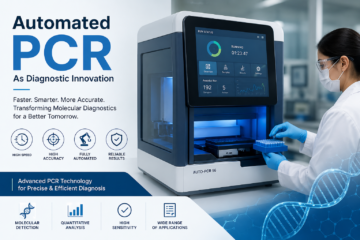
Automated PCR refers to the use of integrated laboratory instruments that perform some or all of the steps involved in polymerase chain reaction testing, including nucleic acid extraction, reagent mixing, amplification, and result detection, with minimal manual intervention. These systems combine robotics, precise temperature control, and software analysis to deliver accurate molecular test results efficiently and consistently.
In simple terms, automated PCR takes a process that once required a skilled technician to perform many separate manual steps and places it inside a machine that handles the entire workflow, from raw sample to a final, interpretable result, often within an hour or two.
Automated PCR systems are widely used in clinical microbiology, virology, genetics, and molecular pathology laboratories, and they play a central role in infectious disease diagnosis, especially for pathogens that are difficult or slow to grow using traditional culture methods.
Automated PCR at a Glance: Key Features Summary
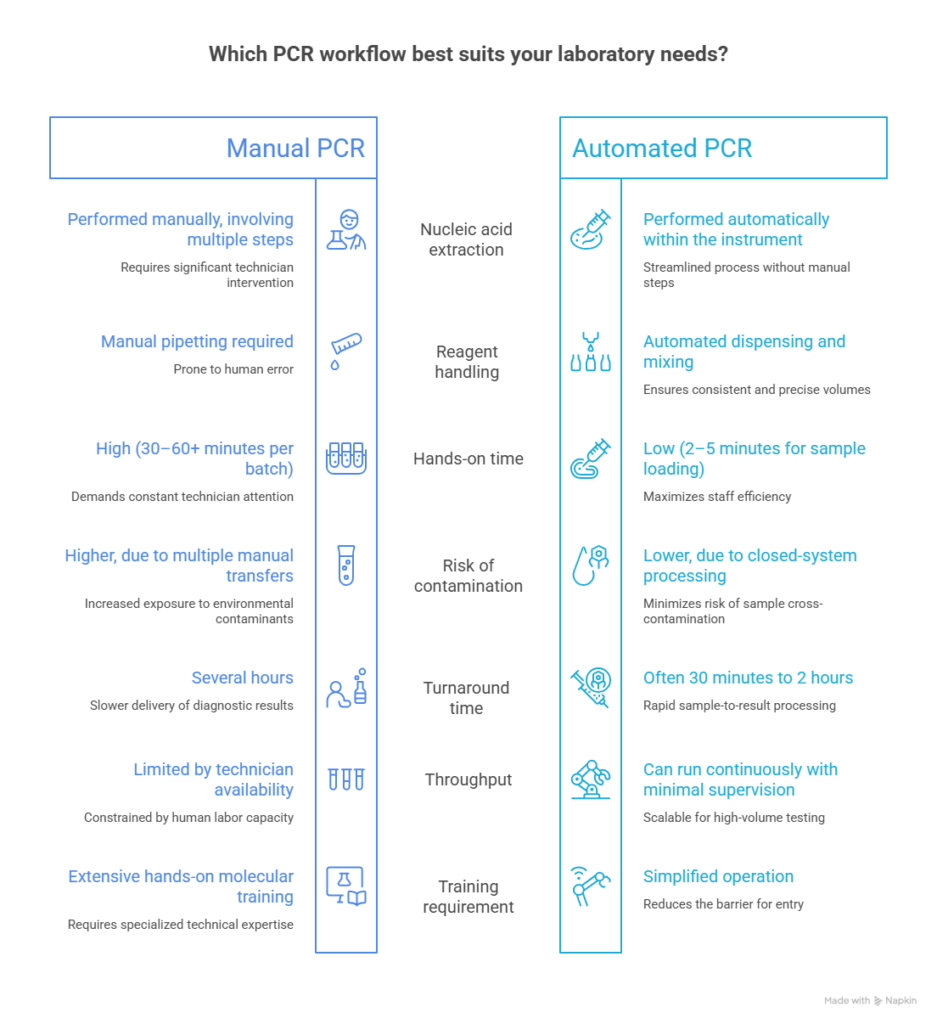
The table below summarizes the core features of automated PCR systems compared to traditional manual PCR testing:
Feature | Manual PCR | Automated PCR |
Performed manually, multiple steps | Performed automatically within the instrument | |
Reagent handling | Manual pipetting required | Automated dispensing and mixing |
Hands-on time | High (30–60+ minutes per batch) | Low (2–5 minutes for sample loading) |
Risk of contamination | Higher, due to multiple manual transfers | Lower, due to closed-system processing |
Turnaround time | Several hours | Often 30 minutes to 2 hours (sample-to-result) |
Throughput | Limited by technician availability | Can run continuously with minimal supervision |
Training requirement | Extensive hands-on molecular training | Simplified operation, though interpretation still requires training |
History of Automated PCR
The story of automated PCR is closely tied to the broader history of polymerase chain reaction technology itself.
- 1983: Kary Mullis developed the polymerase chain reaction technique, a discovery that later earned him the Nobel Prize in Chemistry in 1993. This breakthrough allowed scientists to amplify specific DNA sequences in a test tube.
- Late 1980s: The discovery of Taq polymerase, a heat-stable enzyme derived from bacteria living in hot springs, made PCR practical by eliminating the need to add fresh enzyme after every heating cycle.
- 1990s: Thermal cyclers, machines that automatically control the repeated heating and cooling cycles required for PCR, became standard laboratory equipment, automating the amplification step itself.
- Early 2000s: Real-time PCR (also called quantitative PCR or qPCR) was introduced, allowing scientists to monitor amplification as it happened, rather than only checking results at the end.
- 2000s–2010s: Fully integrated, closed-cartridge automated PCR systems emerged, combining nucleic acid extraction, amplification, and detection into a single automated workflow, dramatically simplifying molecular testing.
- 2019–2020 onward: The COVID-19 pandemic accelerated global adoption of automated PCR systems, as laboratories worldwide needed fast, reliable, and scalable testing solutions to manage unprecedented testing demand.
This evolution from manual, multi-step laboratory processes to fully automated, closed-system testing has made molecular diagnostics faster, safer, and more accessible than ever before.
Classification of PCR Automation Levels
Automated PCR systems can be classified based on the degree of automation involved:
Automation Level | Description | Example Use Case |
Semi-automated PCR | Automated amplification and detection, but manual nucleic acid extraction | Laboratories with existing extraction equipment |
Sample-to-result automated PCR | Fully automated extraction, amplification, and detection within a single closed cartridge | Point-of-care and rapid diagnostic settings |
High-throughput automated PCR | Robotic liquid handling systems combined with automated thermal cyclers for large batch processing | Reference laboratories and public health testing centers |
Types of Automated PCR Systems
- Cartridge-Based Systems
These systems use single-use, disposable cartridges containing all necessary reagents. The sample is loaded directly into the cartridge, and the instrument performs extraction, amplification, and detection automatically, minimizing contamination risk.
- Modular Automated Platforms
These systems separate extraction and amplification into connected modules, often allowing higher throughput and flexibility for laboratories running large sample volumes.
- Point-of-Care Automated PCR Devices
Compact, simplified automated PCR devices designed for use outside traditional laboratory settings, such as clinics, emergency departments, or remote healthcare facilities, providing rapid results with minimal training required.
Components and Parts of an Automated PCR System
Component | Function |
Sample loading port | Where the raw patient sample is introduced into the system |
Extraction module | Automatically isolates nucleic acids (DNA/RNA) from the sample |
Reagent cartridge | Contains pre-loaded primers, probes, enzymes, and buffers needed for amplification |
Thermal cycler unit | Controls precise heating and cooling cycles required for DNA amplification |
Optical detection system | Detects fluorescent signals produced during amplification, indicating the presence of target genetic material |
Software and computer interface | Analyzes fluorescence data and generates interpretable results |
Printer or data output system | Provides printed or digital reports for laboratory records and clinician review |
Principle of Automated PCR
The automated PCR principle is based on the same fundamental science as traditional PCR: the ability to exponentially amplify a specific segment of DNA or RNA using repeated cycles of heating and cooling, combined with automated detection of the amplified product.
Here is the basic principle explained simply:
- A target sequence of DNA or RNA, unique to a specific pathogen or genetic marker, is identified.
- Specific primers, short synthetic DNA sequences that match the beginning and end of the target sequence, are used to guide the amplification process.
- A heat-stable enzyme called Taq polymerase copies the target sequence repeatedly during each temperature cycle.
- With each cycle, the amount of target DNA doubles, resulting in millions of copies after just a few dozen cycles.
- A fluorescent probe or dye binds to the amplified DNA, producing a light signal that increases as more copies are made.
- The automated system’s optical detector measures this fluorescence in real time, allowing the software to determine whether the target sequence was present in the original sample.
Automated PCR systems integrate all these principles into a closed, self-contained workflow, removing the need for manual reagent transfer between steps.
Step-by-Step Working Principle: How Automated PCR Works
Understanding the working principle behind automated PCR helps laboratory professionals maintain quality results and helps clinicians interpret data with confidence. Here is a consolidated workflow from sample loading to reporting:
- Sample Loading The raw patient sample, such as a nasopharyngeal swab, blood, or urine specimen, is loaded directly into the automated PCR cartridge or system without extensive pre-processing.
- Automated Nucleic Acid Extraction The instrument automatically lyses (breaks open) cells or viral particles and isolates DNA or RNA using internal reagents and filtration or magnetic bead technology, removing the need for manual extraction steps.
- Reagent Mixing and Amplification Setup The extracted nucleic acid is automatically combined with primers, probes, enzymes, and buffers contained within the reagent cartridge, preparing the sample for amplification.
- Thermal Cycling The system automatically cycles through precise heating and cooling steps, typically 30 to 45 cycles, allowing the target DNA or RNA sequence to be copied exponentially.
- Real-Time Fluorescence Detection As amplification occurs, the optical detection system continuously measures fluorescent signals produced by probes binding to the amplified target, generating an amplification curve.
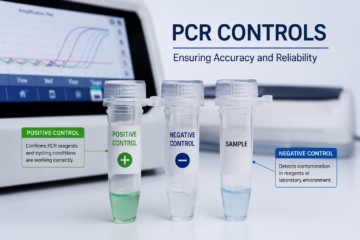
- Result Interpretation and Reporting The software analyzes the amplification curve, comparing it to positive and negative controls, and generates a qualitative (positive/negative) or quantitative result, which is displayed and can be printed or exported to the laboratory information system.
Quick Tip for Lab Professionals: Always verify that internal control signals are within the expected range before releasing a result, especially for negative results. A missing or weak internal control signal may indicate sample inhibition or extraction failure rather than a true negative result.
Procedure for Running an Automated PCR Test
Pre-Analytical Steps
- Collect the appropriate patient sample using proper technique, such as a nasopharyngeal swab for respiratory pathogens or a blood sample for bloodborne targets.
- Label the sample accurately with patient identification details.
- Store and transport the sample according to manufacturer and laboratory guidelines, maintaining appropriate temperature conditions if required.
Analytical Steps
- Load the sample directly into the automated PCR cartridge or instrument, following manufacturer instructions.
- Initiate the test run through the instrument’s software interface.
- The system automatically performs extraction, amplification, and detection without further manual intervention.
- Monitor the run status through the instrument’s display or connected laboratory information system.
Post-Analytical Steps
- Review the generated result, including internal control status, before releasing the report.
- Flag any invalid or indeterminate results for repeat testing, following laboratory protocol.
- Report critical or significant positive results to the requesting clinician promptly, according to institutional policy.
Applications of Automated PCR
Automated PCR is used extensively across many areas of medicine and public health, including:
- Infectious disease diagnosis: Detecting viruses such as SARS-CoV-2, influenza, respiratory syncytial virus (RSV), HIV, and hepatitis viruses
- Sexually transmitted infection testing: Identifying pathogens such as Chlamydia trachomatis and Neisseria gonorrhoeae
- Tuberculosis detection: Rapidly identifying Mycobacterium tuberculosis, including detection of certain drug-resistance markers
- Healthcare-associated infection screening: Detecting organisms like MRSA (methicillin-resistant Staphylococcus aureus) or Clostridioides difficile
- Genetic and oncology testing: Identifying specific gene mutations relevant to inherited conditions or targeted cancer therapies
- Blood bank and transfusion screening: Detecting bloodborne pathogens to ensure blood product safety
- Public health surveillance: Supporting outbreak investigation and monitoring disease trends through large-scale testing capacity
Advantages of Automated PCR
- Significantly reduces hands-on technician time compared to manual PCR testing
- Lowers contamination risk through closed-system, single-use cartridge designs
- Provides faster turnaround times, often delivering results within one to two hours
- Increases testing consistency by minimizing manual pipetting and handling variability
- Allows laboratories to scale up testing capacity during outbreaks or high-demand periods
- Simplifies training requirements, making molecular testing more accessible in diverse healthcare settings
Disadvantages and Limitations
- Higher cost per test compared to some traditional manual molecular methods, due to proprietary cartridges and reagents
- Dependence on manufacturer-specific consumables can create supply chain challenges during high demand
- Limited flexibility to modify or customize testing panels compared to manual, laboratory-developed PCR assays
- Equipment malfunction can halt testing entirely if backup systems are not available
- Requires regular maintenance and quality control to ensure consistent performance
Clinical Significance
Automated PCR has become a cornerstone of modern clinical diagnostics because it allows rapid, sensitive, and specific detection of pathogens and genetic markers, often faster than traditional culture-based methods.
For example, detecting Mycobacterium tuberculosis through culture can take several weeks, while automated PCR can provide results within hours, allowing clinicians to begin appropriate treatment much sooner. Similarly, rapid automated PCR testing for respiratory viruses helps guide infection control decisions in hospitals, reducing the risk of disease transmission to other patients and healthcare workers.
In oncology, automated PCR-based genetic testing helps identify specific mutations that guide targeted therapy selection, supporting more personalized and effective cancer treatment approaches.
Interpretation of Results
Interpreting automated PCR results requires understanding several key factors:
- Qualitative results: Most automated PCR tests report results as positive, negative, or indeterminate, based on whether the target sequence was detected within a set number of amplification cycles.
- Cycle threshold (Ct) values: In quantitative or semi-quantitative assays, a lower Ct value generally indicates a higher amount of target genetic material in the original sample, though interpretation should always follow manufacturer and laboratory guidelines.
- Internal controls: Confirming that internal control signals are within expected ranges is essential before accepting a negative result as valid.
- Clinical correlation: Results should always be interpreted alongside patient symptoms, exposure history, and other relevant clinical information, since no test is perfectly sensitive or specific.
Automated PCR in Special Populations and Settings
Immunocompromised Patients
Immunocompromised patients, such as those undergoing chemotherapy or organ transplantation, often have lower pathogen loads or atypical presentations. Automated PCR’s high sensitivity makes it especially valuable in this population, where rapid and accurate pathogen detection can significantly influence treatment decisions.
Pediatric Patients
Children, particularly infants, often cannot easily provide certain sample types, and their smaller sample volumes require assays validated for pediatric use. Automated PCR systems designed with flexible sample input requirements help support accurate testing across a wide range of ages.
Point-of-Care and Resource-Limited Settings
In rural clinics, emergency departments, or resource-limited regions, compact automated PCR devices provide rapid, laboratory-quality molecular testing without requiring extensive laboratory infrastructure or highly specialized personnel, expanding access to timely diagnosis.
Pregnant Women
Certain infections, such as Group B Streptococcus or sexually transmitted infections, require rapid and accurate detection during pregnancy to guide timely treatment and reduce risks to both mother and baby. Automated PCR’s fast turnaround time supports timely clinical decision-making in these situations.
Frequently Observed Errors
Several common errors can affect automated PCR testing accuracy:
- Improper sample collection: Inadequate swab technique or insufficient sample volume can lead to false-negative results
- Sample degradation: Improper storage or delayed transport can degrade nucleic acids, affecting test accuracy
- Cartridge or reagent handling errors: Using expired reagents or improperly stored cartridges can compromise results
- Instrument malfunction: Mechanical or software errors can produce invalid or indeterminate results
- Contamination: Although automated systems reduce contamination risk, improper handling during sample loading can still introduce contamination
Troubleshooting Common Issues
Problem | Possible Cause | Solution |
Invalid or indeterminate result | Sample inhibition or extraction failure | Repeat testing with a fresh sample, following manufacturer troubleshooting guidance |
Weak internal control signal | Insufficient sample volume or degraded nucleic acid | Recollect sample using proper technique and appropriate transport conditions |
Instrument error message | Software glitch or hardware malfunction | Restart the system and consult manufacturer technical support if the issue persists |
Inconsistent results between runs | Reagent lot variability or calibration drift | Verify reagent lot numbers and perform quality control checks with known positive and negative samples |
Delayed result reporting | Data connectivity or software integration issue | Check laboratory information system connections and restart data transfer processes |
Care and Maintenance
Proper maintenance ensures automated PCR systems continue to deliver accurate and reliable results:
- Perform daily startup checks and system diagnostics as recommended by the manufacturer.
- Run quality control samples regularly, following the laboratory’s quality assurance schedule.
- Clean external surfaces and sample loading ports according to manufacturer disinfection guidelines.
- Store reagent cartridges at the correct temperature and monitor expiration dates closely.
- Schedule periodic preventive maintenance with certified service engineers.
Maintain detailed maintenance and service logs for quality assurance and regulatory compliance.
Quality Assurance: IQC and EQA
Internal Quality Control (IQC)
Internal quality control for automated PCR involves running known positive and negative control samples alongside patient samples, typically with each batch or testing day, to confirm the system is performing accurately. Internal controls embedded within each test cartridge also help verify that extraction and amplification occurred properly for each individual sample.
External Quality Assessment (EQA)
External quality assessment, or proficiency testing, involves participating in external programs where laboratories test standardized samples and compare results with other institutions. This process helps identify systematic errors and ensures automated PCR testing remains accurate and consistent across different laboratories and geographic regions.
Both IQC and EQA are essential components of laboratory accreditation, supporting compliance with standards recommended by organizations such as CLSI and relevant national health authorities.
Safety Precautions
- Follow standard biosafety precautions when handling patient samples, since all specimens should be treated as potentially infectious.
- Use appropriate personal protective equipment, including gloves, masks, and lab coats, during sample collection and handling.
- Dispose of used cartridges and biological waste according to institutional biohazard disposal protocols.
- Ensure proper ventilation and follow manufacturer guidelines when handling any chemical reagents included in the system.
- Report any spills or exposure incidents immediately according to laboratory safety procedures.
- Regularly disinfect work surfaces and instrument exteriors to minimize contamination risk.
Key Points:
- Automated PCR combines nucleic acid extraction, amplification, and detection into a streamlined, often closed-system workflow.
- This technology significantly reduces hands-on laboratory time while improving consistency and reducing contamination risk.
- Automated PCR plays a vital role in infectious disease diagnosis, genetic testing, and public health surveillance.
- Results should always be interpreted alongside internal control status and relevant clinical information.
- Regular quality assurance through IQC and EQA ensures automated PCR systems continue to provide accurate, reliable results.
Conclusion
Automated PCR has fundamentally changed the landscape of molecular diagnostics, making rapid, sensitive, and reliable testing accessible across hospitals, clinics, and public health laboratories worldwide. From its origins in Kary Mullis’s groundbreaking discovery of the polymerase chain reaction to today’s fully integrated, sample-to-result systems, this technology continues to evolve in response to growing diagnostic demands.
For laboratory professionals, understanding the working principle, quality assurance requirements, and troubleshooting steps behind automated PCR improves testing accuracy, reduces preanalytical errors, and strengthens confidence in reported results. For clinicians, recognizing how automated PCR results should be interpreted, alongside internal controls and clinical context, supports more confident, evidence-based patient care decisions.
As diagnostic technology continues to advance, automated PCR remains a cornerstone of modern healthcare, supporting faster diagnosis, better infection control, and improved patient outcomes across a wide range of clinical settings.
Frequently Asked Questions (FAQs)
What is automated PCR used for?
Automated PCR is used to detect infectious pathogens, genetic mutations, and other molecular targets quickly and accurately, supporting diagnosis and treatment decisions across many areas of medicine.
How is automated PCR different from traditional PCR?
Automated PCR integrates nucleic acid extraction, amplification, and detection into a single automated workflow, while traditional manual PCR requires separate manual steps performed by a trained technician.
How long does an automated PCR test take?
Most automated PCR systems provide results within 30 minutes to 2 hours, depending on the specific test and instrument used.
Is automated PCR more accurate than manual PCR?
Automated PCR generally offers greater consistency by reducing manual handling errors, though both methods can achieve high accuracy when performed correctly with proper quality control.
What sample types can be used for automated PCR testing?
Common sample types include nasopharyngeal swabs, blood, urine, and other bodily fluids, depending on the specific pathogen or genetic target being tested.
Can automated PCR detect drug-resistant infections?
Yes, certain automated PCR assays are designed to detect specific genetic markers associated with antibiotic resistance, such as those used in tuberculosis testing.
Why is automated PCR important during disease outbreaks?
Automated PCR allows laboratories to scale up testing quickly and efficiently, providing rapid results that support timely diagnosis, treatment, and infection control decisions during outbreaks.
Are automated PCR results always accurate?
While highly sensitive and specific, automated PCR results should always be interpreted alongside clinical symptoms and internal control status, since no diagnostic test is completely free from limitations.
What quality checks ensure reliable automated PCR results?
Internal Quality Control (IQC) using known positive and negative samples, along with External Quality Assessment (EQA) participation, helps ensure automated PCR systems maintain accurate and consistent performance.
Disclaimer:
The information provided in this article is intended for educational and informational purposes only and should not be considered a substitute for professional medical, laboratory, or technical advice. Always refer to applicable laboratory protocols, manufacturer instructions, professional guidelines, and qualified professionals where appropriate. Please refer to the MeroLab Medical, Laboratory & Educational Disclaimer for complete terms.