

Ion chromatography is an analytical technique used to separate and measure charged particles, called ions, in a liquid sample. If you have ever wondered how laboratories check drinking water for contaminants like nitrate or fluoride, or how they measure salt content in food and pharmaceutical products, ion chromatography is very often the method behind those results. This powerful separation technique has become a cornerstone of environmental testing, clinical diagnostics, food safety, and industrial quality control.
What Is Ion Chromatography? (Definition)
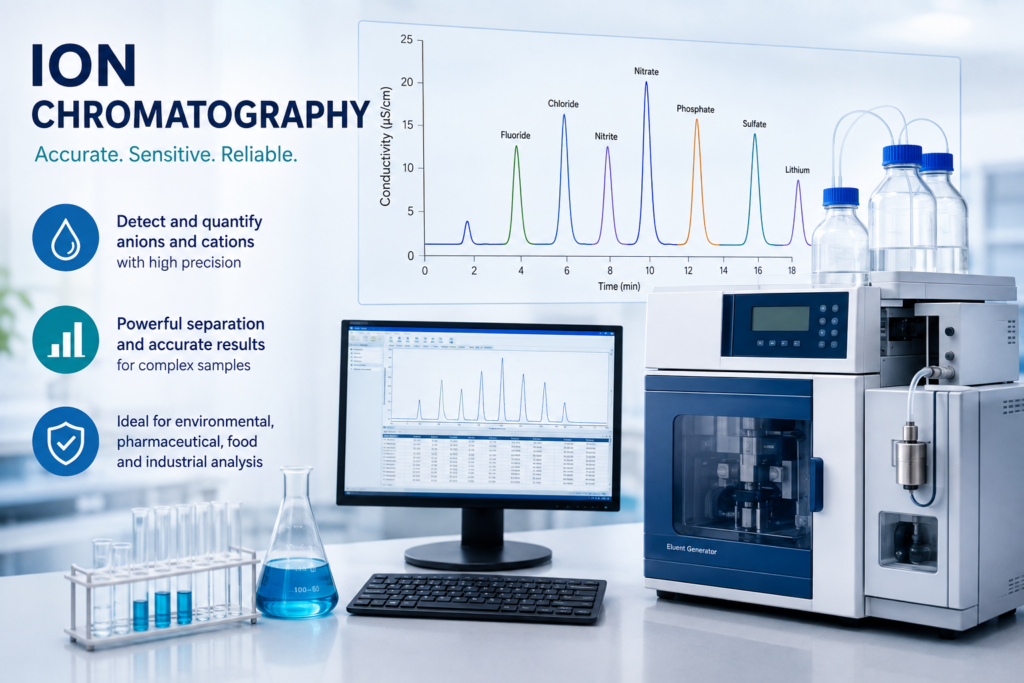
Ion chromatography (IC) is a type of liquid chromatography that separates ions, which are atoms or molecules carrying a positive or negative electrical charge, based on their interaction with a specially designed column. As the sample moves through the column, different ions travel at different speeds depending on their charge, size, and chemical properties, allowing them to be separated and measured individually.
In simple terms, chromatography is a laboratory technique used to separate the different components of a mixture. Ion chromatography specifically focuses on separating and measuring anions (negatively charged ions, such as chloride and sulfate) and cations (positively charged ions, such as sodium and calcium) dissolved in a liquid sample.
This technique is prized for its high sensitivity and ability to detect very small amounts of ions, often at parts-per-billion levels, making it valuable across many industries where precise measurement of dissolved ions matters, from drinking water safety to pharmaceutical quality control.
A Brief History of Ion Chromatography
The roots of ion chromatography trace back to broader developments in ion exchange chromatography during the mid-20th century, when scientists began using specially designed resins to separate charged particles based on their attraction to oppositely charged materials.
However, modern ion chromatography, as a distinct and widely used analytical method, emerged in 1975, when researchers Hamish Small, Timothy Stevens, and William Bauman, working at Dow Chemical Company, introduced a groundbreaking innovation: the use of a suppressor system combined with conductivity detection. This advancement solved a major technical challenge, allowing ions to be detected with much greater sensitivity and accuracy than previous methods allowed.
This breakthrough is widely credited with transforming ion chromatography from a niche laboratory technique into a mainstream analytical method. Since then, the technology has continued to evolve, with improvements in column chemistry, detector sensitivity, and automation making modern ion chromatography systems faster, more reliable, and easier to use than earlier generations of the instrument.
Classification and Types of Ion Chromatography
Ion chromatography can be classified based on the type of ions being separated and the underlying separation mechanism.
1. Classification by Ion Type
Type | What It Separates | Common Examples Measured |
Anion exchange chromatography | Negatively charged ions | Chloride, sulfate, nitrate, fluoride, phosphate |
Cation exchange chromatography | Positively charged ions | Sodium, potassium, calcium, magnesium, ammonium |
2. Classification by Separation Mechanism
- Ion exchange chromatography: The most common form, where ions in the sample compete with ions already present on a charged resin inside the column, separating based on their relative attraction to the resin.
- Ion exclusion chromatography: Used mainly to separate weak acids and other partially charged or uncharged molecules based on differences in size and polarity rather than pure ionic charge.
- Ion-pair chromatography: Uses a special reagent added to the mobile phase (the liquid that carries the sample through the column) to help separate ions that are otherwise difficult to retain on standard ion exchange columns.
Ion Chromatography vs High-Performance Liquid Chromatography (HPLC)
Feature | Ion Chromatography (IC) | HPLC |
Primary target | Charged ions (anions and cations) | Wide range of molecules, both charged and uncharged |
Common detector | Conductivity detector | UV-Vis, fluorescence, or mass spectrometry detectors |
Typical use case | Water quality, salts, small inorganic ions | Pharmaceuticals, organic compounds, larger molecules |
Column type | Ion exchange resin-based columns | Reverse-phase or normal-phase silica-based columns |
While ion chromatography is technically a specialized form of liquid chromatography, it is often discussed as its own distinct technique due to its unique columns, detectors, and applications.
Components and Parts of an Ion Chromatography System
Understanding the main parts of an ion chromatography system helps explain how accurate ion separation and detection are achieved:
- Pump: Delivers the mobile phase (also called the eluent) through the system at a consistent, controlled flow rate.
- Injector or autosampler: Introduces a precise volume of the liquid sample into the flowing mobile phase stream.
- Guard column: A small protective column placed before the main analytical column to filter out particles and contaminants that could damage or clog the system.
- Analytical (separation) column: The core component, packed with an ion exchange resin, where the actual separation of different ions occurs based on their charge and chemical properties.
- Suppressor: A device that reduces the background conductivity of the mobile phase, dramatically improving the system’s ability to detect the target ions with high sensitivity.
- Conductivity detector: Measures the electrical conductivity of the liquid as separated ions pass through, generating a signal that corresponds to each ion’s concentration.
- Data system and software: Processes the detector’s signal into a readable chromatogram, a graph showing peaks that represent each separated ion.
Principle and Working Principle of Ion Chromatography
The working principle of ion chromatography is based on the differing affinities, or attraction strengths, that various ions have toward a charged resin inside the separation column.
Here is how the process works step by step:
- A liquid sample containing dissolved ions is injected into a continuously flowing mobile phase (the eluent).
- This mixture passes through the analytical column, which is packed with a resin carrying a fixed electrical charge.
- Ions in the sample interact with the charged resin, with each type of ion binding more or less strongly depending on its own charge, size, and chemical characteristics.
- Ions that bind weakly to the resin move through the column quickly, while ions that bind more strongly move through more slowly, causing different ions to separate from one another as they travel through the column.
- As each separated ion exits the column, it passes through the suppressor, which reduces unwanted background signal from the mobile phase itself.
- The conductivity detector then measures the electrical signal produced by each ion, generating a distinct peak on the chromatogram for each type of ion present in the sample.
- The position (retention time) of each peak identifies which ion is present, while the peak’s size (area) indicates its concentration in the original sample.
This principle allows ion chromatography to both identify which ions are present in a sample and measure how much of each ion is there, often within a single, automated analytical run.
Step-by-Step Procedure for Performing Ion Chromatography
Follow these general steps to understand how a typical ion chromatography analysis is performed:
- Prepare the sample by filtering it to remove particles that could damage the column, and diluting it if necessary to bring ion concentrations within the instrument’s measurable range.
- Prepare the mobile phase (eluent) according to the specific method being used, ensuring it is properly degassed to prevent air bubbles from disrupting the flow.
- Equilibrate the system by allowing the mobile phase to flow through the column until a stable, consistent baseline signal is achieved.
- Inject the sample into the flowing mobile phase using the autosampler or manual injector.
- Allow separation to occur as the sample moves through the guard column and analytical column.
- Monitor detection as the conductivity detector records the signal produced by each separated ion, generating the chromatogram in real time.
- Analyze the chromatogram, identifying each ion based on its retention time and calculating its concentration based on peak area, typically compared against a calibration curve built from known standard solutions.
- Document and report results, including any relevant quality control checks performed during the run.
- Clean and re-equilibrate the system between sample runs to maintain consistent, reliable performance for subsequent analyses.
Applications of Ion Chromatography
Ion chromatography is used across a wide range of industries and scientific fields, including:
- Environmental and water quality testing: Measuring anions and cations in drinking water, wastewater, and natural water sources to monitor contaminants such as nitrate, fluoride, and sulfate.
- Clinical and biomedical laboratories: Analyzing electrolytes and other ionic compounds in body fluids for research and diagnostic purposes.
- Pharmaceutical quality control: Detecting and quantifying trace ionic impurities in drug formulations to ensure product safety and consistency.
- Food and beverage industry: Measuring salt, preservative, and mineral content in food products to support quality control and regulatory compliance.
- Power generation industry: Monitoring boiler water and steam systems for ion content to prevent corrosion and scaling in industrial equipment.
Semiconductor manufacturing: Testing ultrapure water used in chip manufacturing for trace ionic contamination that could affect product quality.
Advantages of Ion Chromatography
- High sensitivity: Capable of detecting extremely low concentrations of ions, often down to parts-per-billion levels.
- Simultaneous multi-ion analysis: Can identify and measure multiple different ions in a single analytical run.
- Wide applicability: Useful across environmental, clinical, pharmaceutical, food, and industrial testing settings.
- Good reproducibility: Provides consistent, reliable results when properly calibrated and maintained.
- Minimal sample preparation: Compared to some other analytical techniques, sample preparation for ion chromatography is often relatively straightforward.
Disadvantages of Ion Chromatography
- Column and suppressor cost: Specialized columns and suppressor systems can be expensive to purchase and replace over time.
- Sensitivity to sample matrix interference: Complex samples containing many different ions or particulates may require additional sample preparation or dilution.
- Limited to ionic compounds: Ion chromatography is not suitable for analyzing non-ionic (uncharged) organic molecules, which require other techniques such as standard HPLC.
- Column degradation over time: Repeated use, especially with complex or dirty samples, can gradually reduce column performance, requiring periodic replacement.
Requires skilled operation: Proper method development and troubleshooting require trained analytical chemistry staff.
Clinical Significance of Ion Chromatography
While ion chromatography is more commonly associated with environmental and industrial testing, it also holds meaningful value in clinical and biomedical research settings. Measuring electrolytes, which are essential minerals carrying an electrical charge, such as sodium, potassium, and chloride, is critical for understanding fluid balance, kidney function, and overall metabolic health.
In research laboratories, ion chromatography is sometimes used to study ionic composition in biological fluids, contributing to a deeper understanding of conditions involving electrolyte imbalances. It is also used indirectly to support clinical safety by ensuring that pharmaceutical products, intravenous fluids, and dialysis solutions meet strict ionic purity and concentration standards before they reach patients.
Interpretation of Results
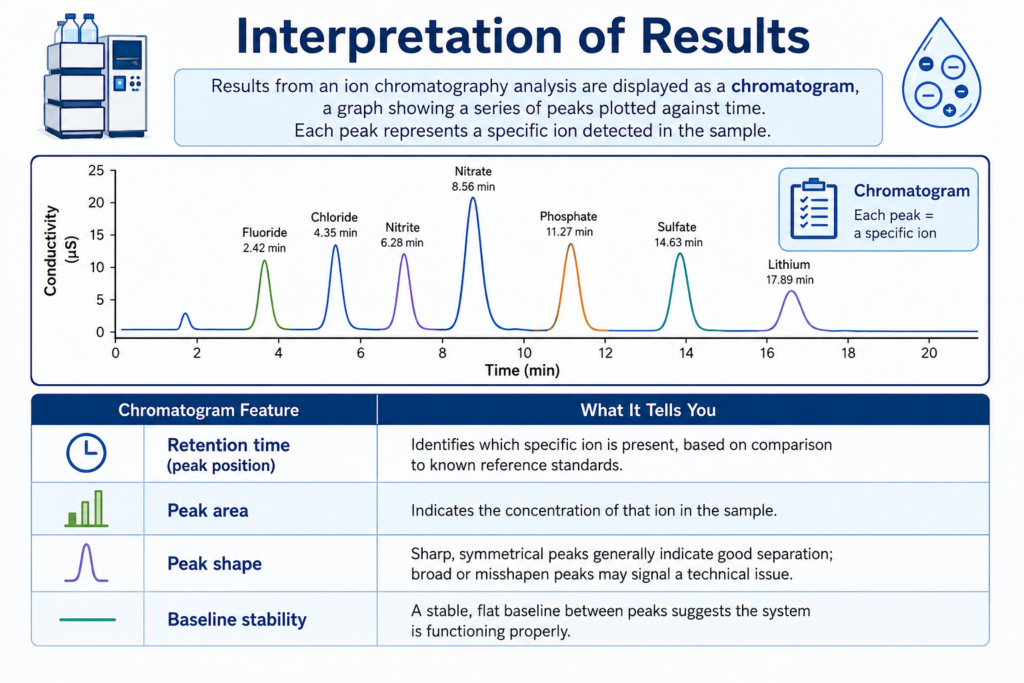
Results from an ion chromatography analysis are displayed as a chromatogram, a graph showing a series of peaks plotted against time. Each peak represents a specific ion detected in the sample.
Chromatogram Feature | What It Tells You |
Retention time (peak position) | Identifies which specific ion is present, based on comparison to known reference standards |
Peak area | Indicates the concentration of that ion in the sample |
Peak shape | Sharp, symmetrical peaks generally indicate good separation; broad or misshapen peaks may signal a technical issue |
Baseline stability | A stable, flat baseline between peaks suggests the system is functioning properly |
To determine the actual concentration of an ion, analysts compare the sample’s peak area to a calibration curve, which is built by running several standard solutions with known ion concentrations beforehand. This comparison allows the software to calculate an accurate concentration value for each ion detected in the unknown sample.
Frequently Observed Errors in Ion Chromatography
- Poor sample filtration, allowing particulates to clog or damage the column over time.
- Air bubbles in the mobile phase, causing unstable baseline readings or irregular peak shapes.
- Column contamination, where residual ions from previous samples interfere with new measurements, sometimes called carryover.
- Incorrect calibration standards, leading to inaccurate concentration calculations.
- Overlapping peaks, occurring when two different ions have very similar retention times, making them difficult to distinguish and quantify accurately.
- Suppressor malfunction, resulting in elevated background noise and reduced sensitivity.
- Temperature fluctuations, which can subtly shift retention times and affect result consistency between runs.
Troubleshooting Common Problems
Problem | Possible Cause | Solution |
Rising or unstable baseline | Suppressor issue or contaminated mobile phase | Inspect suppressor function; prepare fresh mobile phase |
Peaks appear broader than usual | Column degradation or flow rate irregularities | Check column condition; verify pump flow rate |
Retention times shifting between runs | Temperature instability or column aging | Ensure consistent column temperature; consider column replacement |
Unexpectedly low peak signal | Suppressor malfunction or detector issue | Inspect and, if needed, replace the suppressor; check detector calibration |
Overlapping or unresolved peaks | Poor column selectivity for similar ions | Adjust mobile phase composition or switch to a more selective column |
Care and Maintenance of Ion Chromatography Systems
Proper maintenance keeps an ion chromatography system accurate and extends the life of its components:
- Use properly filtered and degassed mobile phase to prevent particulate buildup and air bubble interference.
- Regularly inspect and replace the guard column to protect the more expensive analytical column from contamination.
- Follow manufacturer-recommended column storage procedures when the system is not in regular use, as improper storage can degrade column performance.
- Monitor suppressor performance and replace or regenerate it according to the manufacturer’s guidelines.
- Keep the system running with clean, high-purity water and reagents, since impurities can gradually damage sensitive components.
- Schedule routine preventive maintenance, including pump seal checks and system pressure monitoring, to catch potential issues early.
Quality Assurance: IQC and EQA for Ion Chromatography
Because ion chromatography results often support important safety and regulatory decisions, strong quality assurance practices are essential.
Internal Quality Control (IQC) typically includes:
- Running calibration standards at the start of each analytical batch to confirm the system is measuring accurately.
- Including quality control samples with known ion concentrations throughout the run to monitor consistency and detect any drift in performance.
- Performing regular blank sample runs to check for background contamination or carryover between samples.
- Documenting and tracking calibration curve performance over time to identify any gradual changes in system sensitivity.
External Quality Assessment (EQA) typically includes:
- Participating in inter-laboratory proficiency testing programs, where laboratories analyze standardized samples and compare their results against other participating laboratories.
- Undergoing periodic third-party instrument calibration verification to confirm the system meets recognized accuracy standards.
Laboratories following standards set by organizations such as the U.S. Environmental Protection Agency (EPA) for water testing, or accreditation bodies referencing CLSI (Clinical and Laboratory Standards Institute) guidelines for clinical applications, typically incorporate these IQC and EQA practices into their routine quality management systems.
Safety Precautions When Using Ion Chromatography Systems
- Wear appropriate personal protective equipment (PPE), including gloves and eye protection, when handling samples, standards, and mobile phase reagents.
- Handle chemical reagents according to their safety data sheets (SDS), since some eluents and standards may be corrosive or irritating.
- Ensure proper ventilation in the laboratory area, particularly when preparing or disposing of chemical solutions.
- Dispose of used mobile phase and waste solutions according to your institution’s chemical waste disposal protocols.
- Avoid pressurizing the system beyond manufacturer-specified limits, as high system pressure can cause leaks or equipment damage.
- Report any leaks, unusual odors, or equipment malfunctions immediately to prevent chemical exposure or equipment damage.
Key Points
- Ion chromatography is an analytical technique used to separate and measure charged ions, both anions and cations, in liquid samples.
- The modern technique became widely practical in 1975, following the development of the suppressor system paired with conductivity detection.
- The method separates ions based on their differing attraction to a charged resin inside a specialized analytical column.
- Common applications include water quality testing, pharmaceutical quality control, food safety testing, and clinical research.
- Results are interpreted using a chromatogram, where peak position identifies the ion and peak area indicates its concentration.
- Regular calibration, proper column maintenance, and consistent quality control practices are essential for accurate, reliable results.
Conclusion
Ion chromatography plays a quiet but essential role in ensuring the safety and quality of the water we drink, the medications we take, and the food we eat. By separating and precisely measuring charged ions in liquid samples, this analytical technique supports critical decisions across environmental protection, pharmaceutical manufacturing, and clinical research.
Understanding how ion chromatography works, from its historical development in 1975 to its modern applications today, helps students, laboratory professionals, and scientists appreciate the careful science behind everyday safety standards. As analytical technology continues to advance, ion chromatography remains a trusted, reliable method for answering one of chemistry’s most practical questions: exactly which ions are present in a sample, and how much of each one is really there.
Frequently Asked Questions (FAQs)
What is ion chromatography used for?
Ion chromatography is used to separate and measure charged ions, such as chloride, sulfate, sodium, and potassium, in liquid samples, commonly for water quality testing, pharmaceutical analysis, and food safety testing.
How does ion chromatography differ from regular HPLC?
Ion chromatography specifically separates charged ions using ion exchange columns and conductivity detection, while HPLC is a broader technique that can separate a wide range of both charged and uncharged molecules using various detector types.
What is the role of the suppressor in ion chromatography?
The suppressor reduces background conductivity from the mobile phase, which significantly improves the system’s sensitivity in detecting the target ions.
Can ion chromatography detect both positive and negative ions?
Yes, but typically through separate analyses, since anion exchange chromatography and cation exchange chromatography use different columns and conditions optimized for each ion type.
What does a chromatogram peak represent in ion chromatography?
Each peak represents a specific ion detected in the sample, with the peak’s position (retention time) identifying the ion and the peak’s area indicating its concentration.
Why is calibration important in ion chromatography?
Calibration, using standard solutions with known ion concentrations, allows the system to accurately calculate the concentration of ions detected in unknown samples.
What industries commonly rely on ion chromatography?
Ion chromatography is widely used in environmental testing, pharmaceutical manufacturing, food and beverage quality control, clinical research, and power generation industries.
What causes overlapping peaks in ion chromatography results?
Overlapping peaks occur when two different ions have very similar retention times, often requiring adjustments to the mobile phase or column selection to improve separation.
How often should an ion chromatography column be replaced?
Column lifespan varies based on usage and sample complexity, but regular monitoring of peak shape, resolution, and system pressure helps determine when replacement is needed.