
Introduction
Analytical balance calibration is a critical process that every laboratory professional must understand to ensure accurate and reliable weighing results. Even the most advanced analytical balance can drift out of accuracy over time due to environmental changes, mechanical wear, or simple daily use. Without regular calibration, these tiny errors can quietly creep into laboratory results, affecting everything from pharmaceutical formulations to clinical reagent preparation.
Think of calibration like checking a car’s alignment. Even a slight misalignment might not be obvious at first, but over time, it can cause the car to drift off course. In the same way, an analytical balance may appear to be working fine, but without calibration, its readings can slowly become inaccurate without anyone noticing.
Definition of Analytical Balance Calibration
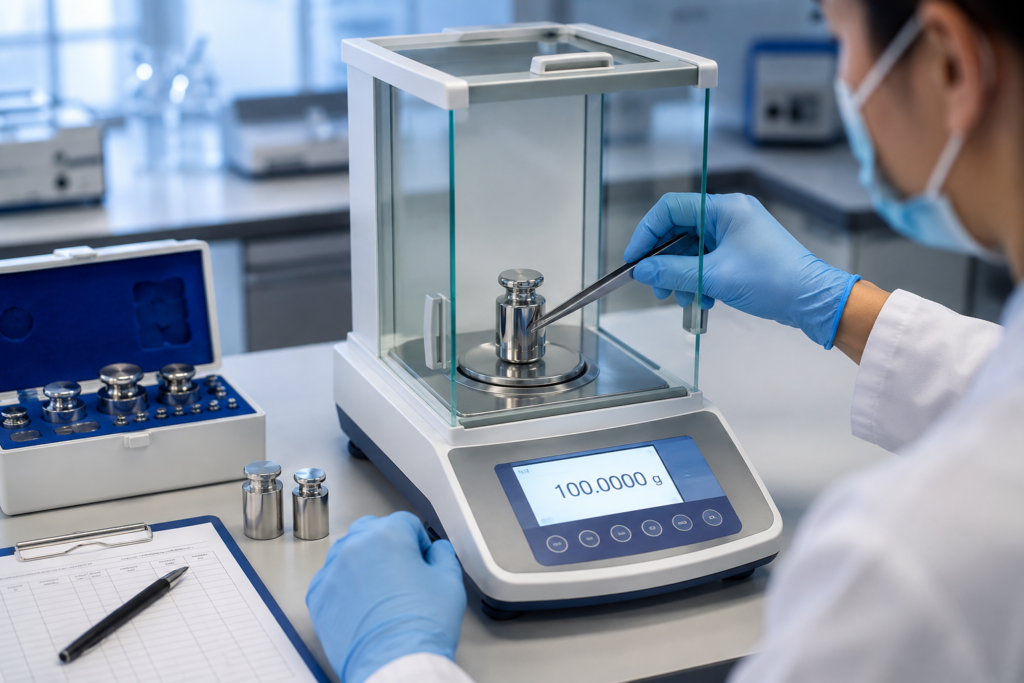
Analytical balance calibration is the process of comparing the readings of an analytical balance against known, certified reference weights to verify and adjust its accuracy. This process ensures that the balance provides measurements that are consistent with recognized international standards of mass.
In simple terms, calibration answers one key question: “Is this balance telling us the truth about weight?” If a calibrated 100 g reference weight produces a reading of 100.0021 g instead of the true value of 100.0000 g, the calibration process identifies the deviation and adjusts the instrument to restore measurement accuracy. the balance remains accurate and trustworthy for laboratory work.
Calibration should not be confused with simple daily “zeroing” or taring. While taring resets the display to zero, calibration is a more thorough process that checks and adjusts the balance’s accuracy across its full weighing range using certified reference standards.
History of Balance Calibration Practices
The concept of calibration has existed for centuries, evolving alongside the development of measurement science, known as metrology.
- Ancient civilizations: Early traders used standardized stone or metal weights to ensure fair and consistent trade, representing some of the earliest forms of calibration.
- 18th–19th centuries: As analytical chemistry developed, scientists like Antoine Lavoisier relied on precise reference weights to validate the accuracy of their balances, recognizing that measurement errors could compromise scientific conclusions.
- Early 20th century: National metrology institutes were established in various countries to maintain official standards of mass, providing a foundation for consistent calibration practices worldwide.
- In the 1960s and 1970s, the implementation of the International System of Units (SI) created a common global standard for measurements, including the kilogram. This development improved the consistency and reliability of calibration procedures across different countries.
- 1980s onward: With the rise of electronic analytical balances, manufacturers introduced internal calibration systems using built-in reference weights, making regular calibration more convenient and accessible.
- Present day: Modern laboratories follow strict calibration schedules guided by international standards such as ISO/IEC 17025 and recommendations from organizations like CLSI, ensuring traceability and consistency across laboratories worldwide.
This historical development highlights how calibration has always been central to trustworthy scientific measurement, long before modern electronic balances existed.
Classification of Calibration Methods
Analytical balance calibration methods are generally classified into two main categories:
Calibration Type | Description | Performed By |
Internal calibration | Uses a built-in reference weight within the balance to automatically adjust accuracy | Balance itself (automatic) |
External calibration | Uses certified external reference weights placed manually on the balance | Trained laboratory personnel or calibration technician |
Both methods play an important role, but external calibration using certified reference weights is generally considered more rigorous and is often required for formal quality assurance and regulatory compliance.
Types of Calibration Checks
Beyond the internal versus external classification, laboratories typically perform several types of calibration-related checks:
- Routine Calibration Verification
A quick daily or weekly check using one or two reference weights to confirm the balance remains within acceptable tolerance.
- Full Calibration
A comprehensive calibration process covering multiple points across the balance’s weighing range, often performed by a certified calibration technician on a scheduled basis, such as quarterly or annually.
- Eccentricity Testing
This check ensures the balance provides consistent readings regardless of where the sample is placed on the weighing pan, since off-center placement can sometimes cause measurement errors.
- Linearity Testing
This test verifies that the balance provides accurate readings consistently across its entire measurement range, not just at one specific weight point.
Components Involved in the Calibration Process
Several key components and tools are involved in performing analytical balance calibration correctly:
Component/Tool | Function |
Certified reference weights | Precisely manufactured weights with known mass, traceable to national or international standards |
Calibration certificate | Official document verifying the accuracy and traceability of reference weights |
Anti-static gloves or forceps | Used to handle reference weights without transferring oils or static charge from hands |
Draft shield | Protects the balance from air currents during calibration |
Calibration logbook | Records calibration dates, results, and technician details for quality assurance and audit purposes |
Leveling indicator | Confirms the balance is properly leveled before calibration begins |
Using certified reference weights is essential, as these weights are manufactured and verified to strict tolerance standards, ensuring the calibration process itself is accurate and trustworthy.
Principle of Analytical Balance Calibration
The principle behind analytical balance calibration is based on comparing a known, certified mass against the balance’s displayed reading to detect and correct any measurement discrepancy.
Here is the basic principle explained simply:
- A certified reference weight with a precisely known mass is placed on the balance.
- The balance’s displayed reading is compared to the certified weight’s actual value.
- If a difference exists between the two values, the balance is adjusted, either automatically through internal calibration mechanisms or manually through calibration software, to correct the discrepancy.
- This process is repeated at multiple weight points across the balance’s range to ensure accuracy throughout its full capacity.
This principle ensures that the balance’s readings remain traceable to internationally recognized standards of mass, which is essential for maintaining trust in laboratory measurements.
Working Principle and Mechanism
Let’s explore the mechanism of analytical balance calibration in more detail:
- Preparation: The balance is placed on a stable, vibration-free surface and allowed to warm up according to the manufacturer’s recommendations.
- Leveling Check: The technician confirms the balance is properly leveled using the built-in spirit level indicator.
- Zeroing: The empty balance is zeroed to establish a baseline reading before calibration weights are introduced.
- Reference Weight Placement: A certified reference weight is carefully placed at the center of the weighing pan using anti-static gloves or forceps to avoid contamination.
- Comparison: The balance’s displayed reading is compared against the certified value of the reference weight.
- Adjustment: If a discrepancy exists beyond the acceptable tolerance, the balance’s internal software or mechanical adjustment mechanism corrects the reading to match the certified reference value.
- Repetition: This process is often repeated using multiple reference weights of different values to verify accuracy across the balance’s full measurement range.
- Documentation: All calibration results, including any adjustments made, are recorded in a calibration logbook or electronic quality management system.
Modern electronic analytical balances often feature automatic internal calibration routines that perform many of these steps electronically, though periodic external calibration using certified weights remains essential for full accuracy verification.
Procedure for Performing Analytical Balance Calibration
Pre-Calibration Steps
- Ensure the balance is placed in a stable environment, away from vibrations, drafts, and direct sunlight.
- Allow the balance to warm up for the manufacturer-recommended time period.
- Confirm the balance is clean and free from dust or residue on the weighing pan.
- Verify that certified reference weights are within their valid calibration period, as indicated on their calibration certificates.
Calibration Steps
- Level the balance using the adjustable feet and built-in spirit level.
- Zero the empty balance before introducing any reference weights.
- Place the appropriate certified reference weight at the center of the weighing pan using anti-static gloves or forceps.
- Record the displayed reading and compare it to the certified weight value.
- If necessary, initiate the balance’s calibration adjustment function, following the manufacturer’s specific instructions.
- Repeat the process with additional reference weights to verify accuracy across different points of the weighing range.
Post-Calibration Steps
- Document all results, including reference weight values, displayed readings, and any adjustments made, in the calibration logbook.
- Attach or reference the calibration certificate for the reference weights used.
- Affix a calibration due date label on the balance, if required by laboratory protocol.
- Report any significant deviations or persistent inaccuracies to laboratory management or a professional calibration service provider.
Applications of Analytical Balance Calibration
Analytical balance calibration is essential across numerous scientific and industrial settings, including:
- Pharmaceutical manufacturing: Ensuring accurate measurement of active pharmaceutical ingredients during drug formulation
- Clinical and diagnostic laboratories: Verifying accuracy when preparing reagents, calibrators, and quality control materials
- Academic and research laboratories: Supporting reliable experimental results and teaching proper measurement practices
- Food and beverage quality control: Ensuring precise measurement of ingredients during product formulation, manufacturing, and compliance testing to maintain product quality and meet regulatory standards.
- Environmental testing: Maintaining measurement accuracy for pollutant and contaminant analysis
- Forensic science laboratories: Supporting legally defensible, accurate measurements of trace evidence
- Regulatory compliance: Meeting requirements set by regulatory bodies and accreditation standards such as ISO/IEC 17025
Advantages of Regular Analytical Balance Calibration
- Ensures consistent accuracy and reliability of laboratory measurements over time
- Builds confidence in experimental results, product quality, and diagnostic testing
- Supports compliance with regulatory and accreditation requirements
- Helps detect early signs of balance malfunction or component wear
- Provides documented evidence of measurement traceability for audits and inspections
- Reduces the risk of costly errors in pharmaceutical formulation or clinical testing
Disadvantages and Limitations
- Requires certified reference weights, which can be costly to purchase and maintain
- Calibration weights themselves require periodic recertification, adding to ongoing costs
- Full calibration procedures can be time-consuming, particularly for high-precision balances
- Requires trained personnel to perform calibration correctly and interpret results
- Environmental factors, such as humidity and temperature fluctuations, can still affect readings even after calibration if conditions are not properly controlled
Clinical and Laboratory Significance
Although calibration of an analytical balance is not a diagnostic test, it plays a vital role in ensuring the accuracy and reliability of laboratory results used in medical diagnostics. Many clinical laboratory processes depend on accurately weighed reagents, calibrators, and quality control materials.
For example, if an analytical balance used to prepare calibration standards for a clinical chemistry analyzer is inaccurate, it could lead to systematic errors across an entire batch of patient test results. This demonstrates why calibration is not simply a routine formality, but a foundational step supporting accurate diagnostic testing and patient safety.
In pharmaceutical settings, accurate calibration ensures that medications are formulated with the correct dosage of active ingredients, directly affecting treatment safety and effectiveness for patients.
Interpretation of Calibration Results
When reviewing analytical balance calibration results, consider the following factors:
- Tolerance limits: Compare the difference between the displayed reading and the certified reference weight value against the manufacturer’s specified tolerance limits.
- Trend analysis: Reviewing calibration records over time can reveal gradual drift, which may indicate the need for professional servicing.
- Consistency across weight points: Accurate calibration should show consistent performance across different weight values, not just at one specific point.
- Environmental conditions during calibration: Note temperature, humidity, and any unusual conditions present during calibration, as these can influence results.
If calibration results consistently fall outside acceptable tolerance limits, the balance should be taken out of service until it can be repaired or professionally serviced.
Frequently Observed Errors
Several common errors can occur during analytical balance calibration:
- Handling reference weights with bare hands: This can transfer oils and moisture, subtly affecting the weight’s true mass over time
- Performing calibration in unstable environments: Vibrations, air currents, or temperature fluctuations can affect calibration accuracy
- Using expired or uncertified reference weights: This compromises the traceability and reliability of the calibration process
- Skipping warm-up time: Calibrating a balance before it has reached thermal stability can produce inaccurate results
- Incomplete documentation: Failing to properly record calibration results can create issues during quality audits or inspections
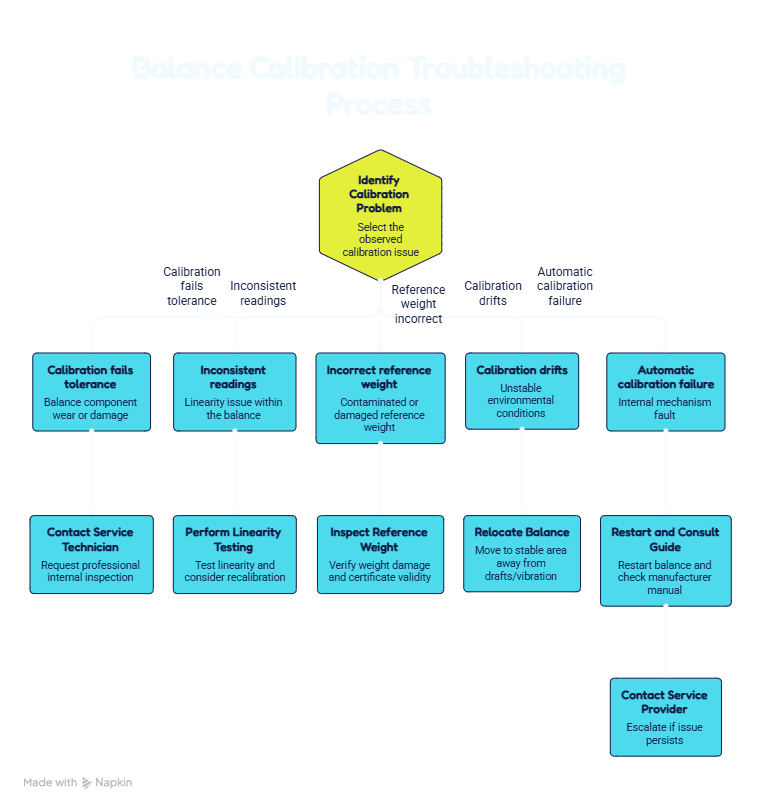
Troubleshooting Common Calibration Issues
Care and Maintenance
Ongoing care supports both the accuracy of the balance and the reliability of its calibration over time:
- Clean the weighing pan and draft shield regularly to prevent residue buildup affecting measurements.
- Store certified reference weights in their protective cases, away from dust, moisture, and direct handling.
- Schedule regular preventive maintenance with qualified service technicians.
- Avoid moving the balance frequently, as relocation can affect its calibration stability.
- Maintain a consistent laboratory environment with stable temperature and humidity levels.
- Keep detailed calibration and maintenance logs for accountability and regulatory compliance.
Quality Assurance: IQC and EQA
Internal Quality Control (IQC)
Internal quality control for analytical balance calibration typically involves routine verification checks using certified reference weights, often performed daily or weekly. These checks confirm the balance remains within acceptable tolerance before it is used for critical laboratory work.
External Quality Assessment (EQA)
External quality assessment in the context of balance calibration often involves engaging accredited external calibration service providers to perform comprehensive calibration and certification at scheduled intervals, such as annually. These external providers issue official calibration certificates, which serve as documented evidence of the balance’s accuracy and traceability to recognized measurement standards.
Laboratories seeking accreditation under standards such as ISO/IEC 17025 must maintain thorough calibration records, demonstrating consistent adherence to both internal and external quality assurance practices.
Safety Precautions
- Always handle certified reference weights using gloves or forceps to avoid contamination and maintain their certified accuracy.
- Store reference weights properly in their designated cases when not in use.
- Avoid placing the balance or reference weights near heat sources, direct sunlight, or areas with high humidity.
- Follow manufacturer guidelines when performing internal calibration adjustments to avoid damaging the balance.
- Ensure proper training before performing calibration procedures, especially for full or external calibration processes.
- Report any damaged or suspect reference weights immediately, and remove them from use until verified or replaced.
Key Takeaways
- Analytical balance calibration ensures that a laboratory balance provides accurate, trustworthy measurements over time.
- Calibration involves comparing the balance’s readings against certified reference weights and adjusting as needed.
- Both internal and external calibration methods play important roles in maintaining measurement accuracy.
- Regular calibration, proper documentation, and quality assurance practices are essential for laboratory accreditation and reliable results.
- Neglecting calibration can lead to significant errors in pharmaceutical formulation, clinical testing, and research outcomes.
Conclusion
Analytical balance calibration plays a foundational role in ensuring accurate and trustworthy measurements across laboratories worldwide. From ancient standardized trade weights to today’s advanced electronic balances with automatic internal calibration systems, the underlying goal has remained the same: ensuring that what a balance displays truly reflects reality.
Understanding the principles, procedures, and quality assurance practices behind analytical balance calibration empowers laboratory professionals, researchers, and students to maintain the integrity of their scientific work. Regular calibration, proper documentation, and adherence to recognized standards are not just regulatory checkboxes; they are essential practices that protect the accuracy of pharmaceutical formulations, clinical test results, and scientific research outcomes.
As laboratories continue to rely on increasingly precise instruments, the importance of consistent, well-documented calibration will only continue to grow. By prioritizing proper calibration practices, laboratories can maintain confidence in their measurements and uphold the highest standards of scientific accuracy and patient safety.
Frequently Asked Questions (FAQs)
What is analytical balance calibration?
Analytical balance calibration is the process of comparing a balance’s readings against certified reference weights to verify and adjust its accuracy, ensuring reliable measurement results.
How often should an analytical balance be calibrated?
Calibration frequency varies by laboratory protocol, but routine verification is often performed daily or weekly, while full external calibration is typically scheduled quarterly or annually.
What is the difference between internal and external calibration?
Internal calibration uses a built-in reference weight within the balance for automatic adjustment, while external calibration uses certified external reference weights, usually performed by trained personnel or a calibration technician.
Why is it important to use certified reference weights during calibration?
Certified reference weights have a known, traceable mass verified against national or international standards, ensuring the calibration process itself is accurate and trustworthy.
Can an analytical balance be used if calibration fails?
No, if calibration results fall outside acceptable tolerance limits, the balance should not be used for critical measurements until it is repaired or properly serviced.
What documents should be kept for analytical balance calibration?
Laboratories should maintain calibration logbooks, reference weight certificates, and any official calibration certificates issued by external service providers for audit and regulatory purposes.
Disclaimer
The information and materials provided on MeroLab are intended solely for educational, informational, professional learning, and public health awareness purposes. The website may contain content related to medical laboratory science, laboratory techniques, diagnostic tests, medical devices and instruments, reagents, diseases and health conditions, laboratory procedures, quality management, research, exam preparation, MCQs, and other healthcare-related topics.