
Introduction
Getting a hepatitis B surface antigen non reactive result on a blood test report often brings a wave of relief, and in most cases, that relief is justified. This result is one of the most common findings in routine health checkups, blood donation screening, prenatal testing, and pre-employment medical exams around the world.
But what does “non reactive” actually mean in medical terms? Is it the same as being completely free of hepatitis B? Does it guarantee lifelong protection? These are important questions, and the answers require a closer look at how the hepatitis B surface antigen (HBsAg) test works.
Hepatitis B is a liver infection caused by the hepatitis B virus (HBV), which can affect the normal functioning of the liver.. It can spread through blood, unprotected sexual contact, and from an infected mother to her baby during childbirth. The hepatitis B surface antigen is a protein found on the outer coat of the virus, and its presence in the blood is one of the earliest and most reliable signs of active infection.
Definition of Hepatitis B Surface Antigen Non Reactive
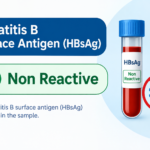
The term hepatitis B surface antigen non reactive means that the laboratory test did not detect the hepatitis B surface antigen (HBsAg) in the blood sample tested. In simple words, it usually means the person is not currently infected with an active, detectable level of hepatitis B virus.
To break this down further:
- Hepatitis B surface antigen (HBsAg):A protein found on the surface of the hepatitis B virus. Its presence in the blood indicates that the virus is actively present in the body.
- Non reactive:A laboratory term meaning the test did not produce a positive signal for the antigen being measured. It is used interchangeably with “negative” in many laboratory reports.
So, a hepatitis B surface antigen non reactive result generally suggests the absence of detectable hepatitis B infection at the time of testing. However, as we will explain later, this result should always be interpreted alongside other clinical information, since no single blood test is 100% infallible in every situation.
History of Hepatitis B Testing
Hepatitis B has affected humans for centuries, but scientific understanding of the virus is relatively recent. In 1965, physician and researcher Baruch Blumberg discovered a protein in the blood of an Australian Aboriginal person that was later linked to hepatitis B infection. This protein was initially called the “Australia antigen” before being identified as the hepatitis B surface antigen.
This discovery, which earned Blumberg the Nobel Prize in Physiology or Medicine in 1976, opened the door to reliable blood screening for hepatitis B. Before this discovery, hepatitis B could only be diagnosed through clinical symptoms and liver function abnormalities, without a specific, testable marker.
Since then, HBsAg testing has become a cornerstone of:
- Blood donor screening programs, drastically reducing transfusion-transmitted hepatitis B.
- Routine antenatal (pregnancy) screening, helping prevent mother-to-child transmission.
- Hepatitis B vaccination programs, which have significantly reduced global infection rates since the vaccine became available in the early 1980s.
Modern testing methods, including automated Enzyme-Linked Immunosorbent Assay (ELISA) and Chemiluminescent Immunoassay (CLIA) techniques, have made HBsAg testing faster, more sensitive, and more widely available than ever before.
Classification of Hepatitis B Serological Markers
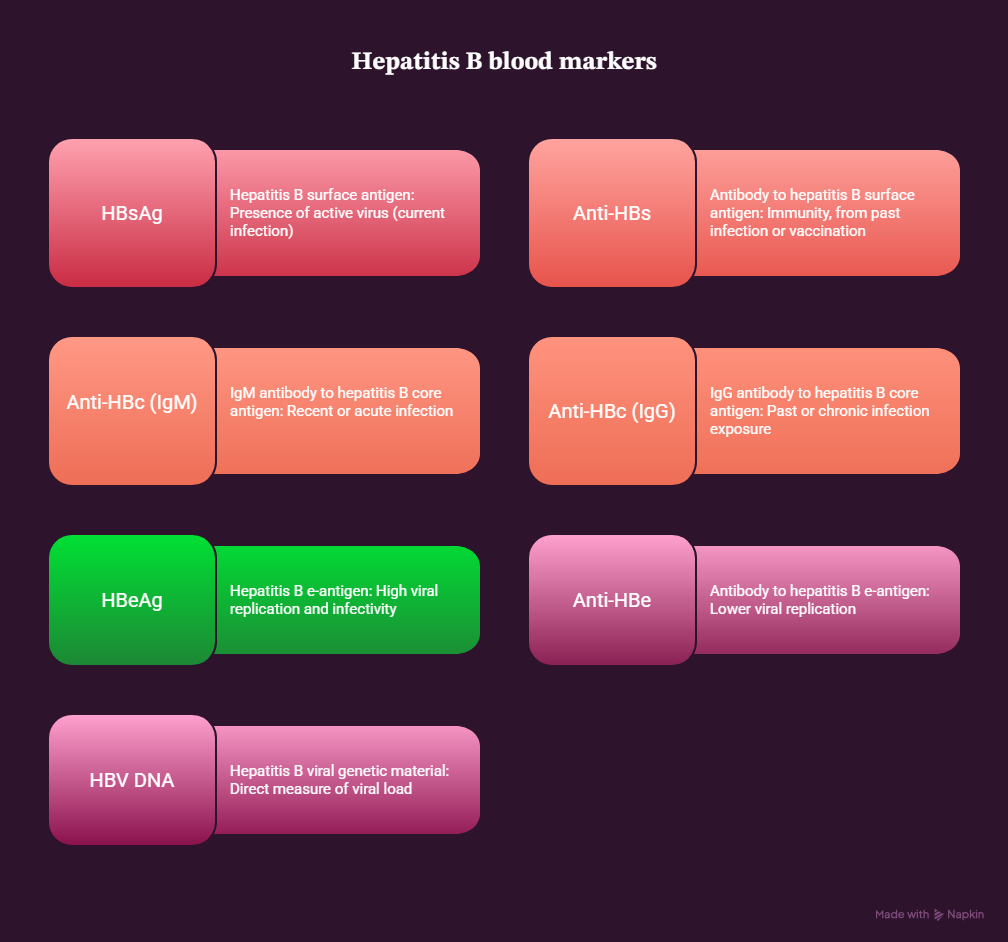
To fully understand a hepatitis B surface antigen non reactive result, it helps to see it in context with other hepatitis B blood markers.
Marker | Full Name | What It Indicates |
HBsAg | Hepatitis B surface antigen | Presence of active virus (current infection) |
Anti-HBs | Antibody to hepatitis B surface antigen | Immunity, from past infection or vaccination |
Anti-HBc (IgM) | IgM antibody to hepatitis B core antigen | Recent or acute infection |
Anti-HBc (IgG) | IgG antibody to hepatitis B core antigen | Past or chronic infection exposure |
HBeAg | Hepatitis B e-antigen | High viral replication and infectivity |
Anti-HBe | Antibody to hepatitis B e-antigen | Lower viral replication |
HBV DNA | Hepatitis B viral genetic material | Direct measure of viral load |
A hepatitis B surface antigen non reactive result only tells part of the story. It must often be considered alongside anti-HBs and anti-HBc results for a complete picture of a person’s hepatitis B status.
Types of Hepatitis B Surface Antigen Test Results
- Reactive (Positive) HBsAg
Indicates the presence of detectable hepatitis B surface antigen, suggesting active infection, either acute or chronic.
- Non Reactive (Negative) HBsAg
Indicates no detectable hepatitis B surface antigen in the blood sample at the time of testing. This is the most common and generally reassuring result.
- Indeterminate or Borderline HBsAg
Occurs when the test signal falls in a gray zone between clearly positive and clearly negative. This usually requires repeat testing or a confirmatory test.
- False Reactive or False Non Reactive
Rare situations where the test result does not match the person’s true infection status due to technical, biological, or timing-related factors, discussed further in later sections.
Components Involved in HBsAg Testing
- Blood sample (serum or plasma):Collected through routine venipuncture, this is the specimen tested for the presence of HBsAg.
- Test kit/reagents:Typically ELISA or CLIA kits containing antibodies specifically designed to bind to the hepatitis B surface antigen if present.
- Control samples:Positive and negative controls run alongside patient samples to confirm the test is working correctly.
- Detection system:An instrument, such as a microplate reader or automated immunoassay analyzer, that measures the signal (color change or light emission) produced when HBsAg binds to the test reagents.
- Confirmatory reagents:Neutralization reagents used in confirmatory testing to verify a reactive result is truly due to HBsAg and not a false signal.
Principle Behind the HBsAg Test
The hepatitis B surface antigen test works on the principle of antigen-antibody interaction. In simple terms, the test uses laboratory-made antibodies that are specifically designed to recognize and bind only to the hepatitis B surface antigen, much like a lock recognizing only its matching key.
If the antigen is present in the patient’s blood sample, it binds to these antibodies, triggering a detectable signal, usually a color change (in ELISA) or a light signal (in CLIA). If the antigen is absent, as in a hepatitis B surface antigen non reactive result, no such binding occurs, and no significant signal is produced.
Working Principle and Mechanism
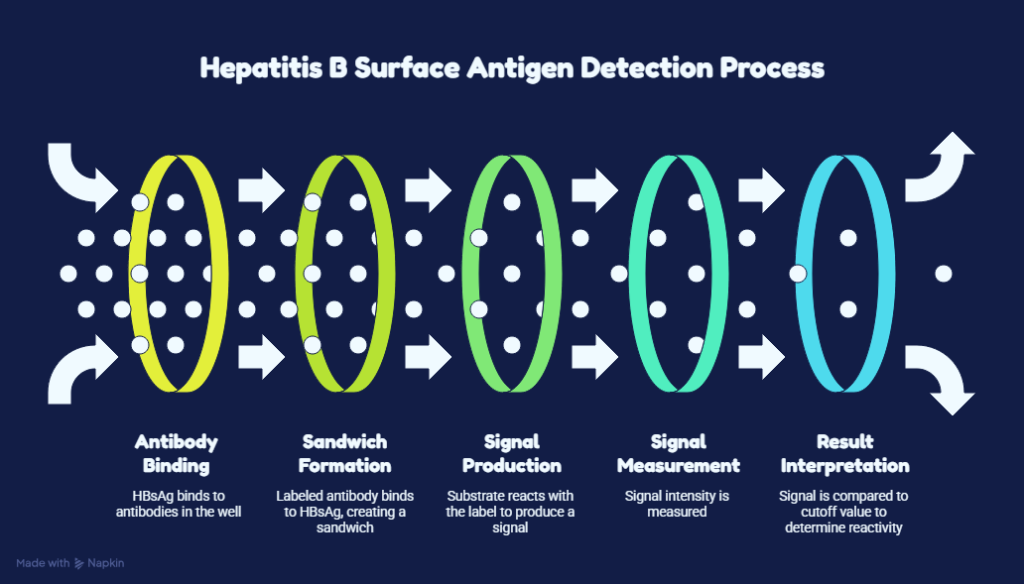
Step-by-Step Mechanism
- The patient’s blood sample is added to a test well or cartridge coated with antibodies specific to HBsAg.
- If HBsAg is present in the sample, it binds to these antibodies.
- A second, labeled antibody (linked to an enzyme or a light-producing chemical) is added, which binds to any captured HBsAg, forming a “sandwich” structure.
- A substrate solution is added, which reacts with the enzyme label to produce a measurable color change, or in CLIA, a light signal.
- The intensity of the resulting signal is measured and compared to a cutoff value determined by the positive and negative controls.
- If the signal is below the cutoff, the result is reported as non reactive (negative); if above, it is reported as reactive (positive).
This mechanism explains why a hepatitis B surface antigen non reactive result reflects the absence of a strong enough antigen-antibody signal, rather than a direct visual confirmation of “no virus at all.”
Procedure for HBsAg Testing
- Collect a venous blood sample from the patient using standard aseptic technique.
- Allow the sample to clot (if using serum) or process immediately (if using plasma), then centrifuge to separate serum or plasma from blood cells.
- Label the sample accurately with patient identification details.
- Load the sample, along with positive and negative controls, into the testing platform (ELISA plate or automated analyzer).
- Incubate the sample as per assay protocol to allow antigen-antibody binding.
- Wash the plate or cartridge to remove any unbound material.
- Add the enzyme-labeled detection antibody and substrate solution.
- Measure the resulting signal using a microplate reader or automated analyzer.
- Compare results against the cutoff value; report as reactive or non reactive accordingly.
- If reactive, proceed to confirmatory (neutralization) testing before final reporting, as per laboratory protocol.
Applications of HBsAg Testing
- Routine Health Screening:Common in annual health checkups and pre-employment medical examinations.
- Blood Donation Screening:Mandatory testing to prevent transfusion-transmitted hepatitis B infection.
- Antenatal Screening:Recommended for all pregnant women to prevent mother-to-child transmission of hepatitis B.
- Pre-Surgical Screening:Often required before surgeries to guide infection control precautions.
- Monitoring Known Hepatitis B Patients:Used to track the progress of chronic hepatitis B infection or response to antiviral treatment.
- Organ and Tissue Donation Screening:Essential to prevent transmission through transplantation.
- Vaccination Status Assessment:Sometimes performed alongside anti-HBs testing to evaluate immune status after vaccination.
Advantages of HBsAg Testing
- Provides a quick, reliable, and widely available way to screen for active hepatitis B infection.
- Enables early detection, allowing timely medical management and reducing the risk of liver complications.
- Supports safe blood donation and organ transplantation practices.
- Helps identify pregnant women at risk of transmitting hepatitis B to their newborns, allowing preventive treatment.
- Cost-effective for large-scale public health screening programs.
Disadvantages and Limitations
- Cannot detect infection during the “window period,” a stage very early in infection before HBsAg levels become detectable.
- A hepatitis B surface antigen non reactive result does not rule out past infection or immunity status; additional tests like anti-HBc and anti-HBs may be needed for a complete picture.
- Rare cases of occult hepatitis B infection exist, where the virus is present in low levels not detected by standard HBsAg testing.
- Test performance can vary slightly between different kits and laboratories, though most modern assays are highly sensitive and specific.
- A single non reactive result does not offer lifelong certainty, since new exposure to hepatitis B can occur at any time.
Clinical Significance
The clinical significance of a hepatitis B surface antigen non reactive result depends heavily on the context in which the test was performed.
- In an unvaccinated, low-risk individual:A non reactive result generally suggests no current hepatitis B infection.
- In a pregnant woman:A non reactive result is reassuring for reducing mother-to-child transmission risk, though testing is usually repeated later in pregnancy if risk factors exist.
- In someone recently exposed to hepatitis B:A non reactive result soon after exposure may reflect the window period rather than true absence of infection, and repeat testing may be recommended.
- In a vaccinated individual:A non reactive HBsAg result combined with a reactive anti-HBs result typically indicates protective immunity from vaccination, not active infection.
- In blood donation screening:A non reactive result allows the donated blood to proceed to further required testing, but it is only one part of a multi-test screening panel.
Clinicians typically interpret HBsAg results alongside a person’s symptoms, risk factors, vaccination history, and other hepatitis B markers, rather than in isolation.
Interpretation of Results
HBsAg | Anti-HBs | Anti-HBc | Interpretation |
Non Reactive | Non Reactive | Non Reactive | No current infection, no immunity (susceptible; vaccination recommended) |
Non Reactive | Reactive | Non Reactive | Immunity due to vaccination |
Non Reactive | Reactive | Reactive | Immunity due to past, resolved natural infection |
Non Reactive | Non Reactive | Reactive | Possible past infection or occult infection; further testing recommended |
Reactive | Non Reactive | Reactive | Current active infection (acute or chronic) |
This table highlights why a hepatitis B surface antigen non reactive result should ideally be interpreted together with anti-HBs and anti-HBc results, especially when trying to distinguish between never being infected, being vaccinated, or having recovered from a past infection.
Frequently Observed Errors
- Testing too early after exposure, within the window period, before HBsAg becomes detectable, leading to a falsely reassuring non reactive result.
- Sample handling errors, such as hemolysis (breakdown of red blood cells) or improper storage, which can affect test accuracy.
- Using expired or improperly stored test kits, reducing test sensitivity.
- Failing to run appropriate positive and negative controls, risking undetected assay failure.
- Misinterpreting a non reactive HBsAg result as complete lifelong hepatitis B immunity, without checking anti-HBs status.
- Not repeating testing when clinically indicated, such as after a known high-risk exposure.
Troubleshooting
Problem | Possible Cause | Recommended Action |
Unexpected non reactive result in high-risk patient | Testing during window period | Repeat testing after appropriate interval (often 4–6 weeks later) |
Inconsistent results between test kits | Variation in assay sensitivity | Confirm using a validated, high-sensitivity assay |
Sample gives invalid or indeterminate result | Poor sample quality, hemolysis, or clotting issues | Recollect and resend a fresh sample |
Reactive result following prior non reactive report | New infection or false previous result | Perform confirmatory testing and clinical correlation |
Care and Maintenance of Samples and Test Systems
- Collect blood samples using proper venipuncture technique to avoid hemolysis, which can interfere with test accuracy.
- Store serum or plasma samples at the recommended temperature (usually refrigerated at 2–8°C for short-term storage) if testing is delayed.
- Store HBsAg test kits according to manufacturer instructions, typically at 2–8°C, and monitor expiry dates closely.
- Avoid repeated freeze-thaw cycles of stored samples, as this can degrade the antigen and affect result accuracy.
- Regularly calibrate and maintain automated immunoassay analyzers according to the manufacturer’s servicing schedule.
Quality Assurance: IQC and EQA in HBsAg Testing
Internal Quality Control (IQC)
- Running positive and negative controls with every batch of HBsAg testing.
- Monitoring control results over time to detect any gradual decline in assay performance.
- Documenting all quality control results as part of routine laboratory records.
- Verifying reagent lot numbers and expiry dates before each testing run.
External Quality Assessment (EQA)
- Participating in national or international proficiency testing schemes, where blind samples are sent to verify laboratory accuracy.
- Undergoing periodic accreditation assessments, often aligned with ISO 15189 or equivalent national laboratory standards.
- Cross-checking reactive results with confirmatory neutralization testing, especially in cases with public health or legal significance, such as blood donor screening.
Safety Precautions
- Always handle blood samples using standard precautions, treating every sample as potentially infectious, regardless of the expected result.
- Wear appropriate personal protective equipment (PPE), including gloves, when collecting or handling blood samples.
- Dispose of used needles, tubes, and testing materials in designated biohazard sharps containers.
- Follow institutional infection control protocols when handling samples from known hepatitis B-positive individuals.
- Ensure hepatitis B vaccination is up to date for laboratory and healthcare staff who regularly handle blood samples, as an added layer of occupational protection.
Key Takeaways
- A hepatitis B surface antigen non reactive result generally indicates no detectable active hepatitis B infection at the time of testing.
- HBsAg testing works through antigen-antibody binding, most commonly using ELISA or CLIA methods.
- A non reactive result does not automatically confirm lifelong immunity; anti-HBs and anti-HBc testing may be needed for a full picture.
- Testing too early after exposure can produce a falsely reassuring non reactive result due to the window period.
- HBsAg results should always be interpreted alongside clinical history, risk factors, and other hepatitis B markers.
- Quality control measures, including IQC and EQA, are essential for ensuring reliable HBsAg test results.
If there is ongoing concern about hepatitis B exposure or risk, follow-up testing and consultation with a healthcare provider is recommended.
Conclusion
A hepatitis B surface antigen non reactive result is, in most everyday situations, good news. It generally means that the hepatitis B virus was not detected in the blood sample at the time of testing, which is reassuring for routine health screenings, blood donation, and antenatal checkups.
However, medicine rarely deals in absolute certainties from a single test alone. Understanding the window period, the difference between infection and immunity, and the importance of additional markers like anti-HBs and anti-HBc helps both healthcare professionals and the general public interpret this result responsibly rather than assuming it tells the complete story.
For anyone with ongoing concerns about hepatitis B exposure, vaccination status, or risk factors, discussing results directly with a qualified healthcare provider remains the safest and most reliable path forward. Being informed about what a hepatitis B surface antigen non reactive result truly means empowers patients, students, and healthcare workers alike to make confident, evidence-based decisions about hepatitis B prevention and care.
Frequently Asked Questions (FAQs)
Does a hepatitis B surface antigen non reactive result mean I don't have hepatitis B?
In most cases, yes, it means the hepatitis B virus was not detected in your blood sample at the time of testing. However, if you were recently exposed to hepatitis B, the test may need to be repeated later, since very early infection can sometimes be missed during the window period.
What is the "window period" in hepatitis B testing?
The window period is the early stage of infection when the virus is present in the body but has not yet reached a level high enough for the hepatitis B surface antigen test to detect it. Testing during this period can produce a falsely reassuring non reactive result.
If my HBsAg is non reactive, am I immune to hepatitis B?
Not necessarily. A non reactive HBsAg result only means there is no current detectable infection. To confirm immunity, doctors usually check the anti-HBs antibody level as well, since immunity can come from either past infection or vaccination.
Can a hepatitis B surface antigen non reactive result still be wrong?
While modern HBsAg tests are highly accurate, rare situations such as testing during the window period, sample handling errors, or certain occult hepatitis B infections can occasionally lead to a misleading result. Clinical correlation and repeat testing help address these situations.
How is the HBsAg test different from the anti-HBs test?
The HBsAg test detects the presence of the virus itself, indicating current infection. The anti-HBs test detects protective antibodies, indicating immunity from either past infection or vaccination. Both tests provide different but complementary information.
Should pregnant women get tested for HBsAg even if they feel healthy?
Yes. Hepatitis B infection often has no obvious symptoms, so routine antenatal HBsAg screening is recommended for all pregnant women to help prevent mother-to-child transmission during childbirth.
How often should someone repeat HBsAg testing?
Routine repeat testing is not usually necessary for low-risk individuals with a non reactive result. However, repeat testing is recommended after a known high-risk exposure, such as needle-stick injury or unprotected contact with an infected person’s blood or bodily fluids.
Can vaccinated individuals still test non reactive for HBsAg?
Yes. In fact, a non reactive HBsAg result combined with a reactive anti-HBs result is the expected pattern in someone who has been successfully vaccinated against hepatitis B, confirming protection without current infection.
What should I do if my HBsAg result is reactive instead of non reactive?
A reactive result should be followed up promptly with a healthcare provider for confirmatory testing and further evaluation, since it may indicate an acute or chronic hepatitis B infection requiring monitoring or treatment.
Medical Disclaimer:
This content is provided for educational and public health awareness purposes only. It is not intended to replace professional medical advice, diagnosis, or treatment. Always consult a qualified healthcare professional for personal medical concerns.