
Introduction
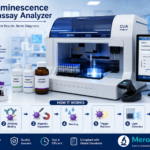
A chemiluminescence immunoassay (CLIA) analyzer is an advanced laboratory instrument designed to identify and quantify extremely low concentrations of biological substances in blood and other clinical samples. It is widely used to measure hormones, tumor markers, vitamins, cardiac biomarkers, and infectious disease indicators with high sensitivity and accuracy.
This technology has become one of the most trusted methods in modern clinical laboratories because it offers high sensitivity, speed, and accuracy.
If you have ever had a thyroid test, a pregnancy hormone test, or a vitamin D check, there is a strong chance your sample was processed using a chemiluminescence immunoassay analyzer. This machine plays a quiet but powerful role behind the scenes of modern diagnostics, helping doctors detect diseases early and monitor treatment progress effectively.
Definition of Chemiluminescence Immunoassay Analyzer
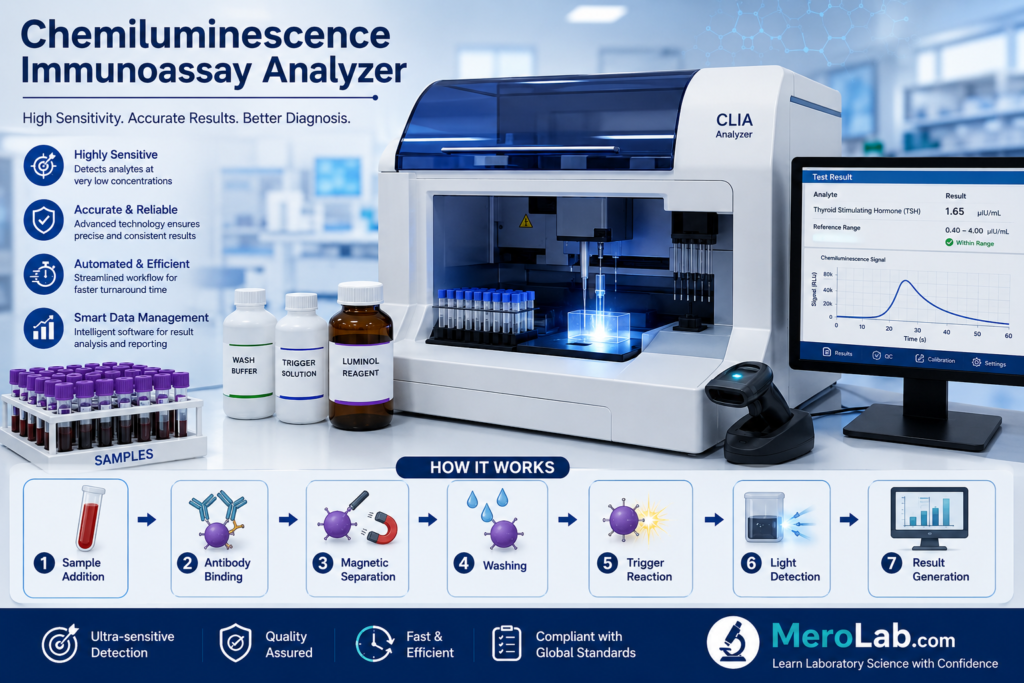
A chemiluminescence immunoassay analyzer is an automated laboratory device that measures the concentration of specific substances, called analytes, in a biological sample using a technique called chemiluminescence. Chemiluminescence refers to the emission of light produced during a chemical reaction, without the need for external heat or light sources.
In simple terms, the analyzer works by allowing the substance in the patient’s blood to react with special antibodies attached to a light-producing chemical. When the reaction happens, a flash of light is produced, and the analyzer measures the amount of light to calculate how much of that substance is present in the sample.
An immunoassay is a test method that uses the specific binding between an antibody (a protein made by the immune system) and an antigen (a substance that triggers an immune response) to detect or measure a target molecule. Combining this immune reaction with chemiluminescence creates a highly sensitive and accurate testing method known as Chemiluminescence Immunoassay, or CLIA.
History of Chemiluminescence Immunoassay Technology
The development of chemiluminescence immunoassay analyzers is closely connected to advances in immunology and analytical chemistry.
- 1959: Rosalyn Yalow and Solomon Berson developed radioimmunoassay (RIA), the first method to measure hormones using antibody-antigen reactions, laying the foundation for future immunoassays.
- 1970s: Scientists began exploring chemiluminescent compounds, such as luminol and acridinium esters, as alternatives to radioactive labels used in RIA, aiming to reduce safety risks associated with radioactive materials.
- 1980s: The first commercial chemiluminescence immunoassay systems were introduced, offering safer and more stable alternatives to radioimmunoassay.
- 1990s–2000s: Automation advanced rapidly, allowing chemiluminescence immunoassay analyzers to process hundreds of samples per hour with minimal manual intervention.
- Present day: Modern chemiluminescence immunoassay analyzers are fully automated, capable of running multiple tests simultaneously with high precision, and are considered a gold standard in many clinical laboratories worldwide.
This shift from radioactive labeling to chemiluminescent labeling greatly improved laboratory safety while maintaining excellent test sensitivity.
Classification of Immunoassay Methods
Chemiluminescence immunoassay is one of several immunoassay techniques used in laboratories. Here is a simple classification:
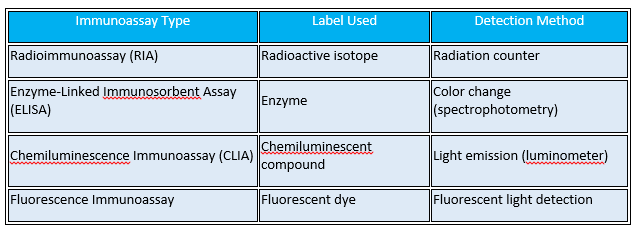
Among these, chemiluminescence immunoassay is widely preferred today because it avoids radioactive materials, offers a wider measurement range, and provides faster results than traditional ELISA methods.
Types of Chemiluminescence Immunoassay Analyzers
Chemiluminescence immunoassay analyzers can be classified based on their assay format and level of automation.
Based on Assay Format
- Direct Chemiluminescence Immunoassay – The label is attached directly to the antigen or antibody, and light is measured directly from the reaction.
- Chemiluminescent Enzyme Immunoassay (CLEIA) – An enzyme acts on a substrate to produce a light-emitting product, combining enzyme technology with chemiluminescence.
Based on Automation Level
- Semi-automated analyzers – Require some manual steps, such as sample loading or reagent mixing.
- Fully automated analyzers – Perform sample loading, mixing, incubation, washing, and detection with minimal human involvement, commonly used in high-volume laboratories.
Components and Parts of a Chemiluminescence Immunoassay Analyzer
A chemiluminescence immunoassay (CLIA) analyzer is composed of several essential components that work together to perform accurate and automated immunoassay testing.
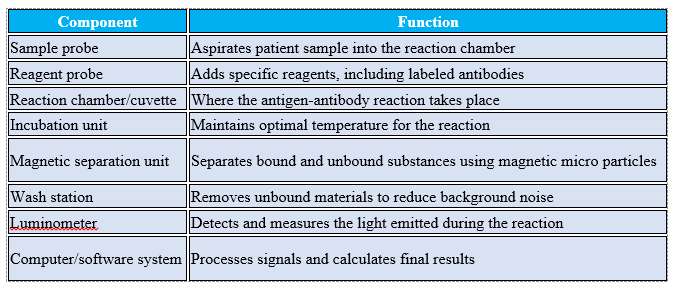
Many modern analyzers use magnetic micro particles coated with antibodies, which allow efficient separation of bound and unbound materials during the washing step, improving accuracy and reducing errors.
Principle of Chemiluminescence Immunoassay
The chemiluminescence immunoassay analyzer principle is based on the specific binding between antibodies and antigens, combined with a light-producing chemical reaction.
Here is the basic principle in simple steps:
- The patient’s sample contains the target analyte, such as a hormone or tumor marker.
- A labeled antibody, attached to a chemiluminescent compound, binds specifically to the target analyte.
- Unbound materials are washed away, leaving only the antigen-antibody complex.
- A triggering reagent is added, causing the chemiluminescent label to emit light.
- The luminometer measures the intensity of light produced.
- Since the amount of light produced is directly proportional to the concentration of the analyte, the analyzer calculates the exact concentration in the sample.
This principle allows even extremely low concentrations of substances, sometimes in picogram levels, to be detected accurately.
Working Principle and Mechanism
Let’s break down the working mechanism of a chemiluminescence immunoassay analyzer into a detailed step-by-step process:
- Sample Loading: The patient’s blood sample, usually serum or plasma, is loaded into the analyzer.
- Reagent Addition: The analyzer automatically adds magnetic microparticles coated with specific antibodies, along with a labeled antibody linked to a chemiluminescent compound such as acridinium ester.
- Incubation: The mixture is incubated at a controlled temperature, allowing the antigen-antibody reaction to occur fully.
- Magnetic Separation: A magnet attracts the microparticles, holding the antigen-antibody complex in place while unbound substances are washed away.
- Washing: Unbound reagents and interfering substances are removed to ensure only the specific reaction remains.
- Triggering Reaction: A trigger solution, often containing hydrogen peroxide and sodium hydroxide, is added to activate the chemiluminescent label.
- Light Emission and Detection: The chemiluminescent reaction produces a flash of light, which is captured by a highly sensitive photomultiplier tube within the luminometer.
- Signal Processing: The analyzer’s software converts the light signal into a numerical result by comparing it to a calibration curve.
- Result Reporting: The final concentration of the analyte is displayed or printed as part of the patient’s report.
This entire mechanism typically takes between 10 to 30 minutes per test, depending on the analyzer model and specific assay.
Procedure for Running a Test on a Chemiluminescence Immunoassay Analyzer
Pre-Analytical Steps
- Collect the patient’s blood sample using proper venipuncture technique.
- Allow the sample to clot if serum is required, then centrifuge to separate serum from blood cells.
- Label the sample accurately with patient identification details.
Analytical Steps
- Load the sample onto the analyzer’s sample rack.
- The analyzer automatically pipettes the sample into a reaction cuvette.
- Reagents, including labeled antibodies and magnetic microparticles, are added automatically.
- The mixture undergoes incubation, magnetic separation, and washing as described earlier.
- The trigger solution is added, and the resulting light emission is measured by the luminometer.
- The software calculates the analyte concentration based on a stored calibration curve.
Post-Analytical Steps
- Results are reviewed by a laboratory professional for accuracy.
- Abnormal or critical results are flagged for further review or repeat testing.
Verified reports are released to the requesting physician.
Applications of Chemiluminescence Immunoassay Analyzers
Chemiluminescence immunoassay analyzers are used extensively across various areas of medicine, including:
- Endocrinology: Measuring hormones such as thyroid-stimulating hormone (TSH), free T3, free T4, cortisol, and insulin
- Oncology: Detecting tumor markers like PSA (prostate-specific antigen), CA-125, and AFP (alpha-fetoprotein)
- Infectious Disease Testing: Identifying markers for hepatitis B, hepatitis C, HIV, and other infections
- Fertility and Reproductive Health: Measuring hormones like FSH, LH, and beta-hCG for pregnancy testing
- Cardiac Marker Testing: Detecting troponin levels to help diagnose heart attacks
- Vitamin and Nutrient Testing: Measuring vitamin D, vitamin B12, and folate levels
Autoimmune Disease Testing: Detecting specific antibodies related to autoimmune conditions
Advantages of Chemiluminescence Immunoassay Analyzers
- Extremely high sensitivity, capable of detecting very low concentrations of analytes
- Faster turnaround time compared to traditional ELISA or radioimmunoassay methods
- Wide dynamic range, allowing accurate measurement across a broad concentration spectrum
- Fully automated systems reduce human error and increase laboratory efficiency
- No radioactive materials involved, making it safer for laboratory staff compared to older RIA methods
- Capable of running multiple different tests simultaneously on a single platform
Disadvantages and Limitations
- Higher initial equipment and reagent costs compared to manual immunoassay methods
- outine maintenance and periodic calibration are essential to ensure accurate test results, reliable performance, and long-term operational stability.
- Certain interfering substances, such as heterophile antibodies, can cause false results
- Highly dependent on proper sample quality; hemolysis or lipemia can affect results
- Requires trained personnel for troubleshooting and quality control processes
Clinical Significance
The clinical value of a chemiluminescence immunoassay analyzer lies in its ability to detect subtle changes in hormone levels, tumor markers, and infectious disease indicators long before symptoms may appear.
For example, an elevated TSH level combined with low free T4 may indicate hypothyroidism, a condition where the thyroid gland does not produce enough hormones. Similarly, rising PSA levels over time may prompt further investigation for prostate abnormalities.
Because chemiluminescence immunoassay analyzers can detect extremely small concentrations, they are particularly valuable in:
- Early cancer marker detection
- Monitoring hormone replacement therapy
- Diagnosing thyroid disorders
- Confirming pregnancy through beta-hCG testing
- Screening blood donations for infectious diseases
Interpretation of Results
Interpreting results from a chemiluminescence immunoassay analyzer requires understanding both the reference range and the clinical context.
- Compare with reference range: Each analyte has an established normal range, which may vary slightly between laboratories and analyzer models.
- Consider patient history: Symptoms, medications, and existing health conditions can influence hormone or marker levels.
- Look for trends: Serial testing over time often provides more clinically useful information than a single result, especially for tumor markers and hormone therapy monitoring.
- Correlate with other tests: Results are often interpreted alongside imaging studies, physical examination findings, or additional laboratory tests for a complete clinical picture.
It is important to remember that a single abnormal result does not automatically confirm a diagnosis; further testing and clinical correlation are usually necessary.
Frequently Observed Errors
Laboratory staff should be aware of common errors that can occur during chemiluminescence immunoassay testing:
- Pre-analytical errors: Improper sample collection, hemolysis, lipemia, or incorrect sample storage temperature
- Analytical errors: Reagent expiration, improper calibration, or carryover contamination between samples
- Interference errors: Presence of heterophile antibodies or biotin supplementation, which can falsely raise or lower results
- Post-analytical errors: Incorrect data entry, transcription mistakes, or delays in reporting test results.
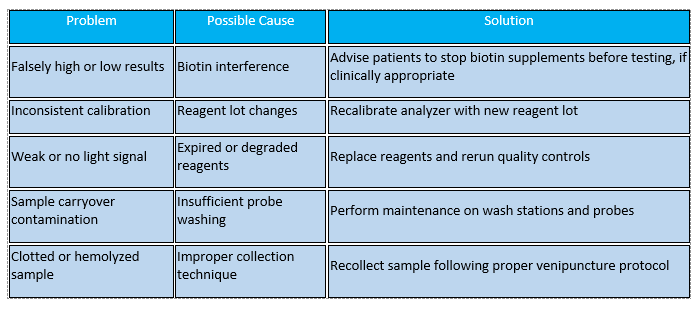
Troubleshooting Common Issues
Care and Maintenance
Proper maintenance keeps a chemiluminescence immunoassay analyzer functioning accurately and reliably:
- Perform daily startup checks, including fluid levels and system diagnostics.
- Run internal quality control samples before processing patient samples each day.
- Clean sample and reagent probes regularly to prevent contamination.
- Replace reagents, wash buffers, and trigger solutions before their expiration dates to ensure accurate and reliable test performance.
- Schedule regular preventive maintenance with certified service engineers.
- Keep detailed maintenance and calibration logs for audit and accreditation purposes.
Quality Assurance: IQC and EQA
Internal Quality Control (IQC)
IQC involves running control samples with known concentrations through the chemiluminescence immunoassay analyzer at regular intervals, typically daily. If results fall within the expected range, it confirms the analyzer is performing accurately.
External Quality Assessment (EQA)
EQA, also known as proficiency testing, involves participating in external programs where laboratories test identical samples and compare their results with other institutions. This helps identify inter-laboratory variation and ensures consistent, reliable testing standards across different facilities.
Both IQC and EQA are essential components of laboratory accreditation and are strongly recommended by organizations such as CLSI (Clinical and Laboratory Standards Institute) to maintain high testing standards.
Safety Precautions
- Wear appropriate personal protective equipment, including gloves and lab coats, when handling samples and reagents.
- Handle trigger solutions carefully, as they may contain corrosive chemicals like sodium hydroxide and hydrogen peroxide.
- Follow proper waste disposal protocols for chemical and biological waste.
- Ensure proper ventilation in areas where reagents are stored and used.
- Follow manufacturer guidelines for safe operation and emergency shutdown procedures.
- Report any spills or exposure incidents immediately according to institutional safety protocols.
Key Takeaways
- A chemiluminescence immunoassay analyzer detects and measures substances like hormones and tumor markers using light emitted from a chemical reaction.
- The technology combines antibody-antigen binding with chemiluminescent labeling for high sensitivity and accuracy.
- Applications span endocrinology, oncology, infectious disease testing, and reproductive health.
- Regular maintenance, calibration, and quality assurance through IQC and EQA are essential for reliable results.
While highly sensitive, results should always be interpreted alongside clinical history and other diagnostic tests.
Conclusion
The chemiluminescence immunoassay analyzer has transformed modern clinical diagnostics by offering a safe, sensitive, and rapid method for detecting hormones, tumor markers, and infectious disease indicators. From its origins rooted in radioimmunoassay technology to today’s fully automated systems, this innovation continues to play a critical role in early disease detection and patient monitoring.
Understanding how this analyzer works, from antibody-antigen binding to light emission and detection, helps students, laboratory professionals, and healthcare providers appreciate the science behind everyday blood test results. As with any diagnostic tool, results should always be interpreted alongside clinical symptoms and other relevant tests by a qualified healthcare provider.
As diagnostic technology continues to advance, chemiluminescence immunoassay analyzers remain a cornerstone of modern laboratory medicine, supporting accurate, timely, and life-saving clinical decisions worldwide.
Frequently Asked Questions (FAQs)
What is a chemiluminescence immunoassay analyzer used for?
A chemiluminescence immunoassay analyzer is used to measure hormones, tumor markers, vitamins, and infectious disease indicators by detecting light produced during an antibody-antigen reaction.
How is chemiluminescence immunoassay different from ELISA?
Chemiluminescence immunoassay uses a light-emitting label and measures results with a luminometer, while ELISA uses an enzyme-based color change measured with a spectrophotometer. CLIA generally offers higher sensitivity and a faster turnaround time.
Is chemiluminescence immunoassay testing safe?
Yes, this method is considered very safe since it does not involve radioactive materials, unlike older radioimmunoassay techniques.
A chemiluminescence immunoassay analyzer is used to measure hormones, tumor markers, vitamins, and infectious disease indicators by detecting light produced during an antibody-antigen reaction.
Chemiluminescence immunoassay uses a light-emitting label and measures results with a luminometer, while ELISA uses an enzyme-based color change measured with a spectrophotometer. CLIA generally offers higher sensitivity and a faster turnaround time.
Yes, this method is considered very safe since it does not involve radioactive materials, unlike older radioimmunoassay techniques.
How long does a chemiluminescence immunoassay test take?
Most tests are completed within 10 to 30 minutes, depending on the specific analyte and analyzer model being used.
Can biotin supplements affect chemiluminescence immunoassay results?
Yes, high doses of biotin can interfere with certain chemiluminescence immunoassay tests, causing falsely high or low results. Patients are often advised to stop biotin supplements before testing.
What samples are used for chemiluminescence immunoassay testing?
Serum or plasma samples obtained through standard venipuncture are typically used for chemiluminescence immunoassay analysis.
Most tests are completed within 10 to 30 minutes, depending on the specific analyte and analyzer model being used.
Yes, high doses of biotin can interfere with certain chemiluminescence immunoassay tests, causing falsely high or low results. Patients are often advised to stop biotin supplements before testing.
Serum or plasma samples obtained through standard venipuncture are typically used for chemiluminescence immunoassay analysis.
Disclaimer
Users are responsible for independently verifying important information and applying appropriate professional judgment before using any information from this website in academic, laboratory, clinical, or professional settings.
MeroLab shall not be responsible or liable for any loss, damage, injury, error, misinterpretation, or consequence arising directly or indirectly from the use, misuse, or reliance upon information or materials provided through this website.