
Introduction
A waterbath is one of the simplest yet most powerful pieces of equipment found in almost every laboratory, hospital, food factory, and research center around the world. This device may look basic from the outside, but it plays a huge role in keeping samples, reagents, and biological materials at an exact and stable temperature.
What is a Water Bath?
Waterbath is a laboratory or industrial device that uses heated water to maintain a constant and controlled temperature for various processes. It is mainly used to warm substances gently, without exposing them directly to a flame or a hot surface. This gentle heating method protects sensitive samples such as enzymes, bacteria cultures, blood samples, and chemical reagents from damage caused by sudden or uneven heat.
The idea behind this equipment is very simple: water absorbs and transfers heat evenly. Because of this natural property, the device keeps the temperature stable for a long time, which is extremely useful for scientific experiments and medical testing.
A Short History of the Water Bath
The concept behind this technology is surprisingly old. It dates back centuries to alchemists and early chemists who needed a gentle and steady heat source for their experiments. Interestingly, the term “bain-marie,” a French phrase still used today in cooking and chemistry, is believed to be named after Mary the Jewess, an ancient alchemist credited with early designs of this kind.
Over time, this simple heating method moved from ancient alchemy labs into modern kitchens and scientific laboratories. Early versions were manually operated and used simple flame heating with a water container. Today, this equipment has evolved into a highly advanced instrument with digital displays, microprocessor controls, and safety alarms, making it far more accurate and reliable than its ancient ancestor.
Classification of Water Bath
This equipment can be broadly classified based on its function, temperature control system, and design. Here is a simple classification:
1. Based on Circulation – Circulating type and non-circulating type
2. Based on Control System – Analog version and digital version
3. Based on Application – Laboratory, industrial, and medical variants
4. Based on Design – Standard, shaking, and serological models
This classification helps users choose the right option depending on their specific requirement, whether it is for a simple heating task or a highly sensitive biological experiment.
Types of Water Bath
Let’s explore the major types available for different purposes.
- Circulating Water Bath
A circulating model continuously moves the water using a pump, ensuring the temperature stays uniform throughout the chamber. It is ideal for experiments where even the smallest temperature variation can affect results, such as enzyme reactions or DNA amplification.
- 2. Non-Circulating WaterBath
This is the simplest design available. It does not have a pump, so heat spreads naturally through the liquid. It is suitable for basic heating tasks like warming reagents or melting substances, where precise uniformity is not critical.
- Shaking WaterBath
This version comes with a gentle shaking or oscillating mechanism. It is commonly used in microbiology and biochemistry labs to keep samples mixed while maintaining a constant temperature, which is useful for bacterial culture growth.
4. Digital WaterBath
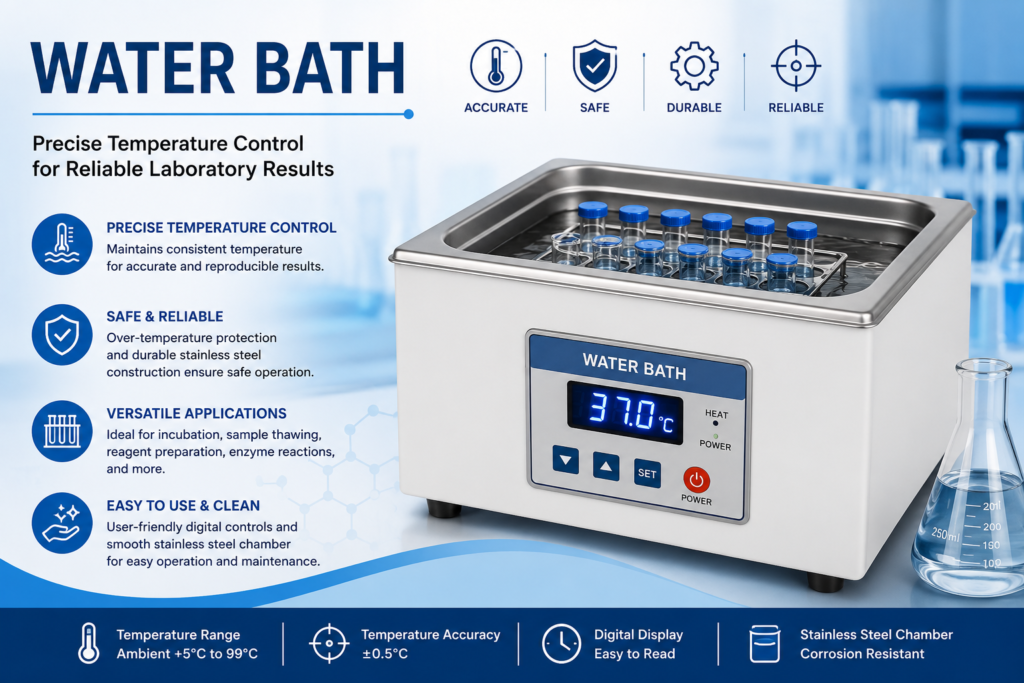
This modern type uses digital sensors and a microprocessor to control temperature precisely. It usually has a digital display showing the exact reading, along with alarms for overheating or low water level.
5. Serological WaterBath
This variant is specially designed for blood testing and serology work. It often includes a transparent lid, allowing users to see the samples without releasing heat, and it maintains temperatures suitable for blood-related tests.
6. Double Boiler Style
This classic design uses two containers – one placed inside the other – with heated liquid in the outer container. It is mostly used in kitchens and small labs for gentle melting and warming processes.
7. Oscillating and Orbital Models
These advanced units combine gentle circular or back-and-forth motion with temperature control, mainly used in specialized research applications requiring both mixing and consistent heat.
Parts of a Water Bath
Understanding the parts of this equipment helps in using it correctly and troubleshooting minor issues. The main components include:
- Outer Body/Chamber – The main structure that holds liquid and insulates heat.
- Inner Tank – Where liquid is filled and samples are placed.
- Heating Element – Usually located at the bottom, responsible for warming the liquid.
- Thermostat/Temperature Controller– Regulates and maintains the set temperature.
- Digital Display/Control Panel – Shows current temperature and allows setting adjustments.
- Lid or Cover – Reduces heat loss and evaporation, keeping samples safe.
- Drain Valve– Located at the bottom for easy draining of used liquid.
- Racks and Test Tube Holders – Hold sample containers, tubes, or flasks securely in place.
- Safety Alarm System – Alerts users about overheating or low liquid levels.
- Circulating Pump (if applicable) – Ensures uniform movement and temperature distribution.
Each part works together to make sure the unit performs its heating job safely and accurately.
Mechanical and Working Principle of Water Bath
The working principle behind this device is based on simple heat transfer through liquid. Here is how it works step by step:
- Liquid is filled into the inner tank of the unit.
- The heating element, usually an electric coil, warms the liquid to the desired temperature.
- A built-in thermostat or digital sensor continuously monitors the temperature.
- Once the set temperature is reached, the heating element automatically switches off or reduces power to maintain stability.
- In circulating models, a pump moves the liquid constantly, spreading heat evenly across the chamber.
- Samples placed inside test tubes, flasks, or beakers absorb heat gradually and safely from the surrounding warmth.
This mechanism ensures that the temperature stays constant, which is extremely important in processes like enzyme activity studies, microbiological culturing, and clinical chemistry testing.
Uses and Applications of Water Bath
This equipment has countless applications across different fields. Some major uses include:
- Molecular Biology– Used for incubating samples during DNA and RNA extraction, and PCR-related sample preparation.
- Microbiology – Helps in growing bacterial cultures at controlled temperatures.
- Clinical Laboratories – Used for blood serum testing, coagulation studies, and warming reagents.
- Food Industry – Used for thawing frozen food, warming food samples, and quality testing.
- Pharmaceutical Industry – Helps in drug dissolution testing and formulation development.
- Chemical Laboratories – Used for melting point determination and dissolving substances.
- Educational Institutions – Commonly used in school and college science laboratories for experiments.
Because of its gentle and controlled heating, this instrument remains irreplaceable in situations where direct flame or dry heat could damage sensitive materials.
Care and Maintenance of Water Bath
Proper care and maintenance can significantly increase the lifespan and accuracy of this equipment. Here are some easy but important maintenance tips:
- Use Distilled or Deionized Water – This prevents mineral deposits and scaling inside the tank.
- Clean Regularly – Empty and clean the tank at least once a week to avoid algae or bacterial growth.
- Check the Heating Element – Inspect it periodically for any damage or corrosion.
- Calibrate the Thermostat– Regular calibration ensures the temperature reading stays accurate.
- Avoid Overfilling or Underfilling – Always maintain the recommended liquid level to protect the heating element.
- Keep the Lid Closed When Not in Use – This reduces dust accumulation and evaporation.
- Unplug Before Cleaning – Always disconnect the power supply before cleaning to avoid electric shock.
- Store Properly – Keep the unit in a dry, dust-free area when not in use for a long period.
Following these simple maintenance steps ensures the equipment continues working accurately for years, saving both time and money.
Safety Precautions While Using a Water Bath
Along with maintenance, safety should never be ignored. A few safety tips include:
- Never touch the liquid or inner tank while the device is operating at a high temperature.
- Always use proper gloves while placing or removing samples.
- Do not use this equipment near flammable chemicals.
- Ensure proper grounding of the electrical connection to avoid short circuits.
- Regularly check the safety alarm system for correct functioning.
Advantages and Disadvantages of Water Bath
Advantages:
- Provides gentle and even heating.
- Safer than direct flame heating.
- Suitable for sensitive biological samples.
- Easy to operate, even for beginners.
- Available in multiple sizes and types for different needs.
Disadvantages:
- Limited to lower temperature ranges compared to dry ovens.
- Evaporation can affect accuracy if the lid is not used.
- Requires regular cleaning to prevent contamination.
Supportive Knowledge: Water Bath vs Other Heating Devices
To gain deeper knowledge, it is helpful to understand how this equipment differs from other similar devices:
Water Bath vs Oil Bath – An oil bath uses oil instead of water, allowing higher temperature ranges, while this equipment is limited by water’s boiling point but is safer and gentler.
Water Bath vs Incubator – An incubator controls both temperature and sometimes humidity or gas levels for cell or bacterial growth, while this device mainly focuses on liquid-based heating.
Water Bath vs Dry Bath– A dry bath heats through metal blocks instead of liquid, making it useful when contamination from water must be avoided.
Understanding these differences helps users select the correct equipment for their specific laboratory or industrial requirement.
Buying Guide: What to Check Before Choosing a Water Bath
If you are planning to purchase this equipment for your lab or workspace, consider these important points:
- Required temperature range and accuracy level
- Tank capacity based on sample volume
- Digital or analog control preference
- Availability of safety alarms
- Circulating or non-circulating requirement
- Brand reliability and warranty support
Choosing the right type ensures long-term efficiency and accurate results for your specific application.
Conclusion
This equipment is truly a powerful and dependable piece of instrumentation that has stood the test of time, from ancient alchemy practices to modern digital laboratories. Its simple working principle, wide classification, multiple types, and countless uses make it an essential tool across scientific, medical, and industrial fields.
By understanding its parts, working mechanism, and proper care and maintenance, users can ensure this equipment delivers accurate results for many years. Whether you are a student learning the basics or a professional relying on it daily, this small but mighty instrument remains a key contributor to scientific progress.
Frequently Asked Questions
What is the main purpose of this equipment
Its main purpose is to provide gentle, even, and controlled heating for samples, reagents, and biological materials.
What temperature can it reach
Most laboratory units can reach temperatures up to 99-100 degrees Celsius, close to the boiling point of water.
Why is distilled water recommended for this equipment?
Distilled water prevents mineral buildup and scaling, which helps maintain the accuracy and lifespan of the heating element.
Its main purpose is to provide gentle, even, and controlled heating for samples, reagents, and biological materials.
Most laboratory units can reach temperatures up to 99-100 degrees Celsius, close to the boiling point of water.
Distilled water prevents mineral buildup and scaling, which helps maintain the accuracy and lifespan of the heating element.