
Introduction
A HEPA filter is one of the most trusted tools we have for cleaning the air we breathe. You will find a HEPA filter inside hospital ventilation systems, biosafety cabinets, air purifiers, vacuum cleaners, and even airplane cabins. But what exactly makes a HEPA filter so special, and why do healthcare workers, microbiologists, and everyday homeowners all depend on it?
In simple terms, a HEPA filter is a type of mechanical air filter that can trap extremely small particles, including dust, pollen, mold spores, bacteria, and some viruses. The word “HEPA” stands for High-Efficiency Particulate Air, and it is not just a marketing term. It is a strict engineering standard that a filter must meet before it can legally be called HEPA.
Definition of a HEPA Filter
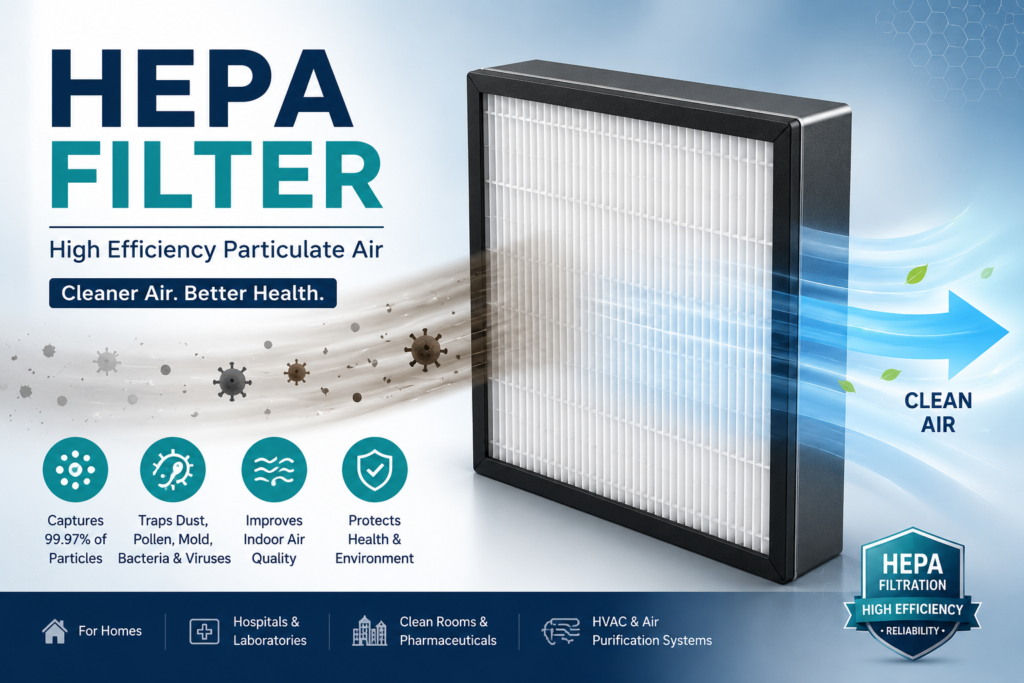
A HEPA filter is officially defined as a pleated mechanical air filter that can remove at least 99.97% of airborne particles that are 0.3 microns (µm) in diameter. A micron is a unit of measurement equal to one-millionth of a meter, far too small to see with the naked eye.
The size 0.3 microns is called the Most Penetrating Particle Size (MPPS). This is not the smallest particle a HEPA filter can catch — it is actually the hardest size for any filter to trap, because particles this size are too small to be blocked easily and too large to move around obstacles freely. If a HEPA filter can catch 99.97% of particles at this most difficult size, it can catch an even higher percentage of particles that are larger or smaller.
To put this in perspective:
- A human hair is about 50–70 microns wide.
- Bacteria typically range from 0.3 to 10 microns.
- Many viruses are smaller than 0.3 microns but often travel attached to larger droplets, which a HEPA filter can still capture.
This strict definition means that not every filter labeled “HEPA-type” or “HEPA-like” on store shelves truly meets the HEPA standard. A genuine HEPA filter must be tested and certified according to recognized standards.
History of the HEPA Filter
The story of the HEPA filter goes back to the 1940s. During this period, scientists working on the Manhattan Project needed a way to capture radioactive dust particles released during the development of nuclear technology. Ordinary filters were not efficient enough to trap such tiny hazardous particles.
Researchers developed a filter made of tightly packed fine fibers that could physically trap microscopic particles. This technology was declassified after World War II and later became known as the High-Efficiency Particulate Air filter, or HEPA filter.
In the following decades, HEPA filtration moved beyond nuclear and military use. It became standard in:
- Hospital operating rooms and isolation wards
- Pharmaceutical clean rooms
- Microbiology and virology laboratories
- Home and commercial air purifiers
- Aircraft cabin ventilation systems
Today, the HEPA filter standard is recognized internationally, and organizations such as the U.S. Department of Energy (DOE), the European Committee for Standardization (CEN), and the Institute of Environmental Sciences and Technology (IEST) maintain strict testing guidelines to certify true HEPA performance.
Classification of HEPA Filters
Filter Class | Efficiency (%) | Common Name |
E10–E12 | 85% – 99.5% | EPA (Efficient Particulate Air) filter |
H13 | 99.95% | True HEPA filter |
H14 | 99.995% | True HEPA filter (higher grade) |
U15–U17 | 99.9995% – 99.999995% | ULPA (Ultra-Low Penetration Air) filter |
U.S. Classification (DOE Standard)
A filter must remove at least 99.97% of particles at 0.3 microns to be officially called a HEPA filter in the United States.
This classification matters because it helps buyers, hospitals, and laboratories choose the correct filter grade for their specific safety needs. A biosafety cabinet, for example, may require an H14 filter, while a home air purifier may only need an H13 HEPA filter.
Types of HEPA Filters
Not all HEPA filters are built the same way. Understanding the different types helps in choosing the right filter for the right purpose.
- True HEPA Filter
This is a genuine, certified HEPA filter that meets the 99.97% efficiency standard at 0.3 microns. It is tested by independent bodies and comes with certification documentation.
- HEPA-Type or HEPA-Like Filter
These filters are designed similarly to true HEPA filters but are not independently tested or certified. They usually capture a lower percentage of particles, sometimes only 99% at larger particle sizes, making them less reliable for critical medical or laboratory use.
- Medical-Grade HEPA Filter
Used in hospitals, operating theatres, and isolation rooms, these filters are built to strict clinical standards and are often integrated into HVAC (Heating, Ventilation, and Air Conditioning) systems.
- Mini-Pleat HEPA Filter
These filters use very closely spaced pleats supported by hot-melt adhesive strips instead of separators, allowing more filter media to fit into a smaller frame. This design increases surface area and airflow efficiency.
Although technically a separate category, ULPA filters are often discussed alongside HEPA filters because they offer even higher filtration efficiency (99.999%), commonly used in semiconductor clean rooms.
Components and Parts of a HEPA Filter
A HEPA filter may look simple from the outside, but it consists of several important parts working together.
- Filter Media: Usually made of borosilicate microfibers or fiberglass, arranged in a random, interlaced pattern. This is the core material that traps particles.
- Pleats: The filter media is folded into pleats to increase the total surface area within a compact frame, improving both airflow and filtration efficiency.
- Separators: Thin strips (often made of aluminum, hot-melt adhesive, or paper) placed between pleats to keep them evenly spaced and prevent them from collapsing.
- Frame: A rigid outer casing, commonly made of wood, particleboard, plastic, or metal, that holds the pleated media securely in place.
- Sealant/Gasket: A sealing gel or gasket around the frame edge that prevents unfiltered air from leaking around the filter instead of passing through it.
- Pre-Filter (in some systems): A coarser filter placed before the HEPA filter to catch larger particles first, extending the HEPA filter’s lifespan.
Working Principle and Mechanism of a HEPA Filter
Many people assume a HEPA filter works like a simple sieve, blocking particles that are too large to pass through tiny holes. In reality, the mechanism is more sophisticated and relies on four main physical processes working together.
- Interception
When a particle traveling in the airstream comes close enough to a fiber, it touches and sticks to it, even without changing its direction of travel. This mainly affects medium-sized particles.
- Impaction
Larger, heavier particles cannot follow the curving path of the air around the fibers. Due to their momentum, they crash directly into a fiber and become trapped. This is effective for bigger particles like dust and pollen.
- Diffusion
The smallest particles, especially those close to or below 0.1 microns, move in a random, zig-zag pattern known as Brownian motion. This erratic movement increases the chance that they will collide with and stick to a fiber, even though they are small enough to theoretically slip through gaps.
- Sieving (Straining)
For particles larger than the actual gaps between fibers, the filter simply blocks them physically, much like a strainer.
Interestingly, particles at the 0.3-micron size (the MPPS) are affected the least by diffusion and impaction, which is exactly why this size is used as the benchmark for testing HEPA filter efficiency. Particles both smaller and larger than 0.3 microns are actually captured with even greater efficiency.
Procedure: How HEPA Filters Are Installed and Tested
Installation Procedure
- Select the correct HEPA filter grade based on the application (home, hospital, laboratory, or industrial clean room).
- Inspect the filter frame and gasket for any physical damage before installation.
- Mount the pre-filter first, if applicable, to protect the HEPA filter from large debris.
- Fit the HEPA filter into its housing, ensuring the airflow direction arrow (usually printed on the frame) matches the system’s airflow.
- Confirm a tight seal around all edges to prevent air from bypassing the filter media.
- Perform an initial leak test before the system is put into regular operation.
Testing and Certification Procedure
HEPA filters used in critical settings such as hospitals and laboratories undergo a process called DOP testing (Dispersed Oil Particulate testing) or PAO testing (Poly-Alpha-Olefin testing):
- A controlled aerosol of oil particles is introduced upstream of the filter.
- A photometer measures particle concentration both before (upstream) and after (downstream) the filter.
- The filter passes if the downstream particle count confirms at least 99.97% efficiency at 0.3 microns.
Any leaks around the frame or seal are identified and repaired or the filter is replaced.
Applications of HEPA Filters
The HEPA filter is used across many industries because of its reliable, science-backed filtration performance.
- Healthcare Settings: Operating rooms, isolation rooms, intensive care units, and pharmacies use HEPA filtration to reduce airborne infection risk.
- Microbiology and Research Laboratories: Biosafety cabinets rely on HEPA filters to protect researchers from airborne pathogens and to protect samples from outside contamination.
- Pharmaceutical Manufacturing: Clean rooms producing sterile drugs and vaccines depend on HEPA filtration to maintain strict air purity standards.
- Home and Office Air Purifiers: HEPA filters help reduce allergens, dust, pet dander, and smoke particles indoors.
- Vacuum Cleaners: HEPA-filtered vacuums prevent fine dust and allergens from being released back into the air during cleaning.
- Aircraft Cabins: Commercial airplanes use HEPA filtration to recirculate cabin air while removing airborne particles and microorganisms.
- Nuclear and Industrial Facilities: HEPA filters continue their original role in capturing hazardous radioactive or chemical particulates.
Advantages of HEPA Filters
- Removes up to 99.97% of airborne particles as small as 0.3 microns.
- Reduces allergens such as pollen, dust mites, and pet dander.
- Helps lower the risk of airborne infection transmission in healthcare settings.
- Does not release ozone or harmful chemical byproducts, unlike some ionizing air purifiers.
- Works passively through physical filtration, requiring no chemical additives.
- Long-lasting when properly maintained, often lasting 6–12 months in home use.
- Internationally standardized and independently testable for quality assurance.
Disadvantages of HEPA Filters
- Cannot remove gases, odors, or volatile organic compounds (VOCs) on its own; a separate activated carbon filter is needed for that.
- Restricts airflow more than standard filters, which may require a stronger fan or motor.
- Replacement filters can be costly, especially medical-grade or ULPA-level filters.
- Improper installation or a damaged seal can significantly reduce filtration efficiency.
- Does not actively kill trapped microorganisms; it only physically traps them.
- Requires regular maintenance and timely replacement to remain effective.
Comparison Table: HEPA Filter vs Other Common Filters
Feature | HEPA Filter | Standard Filter | Activated Carbon Filter | UV Filter |
Particle removal efficiency | 99.97% at 0.3 microns | 20%–50% typically | Not particle-focused | Not particle-focused |
Removes odors/gases | No | No | Yes | No |
Kills microorganisms | No (traps only) | No | No | Yes (with sufficient exposure) |
Common use | Hospitals, labs, air purifiers | Basic HVAC systems | Odor and chemical removal | Water/air disinfection add-on |
Maintenance frequency | Every 6–12 months | Every 1–3 months | Every 3–6 months | Bulb replacement yearly |
Clinical Significance of HEPA Filters
In clinical and laboratory microbiology, the HEPA filter plays a direct role in infection prevention and control. Its importance includes:
- Airborne Infection Isolation Rooms (AIIRs): HEPA filtration helps prevent the spread of airborne pathogens such as Mycobacterium tuberculosis, measles virus, and varicella-zoster virus within hospital settings.
- Biosafety Cabinets: Class II biosafety cabinets, used widely in microbiology laboratories, use HEPA filters to protect laboratory personnel from infectious aerosols while also protecting samples from contamination.
- Operating Room Air Quality: Reducing airborne bacterial load in operating theatres helps lower the risk of surgical site infections.
- Immunocompromised Patient Care: Patients with weakened immune systems, such as those undergoing bone marrow transplants, are often housed in HEPA-filtered positive pressure rooms to reduce fungal spore exposure, including Aspergillus species.
- Pandemic and Outbreak Response: During respiratory disease outbreaks, portable HEPA air purifiers are sometimes used as a supplementary measure in healthcare and public spaces to reduce airborne particle concentration.
It’s important to note that a HEPA filter is a supportive infection control measure. It does not replace standard precautions such as hand hygiene, personal protective equipment, ventilation design, and appropriate isolation protocols.
Quality Assurance: IQC and EQA for HEPA Filtration Systems
Because HEPA filters are used in critical healthcare and laboratory environments, quality assurance is essential.
Internal Quality Control (IQC)
- Routine visual inspection of filter housing and gaskets for damage.
- Regular airflow and pressure differential monitoring across the filter.
- Scheduled DOP/PAO leak testing, typically performed annually or biannually in critical care areas.
- Documentation of installation date, certification, and expected replacement date.
External Quality Assessment (EQA)
- Independent, third-party certification testing to confirm compliance with recognized standards (such as EN 1822 or IEST-RP-CC001).
- Periodic external audits in hospitals and laboratories to verify that HEPA filtration systems meet regulatory and accreditation requirements.
- Cross-verification with national infection control guidelines, especially in facilities handling high-risk pathogens.
Frequently Observed Errors When Using HEPA Filters
- Buying “HEPA-type” filters thinking they are true HEPA filters. Always check for certification documentation.
- Ignoring the airflow direction arrow during installation, which reduces efficiency.
- Delaying filter replacement, causing clogging, reduced airflow, and strain on the fan motor.
- Damaging the filter media by touching or cleaning it directly with water, which permanently ruins the delicate fiber structure.
- Overlooking seal or gasket damage, allowing unfiltered air to bypass the filter entirely.
Assuming HEPA filters remove odors and gases, when in fact a separate carbon filter is required for that purpose.
Troubleshooting HEPA Filter Problems
Problem | Possible Cause | Solution |
Reduced airflow | Clogged filter | Replace filter as per manufacturer schedule |
Persistent odors | No carbon filter present | Add a separate activated carbon filter |
Unusual noise from unit | Fan motor strain due to clogged filter | Inspect and replace filter promptly |
Poor filtration despite new filter | Improper seal or installation | Recheck gasket and frame fitting |
Dust visible after filtration | Non-certified “HEPA-type” filter in use | Replace with a certified true HEPA filter |
Care and Maintenance of HEPA Filters
Proper care extends the life and performance of a HEPA filter:
- Check the manufacturer’s recommended replacement schedule, typically every 6–12 months for home use.
- Never wash or vacuum a true HEPA filter directly, as this damages the fine fiber structure and reduces efficiency permanently.
- Use a pre-filter where possible to trap larger particles and reduce the load on the HEPA filter.
- Keep the surrounding unit clean and free of dust buildup that could clog airflow.
- Store spare filters in a clean, dry, sealed environment away from moisture and direct sunlight.
In clinical settings, follow institutional protocols for scheduled inspection, leak testing, and documentation.
Safety Precautions
- Always wear gloves and, where appropriate, a mask when handling used HEPA filters, especially those from healthcare or laboratory settings, as trapped particles may include infectious material.
- Dispose of used filters according to local biomedical or hazardous waste guidelines if they were used in clinical or laboratory environments.
- Avoid puncturing or bending the filter media during handling, transport, or installation.
- Ensure electrical safety when replacing filters in powered HVAC or purifier units; always switch off and unplug the device first.
- In laboratories, follow institutional biosafety protocols when replacing HEPA filters in biosafety cabinets, as this task may require trained personnel.
Key Takeaways
- A HEPA filter removes at least 99.97% of airborne particles as small as 0.3 microns, the most penetrating particle size.
- HEPA filtration works through four mechanisms: interception, impaction, diffusion, and sieving.
- True HEPA filters must be independently tested and certified; “HEPA-type” filters are not the same and are generally less effective.
- HEPA filters are widely used in hospitals, laboratories, air purifiers, vacuum cleaners, and aircraft cabins.
- HEPA filters do not remove gases or odors and do not kill trapped microorganisms; they simply capture them physically.
- Regular maintenance, correct installation, and periodic leak testing are essential for consistent performance.
- In clinical settings, HEPA filtration is a supportive infection control measure, not a replacement for standard precautions.
Conclusion
The HEPA filter remains one of the most reliable and scientifically validated tools for improving air quality, whether in a hospital isolation room, a research laboratory, or a family living room. Its ability to trap 99.97% of airborne particles at the most challenging size makes it a gold standard in both clinical infection control and everyday air purification.
Understanding how a HEPA filter works, how to choose the right type, and how to maintain it properly can make a real difference in health outcomes, especially for people with allergies, respiratory conditions, or weakened immune systems. As indoor air quality continues to gain global attention, the HEPA filter will likely remain a central technology in protecting the air we all depend on every day.
Whether you are a student learning about filtration mechanisms, a healthcare professional managing infection control, or someone simply looking to breathe cleaner air at home, knowing the facts about the HEPA filter empowers you to make safer, more informed choices.
Frequently Asked Questions (FAQs)
What does HEPA stand for in a HEPA filter?
HEPA stands for High-Efficiency Particulate Air. It refers to a filter that meets a strict standard of trapping at least 99.97% of airborne particles measuring 0.3 microns.
Can a HEPA filter remove viruses from the air?
A HEPA filter can capture many virus-containing droplets and aerosol particles, since viruses are often attached to larger respiratory droplets. However, HEPA filters do not kill viruses; they only physically trap them within the filter media.
How long does a HEPA filter last?
Most home-use HEPA filters last between 6 and 12 months, depending on usage, air quality, and manufacturer guidelines. Hospital and industrial HEPA filters are checked and certified on a regular testing schedule.
What is the difference between a true HEPA filter and a HEPA-type filter?
A true HEPA filter is independently tested and certified to remove 99.97% of particles at 0.3 microns. A HEPA-type or HEPA-like filter is designed similarly but is not certified and usually offers lower filtration efficiency.
Can I wash and reuse a HEPA filter?
No. Washing a true HEPA filter damages its delicate fiber structure and permanently reduces its filtration efficiency. Always follow the manufacturer’s replacement guidelines instead.
Do HEPA filters remove bad odors from a room?
No. A HEPA filter is designed to trap particles, not gases or odor molecules. For odor removal, an additional activated carbon filter is typically required alongside the HEPA filter.